What’s in today’s article?
- Why in News?
- Government Initiatives to Bolster Domestic Clean Technology Manufacturing
- Implications of Market Concentration in India’s Solar PV Module Industry
- India’s Renewable Energy Prospects
Why in News?
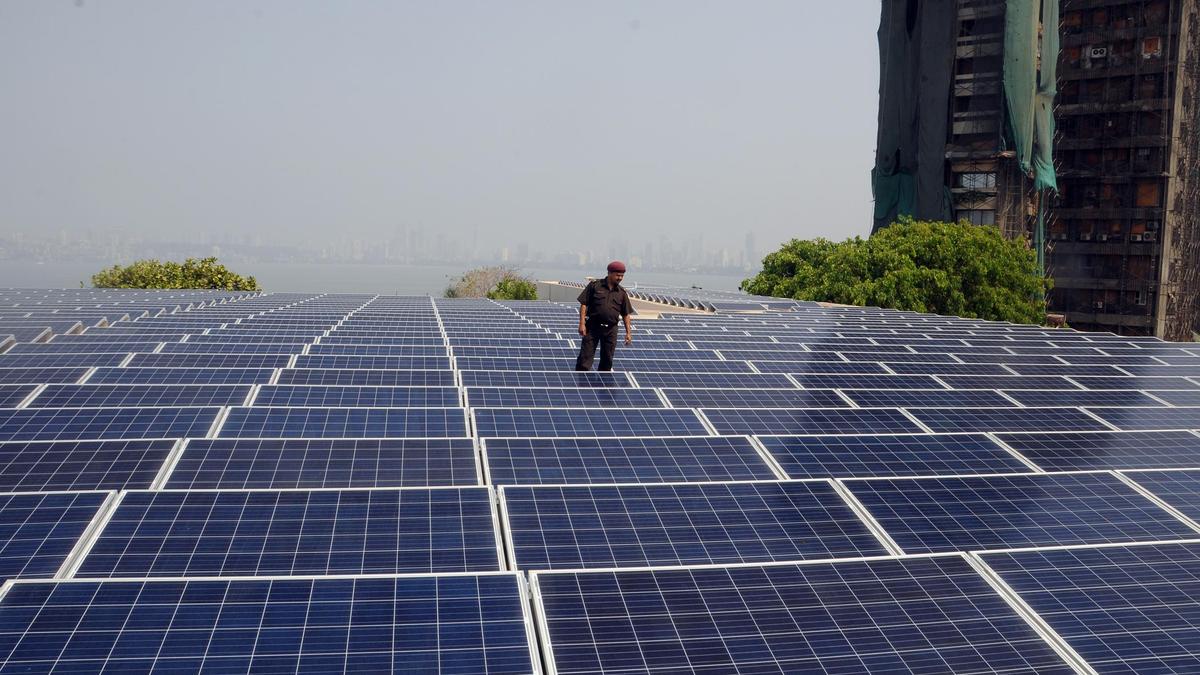
- The Ministry of New and Renewable Energy (MNRE) reimposed its mandate requiring solar projects to source (photovoltaic [PV]) modules exclusively from a government-approved list of domestic manufacturers starting April 1.
- This comes amid concerns over market concentration in India’s solar PV module industry and its potential to drive-up household electricity tariffs.





Government Initiatives to Bolster Domestic Clean Technology Manufacturing:
- The ALMM (Approved List of Model Manufacturers):
- Issued by the MNRE in 2021, it mandates all government-assisted or associated solar projects to use only enlisted modules, effectively barring the use of imported modules in most projects.
- The order aims to enhance energy security by reducing import dependence.
- The order was reimposed recently because the enlisted capacity of around 50 GW is believed to be sufficient and the duty-free import of solar modules from ASEAN countries is detrimental to domestic producers.
- The Production Linked Incentive (PLI) scheme for solar PV modules: Till now, the MNRE has announced incentives for 48.3 GW of module manufacturing capacities under the PLI scheme.
Implications of Market Concentration in India’s Solar PV Module Industry:
- Positive:
- The BCD (Basic Custom Duty of 40% on solar module imports) will help grow the consumption demand of domestically manufactured products.
- Manufacturers anticipate a multifold increase in solar panel installations due to the PM-Surya Ghar Muft Bijli Yojana’s goal of installing one crore household rooftop solar panels.
- Furthermore, solar panel manufacturers are also hoping for a policy change in European countries on the lines of the US which may open the European market for India.
- Negative:

- Companies linked to just five manufacturers control nearly half of the current capacity listed on the ALMM.
- Domestic solar modules are now 90% more expensive than imports, with prices reaching 18 cents per watt compared to 9.1 cents for imported modules.
India’s Renewable Energy Prospects:
- Current situation:
- It should be mentioned that India is the 3rd largest energy consuming country and stands 4th for total renewable power capacity additions.
- As of (May) 2024, India’s renewable energy capacity stands at 195.01 GW with solar power capacity of 85.47 GW, wind power of 46.65 GW, small hydro power of 5 GW and large hydro power of around 46 GW.
- At COP26 India announced its plan to achieve the target of 500GW of non-fossil fuel-based energy by 2030.
- Future projections:
- India’s power consumption is growing at around 10%-12% per annum resulting in an additional power demand of 20-25 GW annually.
- This increasing demand combined with the government initiatives may create a multi fold increase in the demand for solar installations.
- Challenges:
- In order to reach the 2030 target, India needs to add about 44 GW annually, requiring an investment of US$ 190-215 billion over seven years.
- According to the Ministry of Commerce & Industry data, the total solar capacity installed in FY 24 was around 15 GW this far.
- Land acquisition and infrastructure development to establish an efficient transmission network are the major challenges that the industry and the government need to address.
- India’s per capita power consumption is only around one third of the global average.
- In order to reach the 2030 target, India needs to add about 44 GW annually, requiring an investment of US$ 190-215 billion over seven years.
Q.1. What is the PM-Surya Ghar Muft Bijli Yojana?
The Government of India has approved the PM Surya Ghar: Muft Bijli Yojana on 29th February, 2024 to increase the share of solar rooftop capacity and empower residential households to generate their own electricity. The scheme has an outlay of Rs 75,021 crore and is to be implemented till FY 2026-27.
Q.2. What is India’s stand at the COP26?
The Government of India has articulated and put across the concerns of developing countries at the 26th session of the Conference of the Parties (COP26) to the UNFCCC held in Glasgow, United Kingdom. Further, India presented the following five nectar elements (Panchamrit) of India’s climate action.
Source: Despite red flags over ‘excessive profiteering’, ministry reimposed solar module shortlist of domestic producers | FE

 Last updated on April, 2026
→ UPSC Final Result 2025 is now out.
→ UPSC has released UPSC Toppers List 2025 with the Civil Services final result on its official website.
→ Anuj Agnihotri secured AIR 1 in the UPSC Civil Services Examination 2025.
→ UPSC Marksheet 2025 is now out.
→ UPSC Notification 2026 & UPSC IFoS Notification 2026 is now out on the official website at upsconline.nic.in.
→ UPSC Calendar 2026 has been released.
→ Check out the latest UPSC Syllabus 2026 here.
→ UPSC Prelims 2026 will be conducted on 24th May, 2026 & UPSC Mains 2026 will be conducted on 21st August 2026.
→ The UPSC Selection Process is of 3 stages-Prelims, Mains and Interview.
→ Prepare effectively with Vajiram & Ravi’s UPSC Prelims Test Series 2026 featuring full-length mock tests, detailed solutions, and performance analysis.
→ Enroll in Vajiram & Ravi’s UPSC Mains Test Series 2026 for structured answer writing practice, expert evaluation, and exam-oriented feedback.
→ Join Vajiram & Ravi’s Best UPSC Mentorship Program for personalized guidance, strategy planning, and one-to-one support from experienced mentors.
→ Shakti Dubey secures AIR 1 in UPSC CSE Exam 2024.
→ Also check Best UPSC Coaching in India