Governor’s Discretion vs Democratic Mandate Latest News
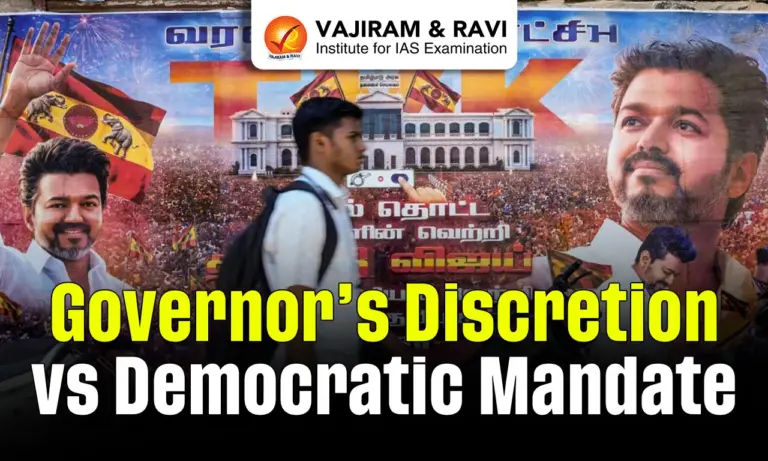
- The decision of the Governor of Tamil Nadu (Rajendra Arlekar) to delay the swearing-in of Tamilaga Vettri Kazhagam (TVK) leader (Vijay) as Chief Minister of Tamil Nadu has revived the constitutional debate over the extent of a Governor’s discretionary powers vis-à-vis the democratic mandate.
- The controversy centres on the Governor reportedly asking TVK leader to furnish proof of support from at least 118 MLAs — the majority mark in the 234-member Assembly — before inviting him to form the government.
Political Background
- Tamilaga Vettri Kazhagam (TVK) emerged as the single largest party with 108 MLAs in the recently held Tamil Nadu assembly elections.
- The support from the Congress raises the tally to 113, which is still short of the majority mark.
- Traditionally, the Governor invites the single largest party or coalition claiming majority to form the government and prove its strength through a floor test in the Assembly.
- The Governor’s insistence on prior proof of majority has sparked criticism from opposition parties and constitutional experts.


Constitutional Position on the Governor’s Powers
- Article 164 of the Constitution: Under this provision,
- The Chief Minister is appointed by the Governor.
- Other ministers are appointed on the advice of the Chief Minister.
- Ministers hold office during the “pleasure of the Governor”.
- Interpretation: However, in a parliamentary democracy, this “pleasure” is not personal discretion but is generally exercised according to constitutional conventions and democratic norms.
Conventional Procedure in Government Formation
- Role of the Governor: The Governor usually,
- Invites the party/alliance staking claim to form government.
- Administers oath to the Chief Minister-designate.
- Appoints a pro-tem Speaker.
- Directs the government to prove majority through a floor test.
- Importance of floor test: The floor of the Assembly is considered the only legitimate forum to determine majority support.
Supreme Court’s Position on Floor Tests
- The judiciary has repeatedly emphasised that legislative majority must be tested on the Assembly floor and not decided subjectively by the Governor.
- Karnataka crisis (2018):
-
- The BJP emerged as the single largest party.
- Congress and JD(S) formed a post-poll alliance and approached the SC after the then Governor (Vajubhai Vala) invited B. S. Yediyurappa to form the government.
- The Governor granted BJP 15 days for a floor test.
- SC intervention: A Bench headed by the then CJI (Dipak Misra) refused to stay the swearing-in. However, the Court advanced the floor test to within 36 hours amid allegations of horse-trading.
- Outcome: The BJP failed to prove majority, after which the Congress–JD(S) alliance formed the government.
- Uttarakhand crisis (2016): The SC reiterated that the floor test is the “ultimate” constitutional mechanism to establish majority and directed then Congress CM (Harish Rawat) to prove majority on the floor of the house.
Core Constitutional Debate – Governor’s Discretion vs Democratic Mandate
- Arguments supporting the Governor:
- The Governor must ensure a stable government.
- Preventing opportunistic defections and political instability is part of the constitutional responsibility of the Governor.
- Seeking proof of support may be viewed as a safeguard against uncertainty.
- Arguments against the Governor’s move:
- The Governor cannot impose subjective political standards beyond constitutional convention.
- Delaying swearing-in undermines the democratic verdict.
- The Governor’s role is largely ceremonial and constitutional, not political.
- Former Union Law Minister Ashwani Kumar described the move as a “graceless stratagem”, “a political outrage”, and “a constitutional heresy”.
Key Constitutional and Governance Issues
- Ambiguity in Governor’s discretion: The Constitution does not clearly define the precise limits of gubernatorial discretion in a hung Assembly.
- Allegations of political bias: Governors are often accused of acting in favour of the Union government or a particular political party.
- Delay in government formation: Unnecessary delays may create political instability, governance vacuum, and scope for horse-trading.
- Weakening of federal principles: Frequent disputes involving Governors raise concerns regarding cooperative federalism, autonomy of States, and misuse of constitutional offices.
Way Forward
- Establish clear constitutional conventions: A codified order of preference for inviting parties to form government can reduce ambiguity.
- Mandatory time-bound floor tests: The Supreme Court’s emphasis on quick floor tests should become a standard constitutional practice.
- Political neutrality of Governors: Governors must function as impartial constitutional heads, guardians of democratic values, not political actors.
- Implement recommendations: For example, Sarkaria and Punchhi commissions recommended non-partisan appointment of Governors, limited discretionary powers, and respect for federal balance.
- Judicial oversight: Courts should continue to ensure that constitutional morality prevails over partisan considerations.
Conclusion
- The Tamil Nadu episode once again highlights the recurring tension between constitutional discretion and democratic legitimacy in India’s parliamentary system.
- While the Governor possesses certain constitutional powers, these must operate within the framework of constitutional morality, federalism, and democratic conventions.
- The Supreme Court’s consistent emphasis on floor tests underlines a fundamental principle: the true test of majority lies not in Raj Bhavan, but on the floor of the legislature.
Source: IE

 Last updated on Oct, 2026
→ UPSC 2027 Notification will be released on 13 January 2027 at upsconline.nic.in.
→ Check Nobel Prize 2026 Winners List here.
→ Download PIB PRiSM Monthly Magazine 2026 here.
→ Check UPSC Monthly Current Affairs Magazine The Recitals here.
→ Check out the latest UPSC Syllabus here.
→ Download UPSC Model Answers for Mains 2026
→ UPSC Mains Question Paper 2026 is out now for Essay & GS Paper 1, 2, 3 & 4.
→ UPSC Calendar 2027 has been released.
→ Enroll in Vajiram & Ravi’s UPSC Mains Test Series 2027 for structured answer writing practice, expert evaluation, and exam-oriented feedback.
→ Join Vajiram & Ravi’s UPSC Mentorship Program 2027 for personalized guidance, strategy planning, and one-to-one support from experienced mentors.
→ Go through the UPSC Mains Previous Year Papers to enhance your preparation.
→ UPSC has released UPSC Toppers List 2025 with the Civil Services final result on its official website.
→ Also check Best UPSC Coaching in India
Governor’s Discretion vs Democratic Mandate FAQs
Q1. What is the constitutional position of the Governor in appointing the Chief Minister in a hung Assembly?+
Q2. Why is the floor test considered the ultimate mechanism to determine majority in a parliamentary democracy?+
Q3. What is the tension between gubernatorial discretion and democratic mandate in India’s federal polity?+
Q4. How have SC judgments shaped the role of Governors in government formation?+
Q5. What is the need for reforms in the office of the Governor?+
Tags: governor’s discretion vs democratic mandate mains articles upsc current affairs upsc mains current affairs