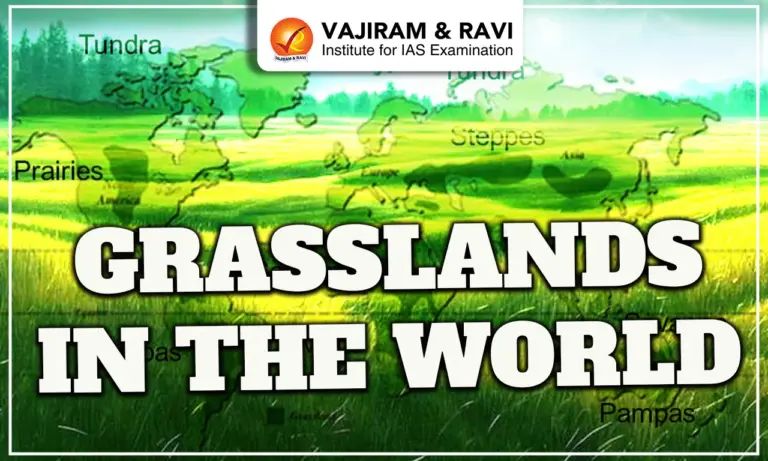
The Grasslands Ecosystem is an ecological system that includes grasses with minimal or no tree cover. These ecosystems exist in different parts of the world under different climatic conditions and known by distinct regional names: Veldt in South Africa, Steppes in Europe and Asia, Downs in Australia and Pampas in South America. The Grasslands in India are concentrated in high Himalayan regions, while the remaining areas are presented by steppes and savannas. The Grassland Ecosystems are primarily characterised by non-woody herbaceous vegetation. In this article, we are going to cover Grassland Ecosystems, its classifications, functions and components.
Grassland Ecosystem
A Grassland Ecosystem refers to a biome where grasses and herbaceous plants dominate, with scattered shrubs and very few trees. Grassland Ecosystems are often described as transitional landscapes that occur in regions where climatic and soil conditions are insufficient for dense forest growth but still supports grasses and shrubs. They act as global food baskets, carbon sinks, and wildlife habitats while supporting millions of people through agriculture and animal husbandry. Despite pressures such as overgrazing, deforestation, and climate change, their preservation is important to maintaining ecological balance. Grasslands, whether known as steppes, pampas, velds, or prairies, remain one of Earth’s most productive and essential ecosystems.
It is often considered a transitional biome that lies between forested and desert regions. Globally, grasslands occupy about 20% of the Earth’s land surface, extending across tropical and temperate zones. Grasslands thrive in areas with moderate to low rainfall, where precipitation is insufficient to support forest growth. Temperatures vary depending on location like tropical grasslands experience warm climates year-round, while temperate grasslands witness hot summers and harsh, snowy winters.
Grassland Ecosystems Structural Components
Grasslands Ecosystems are structured around two important components : biotic (living organisms) and abiotic (non-living factors)
Biotic Components
Biotic Components include all living organisms like producers, consumers and decomposers.
- Producers: Herbaceous grasses and shrubs form the main vegetation and serve as the base of the food chain.
- Primary Consumers: Herbivores like cows, buffaloes, deer, rabbits, termites, millipedes, and insects such as Dysdercus, Coccinella, and Leptocorisa.
- Secondary Consumers: Carnivores that prey on herbivores, such as foxes, jackals, lizards, snakes, frogs, and insectivorous birds.
- Tertiary Consumers: Apex predators like hawks and eagles that feed on secondary consumers.
- Decomposers: Fungi, moulds, and bacteria (e.g., Penicillium, Aspergillus, Rhizopus) that recycle nutrients into the soil.
Abiotic Components
Non-living components include soil, minerals , water and gases. Important elements like carbon, hydrogen, oxygen, nitrogen, phosphorus and sulphur are supplied through air, soil and water. Soil fertility and nutrient availability manage the productivity of grassland ecosystems.




Grasslands Classification
Grasslands can be classified into two types according to their climatic conditions. These classifications include:
1. Tropical Grasslands
- These are found on both sides of the equator within the tropics.
- Rainfall: moderate to low.
- Vegetation: tall grasses reaching up to 3-4 meters.
- Soil: nutrient-deficient and less fertile.
- Examples: Savannahs of Africa, Campos of Brazil, Llanos of Venezuela.
- Fauna: elephants, giraffes, zebras, deer, cheetahs, and leopards.
2. Temperate Grasslands
- Temperate Grasslands are found in mid-latitude regions.
- Precipitation: 25-75 cm, mainly in the form of dew, rain, and snow.
- Climate: hot summers and extremely cold winters (sometimes below 0°F).
- Soil: highly fertile, ideal for agriculture.
- Examples: Pampas (Argentina), Velds (South Africa), Steppe (Asia), Prairie (USA), and Downs (Australia).
- Vegetation: shorter grasses compared to tropical regions.
- Fauna: bison, pronghorns, prairie dogs, and predators such as wolves and coyotes.
Grassland Ecosystem Functions
Grassland Ecosystem has the following functions:
- Biodiversity Support: Provides habitats for diverse flora and fauna.
- Carbon Storage: Stores significant carbon in vegetation and soil.
- Water Filtration: Improves groundwater quality.
- Erosion Control: Grass roots bind soil and help prevent erosion.
- Nutrient Cycling: Facilitate the recycling of vital minerals.
- Forage Production: Serves as grazing land for livestock.
- Wildlife Habitat: Home to large herbivores and predators.
- Recreation: Used for tourism, hiking, and birdwatching.
- Carbon Sequestration: Help combat climate change.
- Cultural Value: Integral to indigenous and pastoral communities.
Flora and Fauna in Grasslands
The Grassland Ecosystem has the following flora and fauna:
Flora
- Dominated by wild grasses, herbs, and scattered shrubs.
- Semi-natural grasslands may include oak, birch, hazel, and hawthorn.
- Perennial grasses stabilize soil and form thick root mats.
- In India, hola meadows are found in South Indian hill slopes adjoining evergreen forests.
Fauna
- Grasslands support the world’s largest land animals.
- Examples: lions, cheetahs, elephants, giraffes, black rhinos, and bison.
- In India, species include the one-horned rhinoceros, deer, antelope, and numerous bird species.
- Soil-dwelling invertebrates enrich biodiversity and aid decomposition.
Grasslands Economic Significance
Grasslands have the following Economic Significance:
- Livestock Grazing: Primary source of fodder for cattle, sheep, and goats.
- Thatching Material: Grass is used for roofing and insulation in rural areas.
- Fuelwood: Shrubs and thorny bushes provide firewood.
- Pollination & Pest Control: Insects and predators regulate agricultural ecosystems.
- Agriculture: Fertile temperate grasslands are global breadbaskets (wheat, barley, maize).
- Rural Economy: Grasslands support the livelihoods of pastoral communities.
Grasslands in India
India has many types of Grasslands:
| Grassland Type | Region | Features |
|
Sub-Himalayan Grasslands |
Terai belt (J&K to Arunachal Pradesh) |
Tall, dense grasses with scattered trees. |
|
Semi-Arid Grasslands |
Gujarat, Rajasthan, Punjab, Delhi, Western UP |
Open, sparse grasses with shrubs. |
|
Dry Sub-Humid Grasslands |
Peninsular India (except Nilgiris) |
Important for crops like wheat and barley. |
|
Montane Grasslands |
Himalayas, NE India |
Found at high altitudes, e.g., Bugyals in Uttarakhand, Khajjiar in Himachal, Dzukou Valley in Nagaland. |
|
Tropical Savannas |
Rajasthan, Deccan Plateau |
Grass-dominated, interspersed with scrub forests. |
|
Wet Grasslands |
Waterlogged plains of North India |
Tall, semi-aquatic grasses, e.g., Phumdis of Manipur. |
Global Names of Grasslands
Grasslands across the world are known by different names:
| Name | Region | Economic Activity |
|
Steppes |
Europe & Asia |
Wheat granaries |
|
Prairies |
North America |
Ranching, dairy, alfalfa cultivation |
|
Pampas |
South America (Argentina) |
Wheat and beef production |
|
Llanos & Cerrados |
South America (Venezuela, Brazil) |
Ranching, agriculture |
|
Savannahs & Velds |
Africa |
Pastoralism |
|
Downs & Canterbury Plains |
Australia & New Zealand |
Sheep rearing, wool production |
|
Puszta |
Hungary |
Wheat and sugar beet cultivation |

 Last updated on March, 2026
→ UPSC Final Result 2025 is now out.
→ UPSC has released UPSC Toppers List 2025 with the Civil Services final result on its official website.
→ Anuj Agnihotri secured AIR 1 in the UPSC Civil Services Examination 2025.
→ UPSC Marksheet 2025 is now out.
→ UPSC Notification 2026 & UPSC IFoS Notification 2026 is now out on the official website at upsconline.nic.in.
→ UPSC Calendar 2026 has been released.
→ Check out the latest UPSC Syllabus 2026 here.
→ UPSC Prelims 2026 will be conducted on 24th May, 2026 & UPSC Mains 2026 will be conducted on 21st August 2026.
→ The UPSC Selection Process is of 3 stages-Prelims, Mains and Interview.
→ Prepare effectively with Vajiram & Ravi’s UPSC Prelims Test Series 2026 featuring full-length mock tests, detailed solutions, and performance analysis.
→ Enroll in Vajiram & Ravi’s UPSC Mains Test Series 2026 for structured answer writing practice, expert evaluation, and exam-oriented feedback.
→ Join Vajiram & Ravi’s Best UPSC Mentorship Program for personalized guidance, strategy planning, and one-to-one support from experienced mentors.
→ Shakti Dubey secures AIR 1 in UPSC CSE Exam 2024.
→ Also check Best UPSC Coaching in India
Grasslands in the World FAQs
Q1. What is the grassland ecosystem?+
Q2. What is the definition of a grassland?+
Q3. What is the grassland ecosystem in India?+
Q4. What are the 4 types of ecosystems?+
Q5. What are the top 3 ecosystems?+
Tags: grasslands in the world