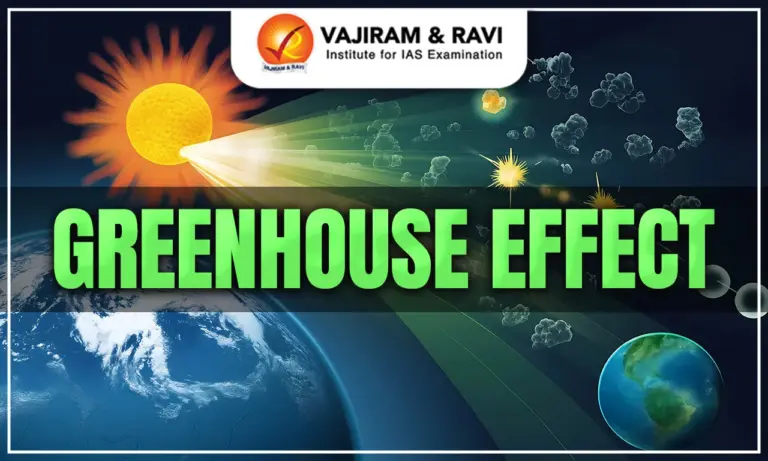
Greenhouse Effect is an impact of atmospheric gases that absorb the heat radiated from the Earth’s surface and thereby causing greenhouse effect. This process is intensified by human activities and has become a big cause of global warming and climate change. In this article, we are going to cover the types, sources, effects and mitigation strategies of Greenhouse Gases.
Greenhouse Effect
The solar radiation enters Earth in the form of shortwaves and easily passes through without much absorption. The Earth’s surface after absorbing part of this radiation warms up and re-emits energy in the form of long wave infrared radiation. A portion of this outgoing heat is trapped by gases such as carbon dioxide, methane, ozone, nitrous oxide, chlorofluorocarbons and water vapour, causing a rise in atmospheric temperature. This heat-trapping process is called the greenhouse effect. Without naturally occurring greenhouse gases, Earth would be very cold and unable to sustain life, as no heat would be retained. However, huge emissions, caused due to human activity, intensify the greenhouse effect leading to abnormal global warming and adverse consequences.
Greenhouse Effect Causes
The greenhouse Effect is caused due to the accumulation of gases like carbon dioxide(CO2), methane, nitrous oxide and water vapour in the atmosphere.
These gases come together to form a blanket layer in the sky that blocks the way for the solar heat to escape in space. This trapping of solar heat leads to warming of the planet. Human induced activities like burning fossil fuels like coal, oil, natural gas, and practices like deforestation, rapid urbanisation and energy intensive industrial processes have contributed to the greenhouse effect. While natural phenomena like volcanic activity and variations in solar radiation contribute, anthropogenic factors remaining the dominant force behind the greenhouse effect.




Greenhouse Gases
Greenhouse gases are gases present in the atmosphere that absorb and hold infrared radiation emitted from the surface of Earth, creating a heating effect. These include both naturally occurring and human-made gases such as water vapour, carbon dioxide, methane, nitrous oxide, and fluorinated gases.
Water Vapour
Water Vapour is the most abundant greenhouse gas present in the atmosphere that reflects back the heat to the surface of Earth, amplifying the heat. Water vapour’s concentration is determined by temperature because warmer air holds more moisture and intensifies global warming.
Carbon Dioxide
Carbon Dioxide is a greenhouse gas that is transparent for incoming solar radiation but absorbs the outgoing terrestrial infrared radiation. Some of this absorbed energy is re-radiated back towards the Earth and raises surface temperature. As Carbon dioxide is denser than air, its concentration is greater near the surface of Earth and its high presence is due to fossil fuel combustion, deforestation and industrial activities making it a significant contributor to global warming today.
Methane (CH₄)
Methane is the second most important greenhouse gas after carbon dioxide, but has a greater heat-trapping capacity per molecule. It is produced naturally by decomposing organic matter and anthropogenically through livestock, rice cultivation, and landfills.
Sources of Methane include:
- Decomposition of animal waste and plant material.
- Livestock rearing, where methane is released during digestion.
- Paddy fields, which become oxygen-deprived and generate methane through anaerobic decomposition.
- Wetlands, permafrost melting, and decaying vegetation.
- Industrial activities like coal mining, oil drilling, and gas pipeline leaks.
- Historically, methane was formed when ancient plant material partially decomposed and was buried underground, later transforming under geological pressure. Its emission today is closely tied to agriculture, fossil fuel extraction, and climate-induced thawing of permafrost regions.
Nitrous Oxide (N₂O)
Nitrous oxide is a greenhouse gas that has a global warming potential about 300 times that of carbon dioxide over a 100-year span. It is primarily linked to agriculture and soil management.
Sources of N₂O include:
- Excessive use of nitrogen-based fertilisers, leading to denitrification by soil bacteria.
- Animal manure management and sewage treatment.
- Combustion of fossil fuels and certain industrial processes like nitric acid production.
- Natural emissions from soil bacteria and thunderstorms.
- Recent research shows atmospheric N₂O levels have been rising steadily at around 0.25% per year. Though small compared to CO₂, its impact on global warming is disproportionately large.
Control Measures: Efficient fertilizer use, adoption of cleaner energy, catalytic converters in vehicles, and sustainable industrial practices can reduce nitrous oxide emissions.
Fluorinated Gases
Fluorinated gases are synthetic, industrially produced gases that have very high global warming potential and long atmospheric lifetimes. They are far more harmful than CO₂, even in small quantities.
Types include:
- Hydrofluorocarbons (HFCs): Used as substitutes for CFCs in refrigeration and air-conditioning.
- Perfluorocarbons (PFCs): By-products of aluminium smelting and semiconductor production.
- Sulphur Hexafluoride (SF₆): Used in the electronics industry and as a tracer gas.
- Nitrogen Trifluoride (NF₃): Emitted during production of solar panels and flat displays, with a global warming potential 17,200 times greater than CO₂.
Black Carbon
Black carbon, though not a gas but a particulate matter, plays a big role in atmospheric warming. Produced from incomplete combustion of fossil fuels and biomass, it strongly absorbs sunlight and warms the atmosphere. When deposited on snow and ice, it reduces their reflectivity (albedo), causing accelerated melting of glaciers and polar ice caps. Although short-lived (stays in the atmosphere for weeks), its impact is severe but also quickly reversible if emissions are reduced.
Sources of black carbon include diesel engines, cookstoves, open biomass burning, industrial emissions, and wildfires. The black carbon impacts regional disruption of rainfall, glacial melting, and significant warming of the lower atmosphere.
Brown Carbon
Brown carbon has complex organic aerosols that appear yellowish or brownish in the atmosphere. These release from biomass burning, fossil fuel combustion, agricultural residue burning, and industrial emissions. They absorb solar radiation at ultraviolet and visible wavelengths, contributing to atmospheric heating, while simultaneously scattering some light, creating mixed effects on climate.
Greenhouse Gases Effects
The excessive presence of greenhouse gases is causing large-scale environmental and socio-economic challenges.
- Rising Sea Levels: increase in ice melt leads to coastal flooding and submergence of islands.
- Extreme Weather: Hurricanes, floods, droughts, and heatwaves have become more frequent and intense.
- Ocean Acidification: CO₂ dissolves in seawater, lowering pH and endangering coral reefs and marine ecosystems.
- Biodiversity Loss: Climate change is causing mass extinctions and disrupting ecosystems.
- Agricultural Challenges: Crop failures, lower yields, and food insecurity are intensifying.
- Health Impacts: Spread of vector-borne diseases, respiratory illnesses, and heat-related disorders are on the rise.
Global Efforts to Mitigate GHG Emissions
International and national initiatives are introduced to counter the threats posed by greenhouse gases. These global efforts include:
- The Paris Agreement: A landmark treaty aimed at limiting global warming to well below 2°C, with efforts to cap it at 1.5°C.
- Renewable Energy: Transition to solar, wind, hydro, and geothermal sources to cut fossil fuel dependence.
- Carbon Pricing: Mechanisms like emissions trading and carbon taxes to incentivize low-carbon technologies.
- Energy Efficiency: Adoption of sustainable practices across industries and households.
- Carbon Capture Projects: Investment in technologies to remove or store carbon emissions.
Greenhouse Effect and Global Warming
The greenhouse effect is important for sustaining life on Earth. However, human-induced intensification has resulted in global warming, which refers to the long-term rise in Earth’s average temperatures. This warming drives climate change, ice melt, extreme weather, and sea-level rise.
The Greenhouse Gas Protocol (GHG Protocol)
The GHG Protocol, developed by the World Resources Institute (WRI) and the World Business Council for Sustainable Development (WBCSD), provides a standardised framework to measure and manage emissions.
It classifies emissions into three scopes:
- Scope 1: Direct emissions from sources owned or controlled by an organisation.
- Scope 2: Indirect emissions from purchased energy like electricity and heating.
- Scope 3: Other indirect emissions across the value chain, such as transport, waste, and product use.

 Last updated on March, 2026
→ UPSC Final Result 2025 is now out.
→ UPSC has released UPSC Toppers List 2025 with the Civil Services final result on its official website.
→ Anuj Agnihotri secured AIR 1 in the UPSC Civil Services Examination 2025.
→ UPSC Marksheet 2025 is now out.
→ UPSC Notification 2026 & UPSC IFoS Notification 2026 is now out on the official website at upsconline.nic.in.
→ UPSC Calendar 2026 has been released.
→ Check out the latest UPSC Syllabus 2026 here.
→ UPSC Prelims 2026 will be conducted on 24th May, 2026 & UPSC Mains 2026 will be conducted on 21st August 2026.
→ The UPSC Selection Process is of 3 stages-Prelims, Mains and Interview.
→ Prepare effectively with Vajiram & Ravi’s UPSC Prelims Test Series 2026 featuring full-length mock tests, detailed solutions, and performance analysis.
→ Enroll in Vajiram & Ravi’s UPSC Mains Test Series 2026 for structured answer writing practice, expert evaluation, and exam-oriented feedback.
→ Join Vajiram & Ravi’s Best UPSC Mentorship Program for personalized guidance, strategy planning, and one-to-one support from experienced mentors.
→ Shakti Dubey secures AIR 1 in UPSC CSE Exam 2024.
→ Also check Best UPSC Coaching in India
Greenhouse Effect FAQs
Q1. What is the greenhouse effect?+
Q2. What are the 5 main causes of the greenhouse effect?+
Q3. What are the four major greenhouse gases?+
Q4. Which agricultural crops produce methane?+
Q5. What is the impact of the greenhouse effect?+
Tags: greenhouse effect