GDP Growth Latest News
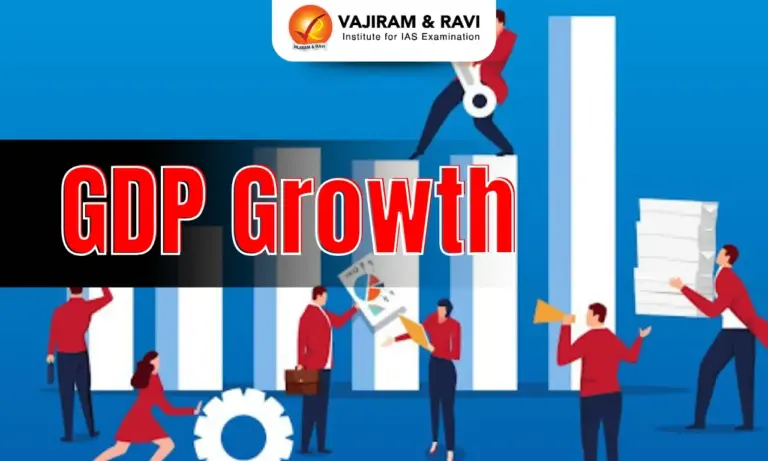
- India posted a robust 8.2% GDP growth, supported by strong manufacturing and services activity.
- However, the IMF assigned India a ‘Grade C’ in national income accounting, highlighting structural weaknesses and statistical gaps.
Current Growth Performance
- India’s economic output for the quarter reached Rs. 48.63 lakh crore, significantly higher than the previous year. The broad-based expansion shows that the current momentum goes beyond a mere post-pandemic rebound.
- Manufacturing grew 9.1%, indicating stronger industrial demand and higher capacity utilisation.
- Services expanded 9.2%, now forming 60% of GDP, with financial services at 10.2%, signalling buoyant credit growth and high transaction volumes.
- Agriculture, supported by improved reservoir levels and horticulture output, rose 3.5%, showing a slight improvement in rural incomes.
- Real GVA rose from Rs. 82.88 lakh crore to Rs. 89.41 lakh crore, confirming real value creation rather than price effects.
- Crucially, nominal GDP grew only 8.8%, showing that inflation, previously a major concern, remained under control through 2024-25.
- Household consumption grew 7.9%, reflecting resilient domestic demand.





Macroeconomic Stability Indicators
- Several macro indicators underline India’s economic resilience:
- Inflation eased, dipping even below target toward the end of 2024-25.
- Bank credit growth remained strong, with well-capitalised banks holding buffers above regulatory norms.
- Fiscal consolidation continued, supported by buoyant GST and direct tax revenues.
- The current account deficit remained modest, helped by strong services exports and diversified forex reserves.
- These signals collectively suggest that India continues to grow even as global economic activity weakens.
IMF’s Grade C Assessment: What It Means
- Despite India’s strong growth numbers, the IMF assigned India a ‘Grade C’ for its national income accounting framework.
- This rating does not evaluate the GDP growth rate itself but the statistical system supporting it. Key shortcomings highlighted:
- Use of an outdated base year (2011-12).
- Dependence on the Wholesale Price Index (WPI) due to the absence of Producer Price Index (PPI) deflators.
- Single deflation method, which introduces cyclical bias.
- Significant gaps between production and expenditure data, indicating incomplete coverage of the informal sector and expenditure components.
- Lack of seasonally adjusted data in quarterly accounts.
- No consolidated datasets for States and local bodies after 2019.
- The IMF’s view suggests that India’s “statistical backbone” needs strengthening to match its economic muscle.
Uneven Recovery Across Sectors
- Despite strong headline numbers, the growth pattern shows unevenness:
- Mining grew barely 0.04%, due to prolonged monsoon disruptions.
- Electricity and utilities grew only 4.4%, affected by a mild winter, reducing peak load demand.
- These sectors are foundational for industrial growth. Their sluggish performance indicates that the recovery has not spread uniformly across the real economy.
- The sectoral contribution to GVA stands at: Primary: 14%, Secondary: 26%, Tertiary: 60%
- This structure mirrors a service-driven economy, but India’s employment profile still remains heavily tilted toward low-productivity agriculture and informal services.
Structural Vulnerabilities
- India’s long-term challenges, highlighted both by the RBI and IMF, include:
- Weak Export Competitiveness
- Trade protectionism, tariff uncertainty, and global geopolitical tensions threaten India’s export growth. Structural scaling of goods exports remains limited.
- Labour Productivity Issues
- A mismatch exists between India’s output structure and its employment structure. A large share of the workforce remains in low-productivity sectors.
- Fragile Statistical and Institutional Capacity
- The absence of updated base years, comprehensive data, and modern statistical tools weakens policy evaluation.
- External Pressures on the Rupee
- Although seemingly stable, the rupee continued to face downward pressure due to a strong U.S. dollar and fluctuating foreign capital flows.
- These issues do not negate India’s growth achievement but underscore the need for deeper institutional reforms to sustain high growth over time.
Source: TH

 Last updated on March, 2026
→ UPSC Final Result 2025 is now out.
→ UPSC has released UPSC Toppers List 2025 with the Civil Services final result on its official website.
→ Anuj Agnihotri secured AIR 1 in the UPSC Civil Services Examination 2025.
→ UPSC Marksheet 2025 is now out.
→ UPSC Notification 2026 & UPSC IFoS Notification 2026 is now out on the official website at upsconline.nic.in.
→ UPSC Calendar 2026 has been released.
→ Check out the latest UPSC Syllabus 2026 here.
→ UPSC Prelims 2026 will be conducted on 24th May, 2026 & UPSC Mains 2026 will be conducted on 21st August 2026.
→ The UPSC Selection Process is of 3 stages-Prelims, Mains and Interview.
→ Prepare effectively with Vajiram & Ravi’s UPSC Prelims Test Series 2026 featuring full-length mock tests, detailed solutions, and performance analysis.
→ Enroll in Vajiram & Ravi’s UPSC Mains Test Series 2026 for structured answer writing practice, expert evaluation, and exam-oriented feedback.
→ Join Vajiram & Ravi’s Best UPSC Mentorship Program for personalized guidance, strategy planning, and one-to-one support from experienced mentors.
→ Shakti Dubey secures AIR 1 in UPSC CSE Exam 2024.
→ Also check Best UPSC Coaching in India
GDP Growth FAQs
Q1. What was India’s latest GDP growth rate?+
Q2. Why did the IMF give India a Grade C?+
Q3. Which sectors drove India’s recent growth?+
Q4. What structural challenges threaten growth sustainability?+
Q5. What does the RBI caution about India’s growth outlook?+
Tags: gdp growth mains articles upsc current affairs upsc mains current affairs