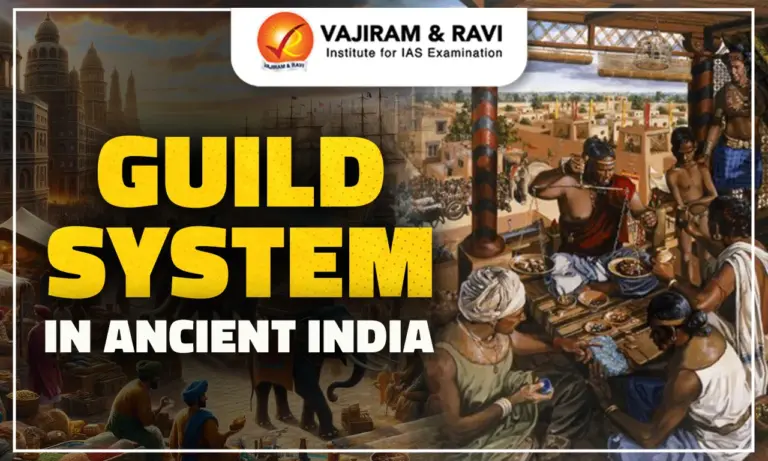
The Guild System in ancient India was an organised association of traders and craftsmen that regulated economic activity and craftsmanship across regions. Its importance lies in its contributions to economic organisation, social welfare, political authority, and cultural enrichment. In this article, we are going to cover the origins, role and impacts of guilds.
Guild System
A guild is a collective of merchants or artisans supervising the practice of a craft within a defined area. In ancient India, the guild system (called “Shreni” or “Gana”) represented a vital socio-economic institution that coordinated different trades and skills. These guilds brought together craftsmen, merchants, and professionals to manage their industries collectively.
Guild System Origin in Ancient India
The start of the guild system in India can be traced back to ancient times when socio-economic life started to become more organised. Guilds evolved gradually across different historical phases:
- Vedic Period (1500–500 BCE): References in the Rigveda and later texts suggest the presence of organised groups of craftsmen such as weavers, carpenters, and metal workers. Although informal, these groups ensured cooperation, division of labour, and exchange of goods. The seeds of the guild system lay in this early collective organisation.
- Mauryan Period (322–185 BCE): Under the Mauryan Empire, guilds transformed into formal institutions. They were registered with the state, paid taxes, and participated in administration. Kautilya’s Arthashastra vividly describes their regulation of trade, fixation of prices, supervision of weights and measures, and even their judicial powers in disputes. Guilds became pivotal intermediaries between the state and the economy.
- Post-Mauryan Period: With the decline of Mauryan central authority, guilds acquired increasing autonomy. They became custodians of local trade, sometimes commanding their militias to protect caravans and trade routes. Inscriptions mention guilds granting donations to temples, constructing infrastructure, and maintaining town life.
- Gupta Period (320–550 CE): This era marked the zenith of guild activity. Guilds not only regulated trade and crafts but also emerged as wealthy corporate bodies with banks, endowments, and political influence. They issued coins, maintained seals, and acted as financial institutions. Their autonomy and wealth made them vital agents in the cultural and economic flowering of the Gupta age.





Guild System Types in Ancient India
The guilds in ancient India were highly diverse, reflecting the range of professions and trades that flourished in society. Broadly, they can be divided into the following categories:
- Merchant Guilds: These were the most influential, comprising traders engaged in both inland and overseas commerce. Merchant guilds such as the Shrenis of the Deccan or the South Indian guild Manigramam regulated long-distance trade, established trade networks across Asia, ensured safe passage of caravans, and negotiated privileges with rulers. They controlled marketplaces, enforced quality, and had the financial clout to donate to temples or fund urban development.
- Craft Guilds: These were organised around particular trades like weaving, metalworking, carpentry, pottery, ivory carving, or jewellery-making. They set strict production standards, trained apprentices, and protected craft secrets. The rise of Indian textiles, metallurgy, and fine arts owes much to the organisational strength of these guilds, which promoted both skill and innovations.
- Professional Guilds: These included groups of scholars, physicians, teachers, and other professionals bound by common ethical standards. They helped regulate intellectual and service-based professions, creating a sense of accountability and prestige. For example, physician guilds maintained codes of conduct and training, while scholarly guilds supported the transmission of learning.
- Regional and Religious Guilds: In addition to occupational divisions, some guilds were regionally based, protecting the interests of traders or craftsmen in a particular locality. Many were also religiously oriented, patronising temples and monasteries, which in turn reinforced their social prestige and moral authority.
Guilds System Functions in Ancient India
- Regulating Trade: Guilds framed codes of conduct, set fair prices, and managed markets and routes, sustaining commerce.
- Quality Assurance: They ensured production met defined standards before reaching buyers.
- Market Oversight: Guilds supervised trade centres, routes, and at times currency, influencing economic stability.
- Mutual Aid: Members received financial and social help during illness, funerals, or emergencies.
- Welfare Activities: Guilds cared for dependents, offered training, and supported widows and orphans.
- Governance Role: They advised rulers, shaped local policies, and occasionally held administrative positions.
- Autonomy: Guilds managed internal laws, elections, and rules, with royal recognition of their self-governing status.
Guild System in Ancient India Importance
Guild System in Ancient India has the following importance:
- Economic Role: By regulating markets and quality, guilds fostered stability and fair trade practices.
- Social Contribution: They provided security nets, strengthened community bonds, and ensured collective welfare.
- Political Power: Guilds influenced governance through wealth and organisation, often impacting regional policies.
- Self-Governance: Operating independently, guilds represented unique autonomous institutions in Indian polity.
- Cultural Growth: They nurtured craftsmanship, encouraged innovation, and contributed to regional arts and industries like textiles and metallurgy.

 Last updated on March, 2026
→ UPSC Final Result 2025 is now out.
→ UPSC has released UPSC Toppers List 2025 with the Civil Services final result on its official website.
→ Anuj Agnihotri secured AIR 1 in the UPSC Civil Services Examination 2025.
→ UPSC Marksheet 2025 is now out.
→ UPSC Notification 2026 & UPSC IFoS Notification 2026 is now out on the official website at upsconline.nic.in.
→ UPSC Calendar 2026 has been released.
→ Check out the latest UPSC Syllabus 2026 here.
→ UPSC Prelims 2026 will be conducted on 24th May, 2026 & UPSC Mains 2026 will be conducted on 21st August 2026.
→ The UPSC Selection Process is of 3 stages-Prelims, Mains and Interview.
→ Prepare effectively with Vajiram & Ravi’s UPSC Prelims Test Series 2026 featuring full-length mock tests, detailed solutions, and performance analysis.
→ Enroll in Vajiram & Ravi’s UPSC Mains Test Series 2026 for structured answer writing practice, expert evaluation, and exam-oriented feedback.
→ Join Vajiram & Ravi’s Best UPSC Mentorship Program for personalized guidance, strategy planning, and one-to-one support from experienced mentors.
→ Shakti Dubey secures AIR 1 in UPSC CSE Exam 2024.
→ Also check Best UPSC Coaching in India
Guild System in Ancient India FAQs
Q1. What was the guild system?+
Q2. What were the three levels of the guild system?+
Q3. What were guilds also known as?+
Q4. When did the guild system in ancient India originate?+
Q5. Who are merchant guilds?+
Tags: the guild system in ancient india