About Halogens
- Halogens are any of the six nonmetallic elements that constitute Group 17 (Group VIIa) of the periodic table.
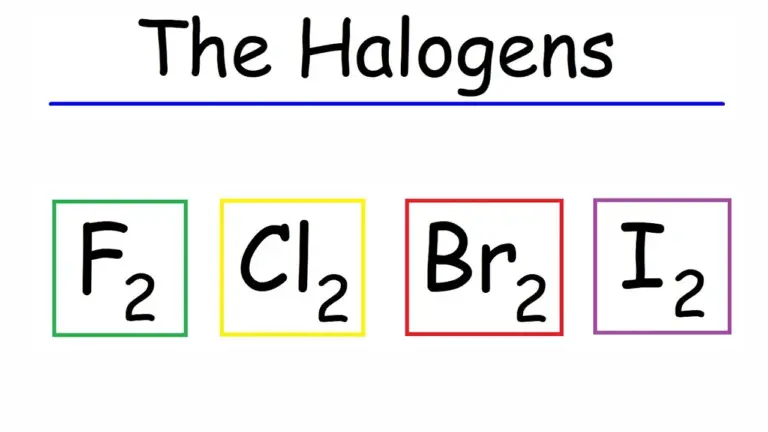
- The halogen elements are:
- fluorine (F), chlorine (Cl), bromine (Br), iodine (I), astatine (At), and tennessine (Ts).
- The word halogen means “salt-producing”, because because halogens react with metals to produce many important salts, of which sodium chloride—table salt, or halite—is best known.
- Properties:
- Halogens are so reactive that they do not occur as free elements in nature. They are the most reactive nonmetals.
- The halogen atoms carry seven valence electrons in their outermost electron shell.
- This accounts for their higher reactivity and tendency to gain one electron and form ionic bonds or share electrons with other elements to form covalent bonds.
- Among all the halogens, fluorine is the most reactive, and Iodine is the least reactive of all.
- In combined form, fluorine is the most abundant of the halogens in Earth’s crust.
- Halogens are the only group on the periodic table that has elements in the solid, liquid, and gas phase at room temperature. At normal temperature and pressure, chlorine and fluorine are gases, bromine is a liquid, and iodine and astatine are solids.
- They are powerful oxidizing agents.
- They have very high electronegativities.
- Halogens have a tendency to form hydrogen halides, which are potent acids when they combine with hydrogen.
Q1) What is electronegativity?
Electronegativity, in chemistry, is the ability of an atom to attract to itself an electron pair shared with another atom in a chemical bond.
Source: Unusual bridging fluorine discovered in one-of-a-kind interhalogen ion







 Last updated on March, 2026
→ UPSC Final Result 2025 is now out.
→ UPSC has released UPSC Toppers List 2025 with the Civil Services final result on its official website.
→ Anuj Agnihotri secured AIR 1 in the UPSC Civil Services Examination 2025.
→ UPSC Marksheet 2025 is now out.
→ UPSC Notification 2026 & UPSC IFoS Notification 2026 is now out on the official website at upsconline.nic.in.
→ UPSC Calendar 2026 has been released.
→ Check out the latest UPSC Syllabus 2026 here.
→ UPSC Prelims 2026 will be conducted on 24th May, 2026 & UPSC Mains 2026 will be conducted on 21st August 2026.
→ The UPSC Selection Process is of 3 stages-Prelims, Mains and Interview.
→ Prepare effectively with Vajiram & Ravi’s UPSC Prelims Test Series 2026 featuring full-length mock tests, detailed solutions, and performance analysis.
→ Enroll in Vajiram & Ravi’s UPSC Mains Test Series 2026 for structured answer writing practice, expert evaluation, and exam-oriented feedback.
→ Join Vajiram & Ravi’s Best UPSC Mentorship Program for personalized guidance, strategy planning, and one-to-one support from experienced mentors.
→ Shakti Dubey secures AIR 1 in UPSC CSE Exam 2024.
→ Also check Best UPSC Coaching in India