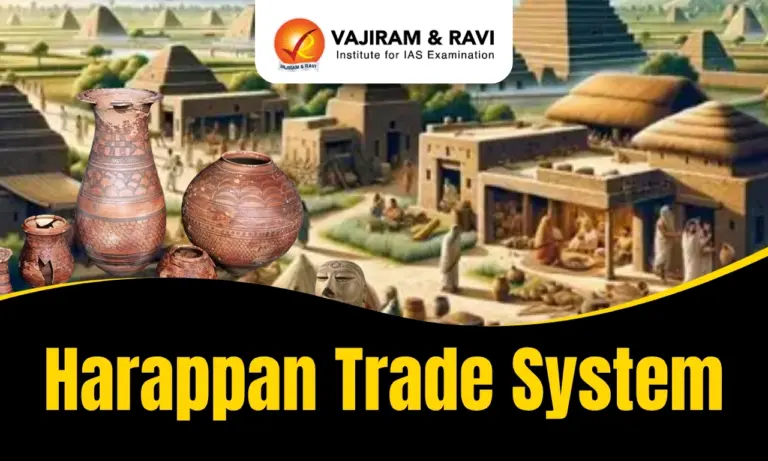
The Harappan Trade System was an important part of life in the Indus Valley Civilization. Trade helped people exchange goods and meet their daily needs, both within their own region and with other areas. It shows that the people of this civilization were well-organised and connected, with a good understanding of how to manage economic activities. Overall, trade played a key role in the growth and development of their cities and society.
Harappan Trade System Key Features
- Strong evidence of trade links: Archaeological discoveries such as Harappan seals, beads, and pottery found in regions like Mesopotamia clearly show that the Indus Valley Civilization maintained long-distance trade relations. Ancient Mesopotamian texts mention “Meluha”, which is believed to refer to the Indus region, highlighting regular commercial contact between the two regions.
- Well-developed trade routes: The Harappans used both land routes and maritime routes for trade. Important port cities like Lothal connected them to overseas markets, while inland routes linked major cities such as Harappa and Mohenjo-daro. Regions like Dilmun (Bahrain) and Makan (Makran coast) acted as intermediary trade centres, facilitating exchange between distant regions.
- Efficient transportation system: Trade was supported by an organised system of transport. Bullock carts were commonly used for land transport, while boats and ships were used along rivers and seas. The presence of dockyards at places like Lothal indicates their advanced knowledge of navigation and water transport.
- Barter-based exchange system: The Harappan economy was based on the barter system, where goods were exchanged directly without the use of coins or currency. This required mutual agreement on value and was supported by trust and standardisation.
- Standardised weights and measures: One of the most remarkable features was the use of uniform stone weights and a proper measurement system. These standardised units ensured accuracy, fairness, and consistency in trade across different regions, reflecting a high level of economic organisation.
- Use of seals for trade and administration: Stone and terracotta seals, often engraved with animal figures and script, were used to mark goods and identify ownership. They may have also acted as a form of authentication or trade control, similar to modern trademarks or official stamps.
- Wide range of traded goods: The Harappans traded a variety of goods, including both raw materials and finished products:
- Exports: agricultural produce, cotton textiles, beads, pottery, ivory items, and semi-precious stones like carnelian
- Imports: metals (like copper and tin), precious stones (like lapis lazuli), and other minerals from regions such as Central Asia, Iran, and Afghanistan
- This shows a diverse and well-balanced trade network.
- Active internal and external trade: Trade took place at both local (internal) and international (external) levels. Different cities specialised in producing certain goods, which were then exchanged with other regions. This created a strong interdependence between urban and rural areas.
- Growth of crafts and industries: Increasing trade led to the development of specialised crafts such as bead-making, metallurgy, pottery, and shell work. Skilled artisans produced high-quality goods, indicating a high level of craftsmanship and technological advancement.
- Cultural exchange through trade: Trade was not limited to goods; it also led to the exchange of ideas, technologies, and cultural practices. This interaction contributed to the overall development and cultural richness of Harappan society.
- Importance of trade in their economy: Trade played a crucial role in the economic prosperity of the civilization. It supported urban growth, ensured the availability of resources, and helped in the spread of skills and knowledge, making the Harappan economy vibrant and well-connected.
Harappan Trade System Routes
- Overland Trade Routes:
- The Indus Valley Civilization developed extensive overland trade routes across difficult terrains. The north-western routes connected them to regions like Central Asia and Afghanistan, enabling long-distance exchange. At the same time, eastern and southern routes linked major urban centres such as Mohenjo-Daro, Harappa, and Lothal, along with smaller settlements. Cities like Dholavira, with strong fortifications, outer walls, and watchtowers, were strategically located to protect traders and ensure safe movement of goods.
- Riverine Trade:
- Apart from land routes, river-based transport played an important role. Even though Dholavira was not located near a major perennial river, it effectively used seasonal streams and channels to move goods. These smaller waterways connected to larger river systems, allowing the transport of bulky goods like grain and metals. This made trade more efficient and helped integrate remote regions into the wider Harappan trade network.
- Maritime Trade:
- Sea trade was one of the most advanced features of the Harappan economy. Due to its proximity to the Arabian Sea, Dholavira was well placed for maritime trade in ancient India. Small boats and ships connected it to important ports like Lothal and Balakot, and even to distant regions such as Mesopotamia. The presence of dockyards at sites like Lothal highlights their strong shipbuilding skills and the importance of overseas trade routes in expanding economic and cultural contacts.


Significance of Harappan Trade System
- Foundation of economic growth: The trade system of the Indus Valley Civilization played a major role in building a strong and stable economy by ensuring continuous exchange of goods.
- Boost to urbanisation: Trade supported the growth of major cities like Harappa and Mohenjo-daro, leading to better infrastructure, planning, and expansion of urban centres.
- Development of crafts and industries: Increased trade demand encouraged specialised crafts such as bead-making, metallurgy, pottery, and jewellery, improving skills and production quality.
- Expansion of internal and external connectivity: It connected different regions through well-developed land and maritime routes, and linked the Harappans with distant areas like Mesopotamia.
- Efficient resource distribution: Trade ensured proper distribution of raw materials and finished goods across regions, reducing scarcity and supporting balanced development.
- Encouragement of specialisation: Different regions focused on producing specific goods, leading to division of labour and economic efficiency.
- Cultural interaction and exchange: Trade facilitated the exchange of ideas, technologies, and cultural practices, enriching Harappan society.
- Technological advancement: The need for better trade led to innovations in transport, shipbuilding, weights and measures, and craft techniques.
- Strengthening of administrative control: The use of standardised weights, measures, and seals reflects a well-organised system of trade regulation and governance.

 Last updated on Oct, 2026
→ UPSC 2027 Notification will be released on 13 January 2027 at upsconline.nic.in.
→ Check Nobel Prize 2026 Winners List here.
→ Download PIB PRiSM Monthly Magazine 2026 here.
→ Check UPSC Monthly Current Affairs Magazine The Recitals here.
→ Check out the latest UPSC Syllabus here.
→ Download UPSC Model Answers for Mains 2026
→ UPSC Mains Question Paper 2026 is out now for Essay & GS Paper 1, 2, 3 & 4.
→ UPSC Calendar 2027 has been released.
→ Enroll in Vajiram & Ravi’s UPSC Mains Test Series 2027 for structured answer writing practice, expert evaluation, and exam-oriented feedback.
→ Join Vajiram & Ravi’s UPSC Mentorship Program 2027 for personalized guidance, strategy planning, and one-to-one support from experienced mentors.
→ Go through the UPSC Mains Previous Year Papers to enhance your preparation.
→ UPSC has released UPSC Toppers List 2025 with the Civil Services final result on its official website.
→ Also check Best UPSC Coaching in India
Harappan Trade System FAQs
Q1. What was the Harappan Trade System?+
Q2. Did the Harappans have trade relations with other civilizations?+
Q3. What were the main trade routes used by the Harappans?+
Q4. What goods were traded in the Harappan Civilization?+
Q5. Why was trade important for the Harappan Civilization?+
Tags: harappan trade system history history notes