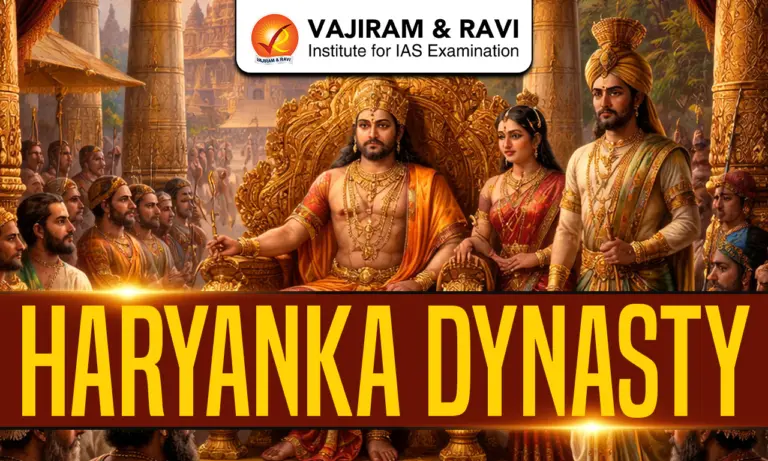
The Haryanka Dynasty was one of the earliest ruling dynasties of Magadha. According to the Mahavamsa, It played a crucial role in the political rise of eastern India between 544 BCE and 413 BCE. The dynasty was founded by Bimbisara and eventually it laid the foundation of Magadha’s expansion into a powerful kingdom.
Haryanka Dynasty Historical Background
The Haryanka Dynasty ruled Magadha during a transformative period marked by political consolidation and external interactions. Its emergence coincided with broader developments in northern India.
- Origin and Chronology: According to Mahavamsa, the dynasty ruled from 544 BCE to 413 BCE, though some historians suggest a later 5th-4th century BCE timeline based on short chronology interpretations.
- Founder and Early Rule: Bimbisara was appointed as the king at fifteen by his father Bhattiya. He established strong foundations through diplomacy, administration and territorial consolidation in Magadha.
- Capital and Expansion: The initial capital was Rajagriha, strategically located. Later, Udayin shifted it to Pataliputra near modern Patna, enhancing administrative and military control over the Ganga plains.
- External Context: This period during Haryanka Dynasty overlapped with the Achaemenid expansion under Darius I around 517-516 BCE, indicating early contacts between Indian and Persian political spheres.
Haryanka Dynasty Rulers
The Haryanka Dynasty rulers significantly expanded Magadha through conquest, alliances and administrative innovations, establishing it as a dominant regional power. The key rulers of this dynasty and their contributions has been discussed below:
Bimbisara (544-492 BCE)
- He is the founder of the dynasty and ruled for about 52 years.
- He expanded Magadha by conquering Anga and forming alliances through marriages with Kosala, Vaishali and Madra.
- He maintained efficient governance with officials like Sona Kolivisa, Kumbhaghosaka and physician Jīvaka.
- He supported both Buddhism and Jainism, associating with Mahavira and Buddha.
Ajatashatru (493-462 BCE)
- He was the son of Bimbisara. He seized power, possibly by imprisoning or killing his father.
- Under him, Magadha reached its greatest territorial extent through aggressive expansion.
- He fought the Vajjika League led by the Lichhavis and successfully conquered them.
- He is also associated with the use of war technologies like catapults.
Udayin (460-444 BCE)
- He is the successor of Ajatashatru.
- He is credited with shifting the capital to Pataliputra, strategically located at the confluence of the Ganga and Son rivers, strengthening Magadha’s position.
Later Rulers
- Successors included Anuruddha, Munda, Darshaka and Nagadasaka according to Buddhist tradition.
- However, Puranas mention Nandivardhana and Mahanandin, indicating conflicting succession traditions.





Haryanka Dynasty Administration and Governance
The administrative system of the Haryanka Dynasty reflects early state organization with structured governance and official hierarchies mentioned in ancient texts.
- Village Administration: Gramakas acted as village headmen who managed local assemblies and ensured smooth functioning of rural administration at the grassroots level.
- Central Officials: Mahamatras were high ranking officials responsible for executive, judicial and military duties, indicating a centralized administrative system with multiple functional roles.
- Bureaucratic Structure: The presence of ministers, treasurers and advisors such as Koliya and Kumbhaghosaka shows an organized bureaucracy supporting royal authority and governance efficiency.
- Capital Administration: The shift to Pataliputra improved control over trade routes and political regions, making governance more effective in expanding territories.
Haryanka Dynasty Society
The period of Haryanka Dynasty rule witnessed significant religious and social developments, especially with the rise of new philosophical traditions in northern India.
- Religious Diversity: Both Buddhist and Jain texts claim royal patronage. Bimbisara is described as a follower of Mahavira in Jain texts and of Buddha in Buddhist sources.
- Royal Patronage: Bimbisara supported Buddha’s Sangha by deputing Jīvaka and granting land for monastic establishments, reflecting active state support for religious institutions.
- Ajatashatru’s Role: Ajatashatru was contemporary with Mahavira and Buddha, continuing patronage of these traditions and contributing to their spread across Magadha.
- Social Structure: Society included administrators, ministers, physicians and village leaders, indicating a stratified yet organized social system linked closely with governance.
Haryanka Dynasty Decline
The decline of the Haryanka Dynasty was marked by internal instability, succession disputes and eventual overthrow by new political forces.
- Succession Conflicts: Multiple traditions suggest uncertain succession after Udayin, with rulers like Anuruddha, Munda and Nagadasaka possibly ruling simultaneously or in fragmented regions.
- Political Instability: Historical interpretations highlight court intrigues and frequent changes of rulers, weakening central authority and creating administrative disorder within Magadha.
- Assassinations and Intrigues: Jain texts mention Udayin’s assassination by a rival kingdom, while other accounts indicate repeated internal violence among successors.
- End of Dynasty: According to Mahavamsa, the last ruler Nagadasaka was overthrown by minister Shishunaga, leading to the establishment of the Shaishunaga dynasty around 413 BCE.

 Last updated on April, 2026
→ UPSC Final Result 2025 is now out.
→ UPSC has released UPSC Toppers List 2025 with the Civil Services final result on its official website.
→ Anuj Agnihotri secured AIR 1 in the UPSC Civil Services Examination 2025.
→ UPSC Marksheet 2025 is now out.
→ UPSC Notification 2026 & UPSC IFoS Notification 2026 is now out on the official website at upsconline.nic.in.
→ UPSC Calendar 2026 has been released.
→ Check out the latest UPSC Syllabus 2026 here.
→ UPSC Prelims 2026 will be conducted on 24th May, 2026 & UPSC Mains 2026 will be conducted on 21st August 2026.
→ The UPSC Selection Process is of 3 stages-Prelims, Mains and Interview.
→ Prepare effectively with Vajiram & Ravi’s UPSC Prelims Test Series 2026 featuring full-length mock tests, detailed solutions, and performance analysis.
→ Enroll in Vajiram & Ravi’s UPSC Mains Test Series 2026 for structured answer writing practice, expert evaluation, and exam-oriented feedback.
→ Join Vajiram & Ravi’s Best UPSC Mentorship Program for personalized guidance, strategy planning, and one-to-one support from experienced mentors.
→ Shakti Dubey secures AIR 1 in UPSC CSE Exam 2024.
→ Also check Best UPSC Coaching in India
Haryanka Dynasty FAQs
Q1. Who founded the Haryanka Dynasty?+
Q2. What was the capital of the Haryanka Dynasty?+
Q3. Who was the most powerful ruler of the Haryanka Dynasty?+
Q4. What type of administration existed in the Haryanka Dynasty?+
Q5. How did the Haryanka Dynasty come to an end?+
Tags: geography geography notes haryanka dynasty