Higher Education Commission of India Bill 2025 Latest News
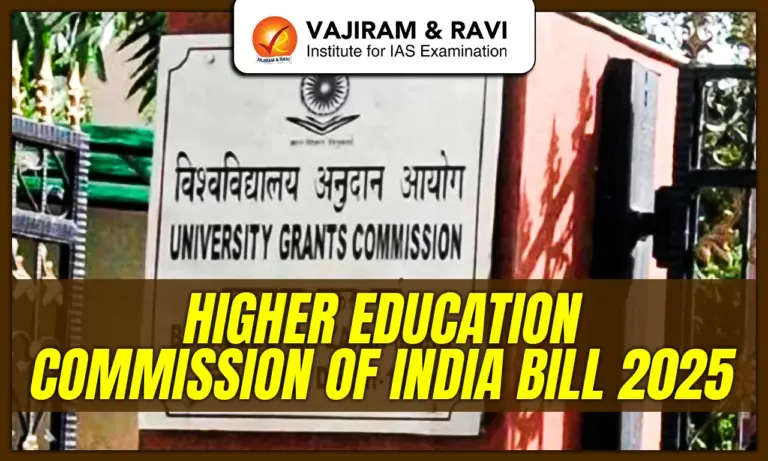
- Five years after NEP 2020 proposed it, the government is set to table the Higher Education Commission of India (HECI) Bill 2025 in the upcoming Winter Session.
- The Bill aims to merge the regulatory roles of the UGC, AICTE, and NCTE into one unified authority, marking the second attempt to establish a single higher education regulator in India.
HECI: India’s Proposed Single Regulator for Higher Education
- The Higher Education Commission of India (HECI) Bill draws directly from NEP 2020, which recommended replacing the fragmented regulatory structure with a single overarching authority.
- Currently, India’s higher education landscape is regulated by multiple statutory bodies:
- the University Grants Commission (UGC) oversees higher education,
- the All India Council for Technical Education (AICTE) regulates technical and professional education, and
- the National Council for Teacher Education (NCTE) governs teacher education.
Four Verticals Under HECI
- NEP 2020 outlines four specialised bodies within HECI:
- National Higher Education Regulatory Council (NHERC): Regulates all higher education except medical and legal fields.
- National Accreditation Council (NAC): Serves as the accrediting authority.
- General Education Council (GEC): Frames academic learning outcomes and standards.
- Higher Education Grants Council (HEGC): Handles funding and grants (though officials indicate funding may still rest with the government).
- HECI itself will function as a compact body of eminent experts overseeing the four verticals.
Reducing Red Tape and Conflict of Interest
- NEP 2020 criticised the existing system for being “mechanistic and disempowering”, with concentrated powers, regulatory overlap, and conflicts of interest.
- The new commission aims to streamline governance, ensure accountability, and eliminate bureaucratic hurdles.
Autonomy and Quality Focus
- The Bill seeks to empower higher education institutions to operate as “independent self-governing institutions” while ensuring excellence through a transparent accreditation system and enhanced institutional autonomy.





The 2018 HECI Bill: Key Provisions and Why It Stalled
- The government’s first attempt to replace the UGC came through the Higher Education Commission of India (HECI) Bill, 2018.
- It proposed a new commission with a chairperson, vice-chairperson, and 12 members appointed by the Centre.
- Since the Bill did not merge AICTE and NCTE, their chairpersons were included as members.
- The 2018 draft limited HECI’s powers to setting academic standards and granting autonomy while leaving funding authority with the Ministry of Human Resource Development.
- It also planned an advisory council headed by the HRD Minister and comprising state higher education council heads.
- However, the Bill drew criticism for potentially centralising authority and creating excessive overregulation.
- Following strong pushback during public consultations, it was shelved and revisited for alignment with the NEP 2020 framework.
Opposition to HECI: Concerns Over Centralisation and Autonomy
- Fears of Excessive Centralisation
- Critics argue that the HECI framework concentrates too much authority with the Union government.
- The 2018 Bill shifted UGC’s financial powers to the MHRD, raising concerns that universities could lose autonomy and become dependent on central directives.
- Lack of Diverse Representation
- Opposition leaders objected to the commission’s composition.
- They noted the absence of representation from disadvantaged groups — women, Dalits, Adivasis, OBCs, minorities, and persons with disabilities — while industry stakeholders were prominently included.
- Apprehensions From States
- The then CM of Tamil Nadu warned that centralised funding could lead to biased resource allocation.
- He feared that replacing UGC grants with ministry-controlled funding might shift to a 60:40 Centre-state share, reducing states’ financial autonomy.
- Parliamentary Panel’s Warning
- A parliamentary standing committee flagged “excess centralisation” concerns.
- The panel noted that while multiple regulators create inconsistency, the proposed HECI model risks trapping state universities between national and state rules, with insufficient state representation in decision-making.
- Overall Concern
- Across political and academic circles, the prevailing worry is that HECI could weaken federalism, dilute institutional autonomy, and marginalise key stakeholders in higher education governance.

 Last updated on March, 2026
→ UPSC Final Result 2025 is now out.
→ UPSC has released UPSC Toppers List 2025 with the Civil Services final result on its official website.
→ Anuj Agnihotri secured AIR 1 in the UPSC Civil Services Examination 2025.
→ UPSC Marksheet 2025 is now out.
→ UPSC Notification 2026 & UPSC IFoS Notification 2026 is now out on the official website at upsconline.nic.in.
→ UPSC Calendar 2026 has been released.
→ Check out the latest UPSC Syllabus 2026 here.
→ UPSC Prelims 2026 will be conducted on 24th May, 2026 & UPSC Mains 2026 will be conducted on 21st August 2026.
→ The UPSC Selection Process is of 3 stages-Prelims, Mains and Interview.
→ Prepare effectively with Vajiram & Ravi’s UPSC Prelims Test Series 2026 featuring full-length mock tests, detailed solutions, and performance analysis.
→ Enroll in Vajiram & Ravi’s UPSC Mains Test Series 2026 for structured answer writing practice, expert evaluation, and exam-oriented feedback.
→ Join Vajiram & Ravi’s Best UPSC Mentorship Program for personalized guidance, strategy planning, and one-to-one support from experienced mentors.
→ Shakti Dubey secures AIR 1 in UPSC CSE Exam 2024.
→ Also check Best UPSC Coaching in India
Higher Education Commission of India Bill 2025 FAQs
Q1. What is the Higher Education Commission of India Bill 2025?+
Q2. Why is the HECI Bill being introduced now?+
Q3. What are the four verticals proposed under HECI?+
Q4. Why did the earlier 2018 HECI Bill fail?+
Q5. What are major concerns about the new HECI structure?+
Tags: Higher Education Commission of India Bill 2025 mains articles upsc current affairs upsc mains current affairs