About Holy Grail Energy Production:
- Scientists have been able to generate higher energy in a fusion experiment than the energy applied for causing the fusion reaction.
- Nuclear fusion is described as the “holy grail” of energy production, as it is almost limitless, requires no fossil fuels, and leaves behind no hazardous waste.
- It is the process that powers the Sun and other stars.
- Nuclear fusion mimics the natural reactions occurring within the Sun, and has been a goal of scientists around the world since the 1950s.
- It works by taking pairs of light atoms and forcing them together – this “fusion” releases a lot of energy.
- For example, the fusion of two nuclei of a heavier isotope of hydrogen, called tritium, produces at least four times as much energy as the fission of a uranium atom which is the normal process of generating electricity in a nuclear reactor.
- And importantly, the process produces no greenhouse gas emissions and therefore does not contribute to climate change.
- But one of the challenges is that forcing and keeping the elements together in fusion requires very high temperatures and pressures.
- Until now, no experiment has managed to produce more energy than the amount put in to make it work.
Experiment:
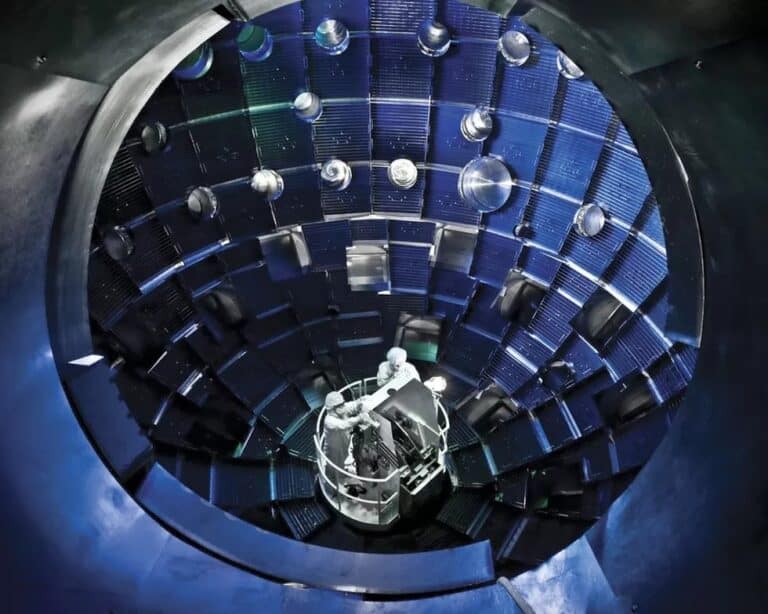
- The experiment which cost $3.5 billion, forced a minuscule amount of hydrogen into a peppercorn-sized capsule.
- For forcing the hydrogen into the capsule, scientists used a powerful 192-beam laser that could generate 100 million degree Celsius of heat.
- It is also called ‘inertial fusion’.
- At some other places, including the international collaborative project in southern France called ITER in which India is a partner; very strong magnetic fields are used for the same purpose.
- The laser beam was hotter than the Sun’s centre and helped to compress the hydrogen fuel to more than 100 billion times that of Earth’s atmosphere.
- Under the pressure of these forces, the capsule started imploding on itself and leading to the fusion of hydrogen atoms and the release of energy.





Difference between nuclear fission and nuclear fusion:
- Nuclear fusion is the opposite of nuclear fission, where heavy atoms are split apart.
- Fission is the technology currently used in nuclear power stations, but the process also produces a lot of waste that continues to give out radiation for a long time.
- It can be dangerous and must be stored safely.
Q1) What is ITER?
ITER is an acronym for the International Thermonuclear Experimental Reactor. The ITER project is one of the most ambitious energy projects in the world today in which about 35 nations are collaborating to build the world’s largest tokamak, a magnetic fusion device designed to prove the feasibility of fusion as a large-scale and carbon-free source of energy..
Source: Economic Times

 Last updated on March, 2026
→ UPSC Final Result 2025 is now out.
→ UPSC has released UPSC Toppers List 2025 with the Civil Services final result on its official website.
→ Anuj Agnihotri secured AIR 1 in the UPSC Civil Services Examination 2025.
→ UPSC Marksheet 2025 is now out.
→ UPSC Notification 2026 & UPSC IFoS Notification 2026 is now out on the official website at upsconline.nic.in.
→ UPSC Calendar 2026 has been released.
→ Check out the latest UPSC Syllabus 2026 here.
→ UPSC Prelims 2026 will be conducted on 24th May, 2026 & UPSC Mains 2026 will be conducted on 21st August 2026.
→ The UPSC Selection Process is of 3 stages-Prelims, Mains and Interview.
→ Prepare effectively with Vajiram & Ravi’s UPSC Prelims Test Series 2026 featuring full-length mock tests, detailed solutions, and performance analysis.
→ Enroll in Vajiram & Ravi’s UPSC Mains Test Series 2026 for structured answer writing practice, expert evaluation, and exam-oriented feedback.
→ Join Vajiram & Ravi’s Best UPSC Mentorship Program for personalized guidance, strategy planning, and one-to-one support from experienced mentors.
→ Shakti Dubey secures AIR 1 in UPSC CSE Exam 2024.
→ Also check Best UPSC Coaching in India