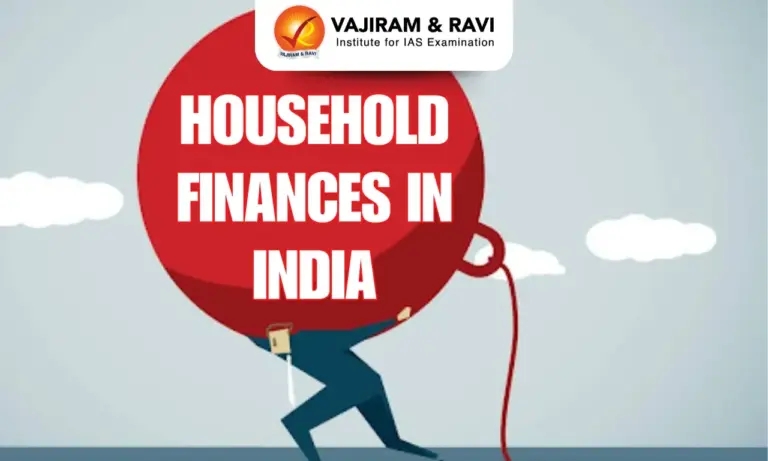
Household Finances in India Latest News
- With Union Budget 2026 approaching, India’s macroeconomic indicators project stability and strong relative growth amid global uncertainty.
- However, a closer reading of RBI data (Financial Stability Report, Annual Report 2024–25) and recent Budget documents reveals a structural shift in India’s growth mode.
- The Indian households saving less and borrowing more, thereby absorbing economic risks earlier shared by the State.
Aggregates Presenting a Partial Picture
- Household debt: 41.3% of GDP (March 2025), lower than peers like China (60.1%), Malaysia (69.6%), Thailand (88%).
- Trajectory: Gradual rise from about 36% (mid-2021) to 41% (2025), indicating no traditional household debt crisis.
- Limitation: Debt-to-GDP ratios reveal how much debt exists, not why households are borrowing or their repayment capacity.





Uneven Incomes, Stable Consumption
- RBI Annual Report (2024–25): It highlights uneven real income growth, especially outside formal and high-productivity sectors.
- Borrowing as an adjustment mechanism: Despite this, consumption remains resilient, implying households are adjusting via borrowing, not income growth or savings.
Credit as a Cushion, Not Capital
- Asset vs consumption credit: Borrowing is increasingly used to bridge income–expenditure gaps, not to create assets.
- Household vulnerability: Even moderate debt becomes risky when it substitutes for income growth and savings.
Stock vs Flow – Where the Stress Lies
- Balance sheet position:
- Financial liabilities accounted for 41.3% of GDP (in March 2025), while gross household financial assets stood at 106.6% of GDP.
- There is no indication that liabilities have surpassed assets, and households continue to be net holders of financial wealth – meaning household finances remain sound.
- Flow data (critical insight):
- Net financial savings fell to 3–4% of GDP, later rebounding to 7.6% (Q4, 2024–25).
- Volatility is driven by faster growth of liabilities than assets.
- Inference: Financial wealth may rise, but the shock-absorbing buffer is eroding.
Why are Households Borrowing More (The Fiscal Angle)
- At the State level (Quiet transfer of risk from State to households):
- A Study of Budgets 2024–25 reveals that State governments have prioritised capital expenditure while limiting revenue expenditure.
- Committed expenditures — interest payments, pensions, and salaries — now account for between 30 and 32% of State revenue receipts, leaving little space for income support or countercyclical transfers.
- States have actually become less responsive to household income stress while also becoming fiscally leaner.
- At the Union level:
- The Budget 2025-26 shows a continued emphasis on public investment, with capital expenditure budgeted at ₹11.2 lakh crore and effective capital expenditure at ₹15.5 lakh crore.
- This strategy is growth-enhancing, but it is not household-neutral.
- Infrastructure investment raises medium-term potential, yet does little to smooth short-term income volatility.
A Macro Risk Hiding in Plain Sight
- Private consumption: Accounts for close to 60% of GDP, making household spending the economy’s primary stabiliser.
- Three interacting trends:
- Uneven income growth (RBI Annual Report).
- Rapid expansion of unsecured retail credit despite improved borrower profiles.
- Volatile and compressed net financial savings.
- Risk: Any shock—income slowdown, tighter financial conditions, unemployment—could force abrupt consumption retrenchment, destabilising growth.
Challenges and Policy Options for Budget 2026-27
- Challenges:
- Rising household leverage: Especially among vulnerable groups.
- Debt-financing: Consumption-led growth.
- Reduced fiscal cushioning: At State and Union levels.
- Declining household capacity: To absorb economic shocks.
- Policy options:
- Enhance disposable incomes: Targeted income support, tax relief for middle and lower-income groups.
- Promote labour-intensive employment: To stabilise income flows.
- Rebalance fiscal policy: Complement capital expenditure with selective revenue spending for income smoothing.
- Strengthen household savings: Incentivise financial savings and reduce dependence on unsecured credit.
- Align growth with resilience: Ensure that consumption growth is backed by incomes, not debt.
Conclusion
- India’s macroeconomic stability ahead of Union Budget 2026 masks a fragile household finance dynamic.
- Growth sustained by debt-financed consumption is not self-sustaining. Restoring balance between income, savings, and borrowing must become a central fiscal priority.
- Without strengthening household shock-absorbing capacity, India risks an economy where growth persists on the surface while resilience steadily weakens beneath.
Source: TH

 Last updated on March, 2026
→ UPSC Final Result 2025 is now out.
→ UPSC has released UPSC Toppers List 2025 with the Civil Services final result on its official website.
→ Anuj Agnihotri secured AIR 1 in the UPSC Civil Services Examination 2025.
→ UPSC Marksheet 2025 is now out.
→ UPSC Notification 2026 & UPSC IFoS Notification 2026 is now out on the official website at upsconline.nic.in.
→ UPSC Calendar 2026 has been released.
→ Check out the latest UPSC Syllabus 2026 here.
→ UPSC Prelims 2026 will be conducted on 24th May, 2026 & UPSC Mains 2026 will be conducted on 21st August 2026.
→ The UPSC Selection Process is of 3 stages-Prelims, Mains and Interview.
→ Prepare effectively with Vajiram & Ravi’s UPSC Prelims Test Series 2026 featuring full-length mock tests, detailed solutions, and performance analysis.
→ Enroll in Vajiram & Ravi’s UPSC Mains Test Series 2026 for structured answer writing practice, expert evaluation, and exam-oriented feedback.
→ Join Vajiram & Ravi’s Best UPSC Mentorship Program for personalized guidance, strategy planning, and one-to-one support from experienced mentors.
→ Shakti Dubey secures AIR 1 in UPSC CSE Exam 2024.
→ Also check Best UPSC Coaching in India
Household Finances in India FAQs
Q1. How does rising household debt challenge the sustainability of India’s consumption-led growth model?+
Q2. Why are debt-to-GDP ratios an inadequate indicator of household financial health in India?+
Q3. How fiscal consolidation has led to a silent transfer of economic risk from the State to households in India?+
Q4. What macroeconomic risks arise from the increasing use of unsecured retail credit in India?+
Q5. Why is restoring household savings critical for maintaining macroeconomic stability in India?+
Tags: household finances in india mains articles upsc current affairs upsc mains current affairs