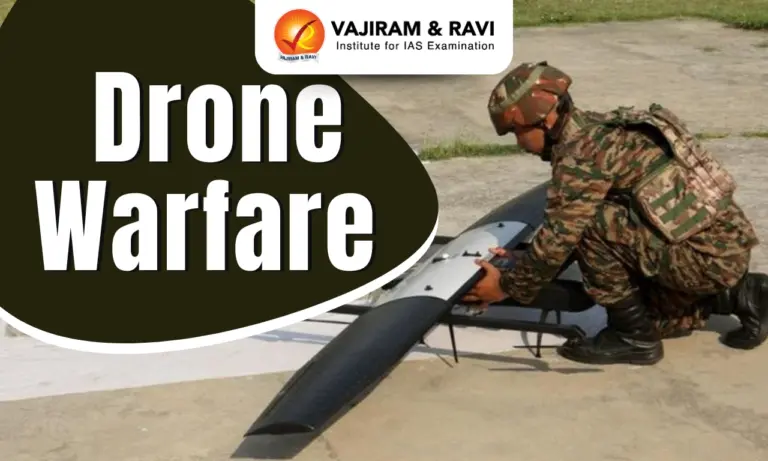
Drone Warfare Latest News
- The ongoing wars in Ukraine, Lebanon, and West Asia (US-Israel-Iran conflict) have demonstrated a fundamental shift in how modern wars are fought.
- Drones — cheap, mass-produced, and rapidly adaptable — have moved from support tools to central instruments of warfare, challenging decades-old assumptions about military power.
End of Conventional Superiority
- For decades, battlefield dominance belonged to nations with advanced tanks, aircraft, warships, precision missiles, and large defence budgets.
- Smaller militaries and non-state actors were largely confined to guerrilla and asymmetric tactics.
- This paradigm has now been shattered. Commercially derived drones, produced at scale and deployed widely, have redefined military power.
- They perform functions spanning:
- Intelligence, Surveillance and Reconnaissance (ISR)
- Target acquisition and artillery spotting
- Precision strikes and deep-strike missions
- Electronic warfare and logistics support
- The result is a continuous and interconnected battlespace where no position is truly safe, no movement remains concealed for long, and detection is rapidly followed by destruction.


Ukraine: The World’s First Industrial-Scale Drone War
- Russia’s invasion of Ukraine (February 2022) began as a conventional war. Within two years, it became the world’s first industrial-scale, drone-intensive conflict.
- Ukraine initially adapted commercially available drones — designed for photography, mapping and surveying — into improvised reconnaissance and strike systems.
- By 2024, drones were integrated into every layer of Ukrainian combat: battlefield surveillance, frontline targeting, and deep-strike missions against Russian logistics and infrastructure.
The FPV Revolution
- At the core of Ukraine’s drone warfare is the First-Person View (FPV) drone — a cheap, commercially available platform originally built for recreational racing.
- Operators control them via live video fed to VR-style goggles, giving exceptional precision and manoeuvrability.
- FPV drones were rapidly converted into:
- Kamikaze/Strike drones — small quadcopters carrying explosive payloads, flown directly into targets as disposable precision missiles. A drone worth a few hundred dollars can destroy armoured vehicles worth millions.
- Bomber drones — adapted from commercial DJI Mavic and Matrice platforms; they drop grenades and anti-tank mines and survive missions, enabling repeated sorties against trenches and bunkers.
- Interceptor and long-range attack variants — used to strike deep inside Russian territory against airbases, logistics hubs and critical infrastructure.
Loitering Munitions
- Ukraine also deploys loitering munitions — drone-missile hybrids that loiter over a target area before striking:
- RAM II — short-range precision munition used alongside reconnaissance drones like Shark and PD-2
- UJ-31 Zozulya — an aerially deployed “parasite drone” carried by the larger UJ-22 UAV, enabling penetration of heavily contested airspace under intense electronic warfare conditions
Ukraine’s Most Significant Innovation: Fibre-Optic FPV Drones
- Conventional drones rely on radio-frequency links, which are vulnerable to jamming.
- Ukraine’s most critical innovation is the fibre-optic FPV drone, which transmits commands and video through ultra-thin fibre-optic cables that unspool during flight.
- This makes them immune to electronic jamming — a decisive advantage in heavily contested electromagnetic environments, and one that Russia has struggled to counter.
Iran’s Strategic Drone Model
- Iran represents a structurally distinct model of drone warfare. The Islamic Revolutionary Guard Corps (IRGC) does not use drones merely as tactical tools.
- Instead, it integrates them into a broader strategy of deterrence, coercion and power projection across West Asia.
- Through Shahed variants and platforms supplied to proxy forces in Iraq, Syria, Lebanon and Yemen, Iran has demonstrated the ability to threaten US and Israeli military bases, naval assets and critical infrastructure across the region — at remarkably low cost.
The Economics of Drone Warfare
- The drone revolution is defined as much by economics as by technology. Key shifts include:
- Cheap, mass-produced drones are replacing expensive conventional platforms
- Industrial production capacity has become a core military capability
- Warfare is increasingly a test of industrial endurance — the ability to build, deploy and counter ever-evolving drone systems continuously
India’s Relevance and Takeaways
- India faces active drone threats on both its western and northern borders. Pakistan has used Turkish Bayraktar TB2 drones; China has an advanced indigenous drone programme.
- Several key lessons from global drone warfare are directly relevant to India:
- India must invest in domestic drone manufacturing under Make in India / iDEX frameworks.
- Counter-drone systems — both kinetic and electronic — need to be integrated into India’s air defence architecture.
- Asymmetric warfare capability using drones is as important as conventional platforms.
- The fibre-optic drone technology gap must be urgently addressed.
Conclusion
- Drones are no longer just weapons — they are the infrastructure of modern war, shaping how conflicts are surveilled, fought, sustained and decided.
- The nation that can out-produce, out-innovate and out-counter in the drone domain will hold the decisive military edge in 21st-century conflicts.

 Last updated on Oct, 2026
→ UPSC 2027 Notification will be released on 13 January 2027 at upsconline.nic.in.
→ Check Nobel Prize 2026 Winners List here.
→ Download PIB PRiSM Monthly Magazine 2026 here.
→ Check UPSC Monthly Current Affairs Magazine The Recitals here.
→ Check out the latest UPSC Syllabus here.
→ Download UPSC Model Answers for Mains 2026
→ UPSC Mains Question Paper 2026 is out now for Essay & GS Paper 1, 2, 3 & 4.
→ UPSC Calendar 2027 has been released.
→ Enroll in Vajiram & Ravi’s UPSC Mains Test Series 2027 for structured answer writing practice, expert evaluation, and exam-oriented feedback.
→ Join Vajiram & Ravi’s UPSC Mentorship Program 2027 for personalized guidance, strategy planning, and one-to-one support from experienced mentors.
→ Go through the UPSC Mains Previous Year Papers to enhance your preparation.
→ UPSC has released UPSC Toppers List 2025 with the Civil Services final result on its official website.
→ Also check Best UPSC Coaching in India
Drone Warfare FAQs
Q1. Why is Drone Warfare considered a revolution in modern warfare?+
Q2. How has Drone Warfare changed the conflict in Ukraine?+
Q3. What role does Drone Warfare play in Iran's military strategy?+
Q4. Why is the economics of Drone Warfare important?+
Q5. What lessons does Drone Warfare offer for India?+
Tags: Drone Warfare mains articles upsc current affairs upsc mains current affairs