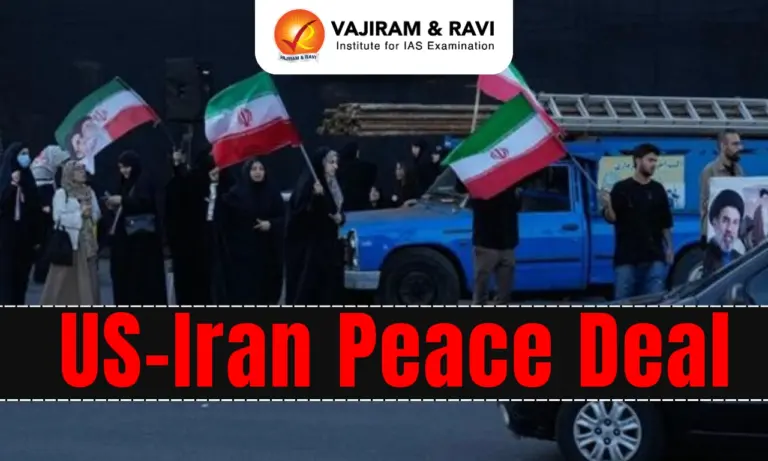
US-Iran Peace Deal Latest News
- The United States and Iran have announced a framework peace deal, ending nearly four months of war that began with joint US-Israeli strikes on Iran in February 2026.
- The Memorandum of Understanding (MoU) is scheduled to be formally signed on June 19 in Switzerland. The full text of the MoU has not been officially released.
Background: Timeline
- Dec 2025 – Iranian rial collapses to a record low; economic protests in Tehran
- Feb 28, 2026 – US-Israel launch coordinated strikes on Iran; Supreme Leader Ali Khamenei killed
- April 7, 2026 – A fragile first ceasefire announced; Israel kept out of talks
- June 15, 2026 – US-Iran reach interim peace deal; Hormuz set to reopen
- The war has killed thousands, disrupted global energy markets. Earlier, the US strike had severely damaged Iran’s nuclear enrichment facilities at Natanz, Isfahan and Fordow during Operation Midnight Hammer (June 2025).


Key Points of the MoU
- The final agreement is to be approved by a UN Security Council resolution.
Military Provisions
- Permanent ceasefire on all fronts, including Lebanon
- US to lift its naval blockade on Iranian ports within 30 days
- US forces to withdraw from areas surrounding Iran
- US commits not to increase its regional military presence or impose new sanctions
Strait of Hormuz
- Iran to immediately open the Strait to all commercial vessels
- Reopening to happen “under Iranian arrangements” — a significant diplomatic win for Tehran
- The Strait carries one-fifth of all globally traded oil, making its reopening critical for world energy markets
Economic Provisions
- US to release $24 billion in Iranian frozen assets
- Oil and energy sanctions to be temporarily waived
- US and allies to negotiate a $300 billion reconstruction plan for Iran within 60 days
- Final negotiations will not begin until half of Iran’s frozen funds are released and the naval blockade is lifted
Nuclear Provisions
- Iran reiterates commitment to not produce nuclear weapons
- Iran to maintain status quo on its nuclear programme — no further uranium enrichment — pending a final deal within 60 days
- The comprehensive nuclear deal is deferred to subsequent negotiations
What Triggered the Signing
- The immediate catalyst was an Israeli airstrike on Beirut just before the deal announcement. This provoked Iran to prepare retaliation.
- Trump quickly distanced the US from the Israeli action, stating it “should not have happened.”
- To prevent a collapse of ceasefire talks, Trump announced an immediate lifting of the naval blockade — rather than waiting 30 days as originally planned.
- This was Iran’s non-negotiable pre-condition for negotiations. Iran, in turn, held back from striking Israel and agreed to sign the MoU.
- Key mediators credited with brokering the deal: Pakistan, Qatar, Saudi Arabia, and Turkey.
The Nuclear Question: Why Was It Deferred
- Before the war, the US had two key sources of leverage over Iran — comprehensive sanctions that had crippled Iran’s economy, and damage to Iran’s nuclear facilities during Operation Midnight Hammer.
- However, Iran countered both by weaponising control over the Strait of Hormuz and demonstrating the reach of its missiles and drones against US allies’ infrastructure.
- Iran has actually retaliated against nearly double the number of targets that US-Israel struck during the ceasefire period since April 8. This proved that American military action could not dislodge Iran’s new leverage.
- The MoU essentially restores the nuclear status quo to pre-war levels (as of February 27) — meaning the war achieved little on the nuclear front. This is why the comprehensive nuclear deal has been left for later.
Iran’s Internal Dilemma: Why Accept the Deal at All
- America’s military card has been spent. Trump used military force and failed to achieve strategic objectives. Tehran can now negotiate from a position of demonstrated strength.
- Economic relief is urgent. Frozen asset releases and sanction waivers are immediate economic gains. Iran’s economy is under severe stress — missing this window is not in Tehran’s interest.
- Iran retains its deterrent. The MoU places no limits on Iran’s missile programme or drone capabilities. Iran can return to pre-MoU conditions if the US violates the terms. This gives Tehran a safety net.
The 60-Day Litmus Test
- The MoU initiates a 60-day verification and implementation period. Experts argue this period is more important than the deferred nuclear deal itself.
- Four factors will determine if a final agreement is achievable:
- How effectively the US restrains Israel from provocative strikes
- The pace of US naval withdrawal from Iranian ports
- The scale of frozen asset releases by Washington and Arab allies
- The scope of the broader US military pullback from the region
India’s Stakes
- India imports a substantial portion of its crude oil from the Persian Gulf region; Hormuz disruption directly raised energy costs.
- Indian sailors on ships in the Strait were reportedly endangered during the conflict — EAM Jaishankar protested attacks on vessels carrying Indian nationals.
- India’s energy security, Chabahar port access, and West Asia connectivity all depend on regional stability.
- Resolution of the Iran energy crisis also has implications for Bangladesh’s economy, which was already suffering from an energy shortage linked to the US-Iran war.

 Last updated on Oct, 2026
→ UPSC 2027 Notification will be released on 13 January 2027 at upsconline.nic.in.
→ Check Nobel Prize 2026 Winners List here.
→ Download PIB PRiSM Monthly Magazine 2026 here.
→ Check UPSC Monthly Current Affairs Magazine The Recitals here.
→ Check out the latest UPSC Syllabus here.
→ Download UPSC Model Answers for Mains 2026
→ UPSC Mains Question Paper 2026 is out now for Essay & GS Paper 1, 2, 3 & 4.
→ UPSC Calendar 2027 has been released.
→ Enroll in Vajiram & Ravi’s UPSC Mains Test Series 2027 for structured answer writing practice, expert evaluation, and exam-oriented feedback.
→ Join Vajiram & Ravi’s UPSC Mentorship Program 2027 for personalized guidance, strategy planning, and one-to-one support from experienced mentors.
→ Go through the UPSC Mains Previous Year Papers to enhance your preparation.
→ UPSC has released UPSC Toppers List 2025 with the Civil Services final result on its official website.
→ Also check Best UPSC Coaching in India
US-Iran Peace Deal FAQs
Q1. What is the significance of the US-Iran Peace Deal?+
Q2. Why was the nuclear issue deferred in the US-Iran Peace Deal?+
Q3. What economic benefits are included in the US-Iran Peace Deal?+
Q4. What factors will determine the success of the US-Iran Peace Deal?+
Q5. Why is the US-Iran Peace Deal important for India?+
Tags: mains articles upsc current affairs upsc mains current affairs US-Iran Peace Deal