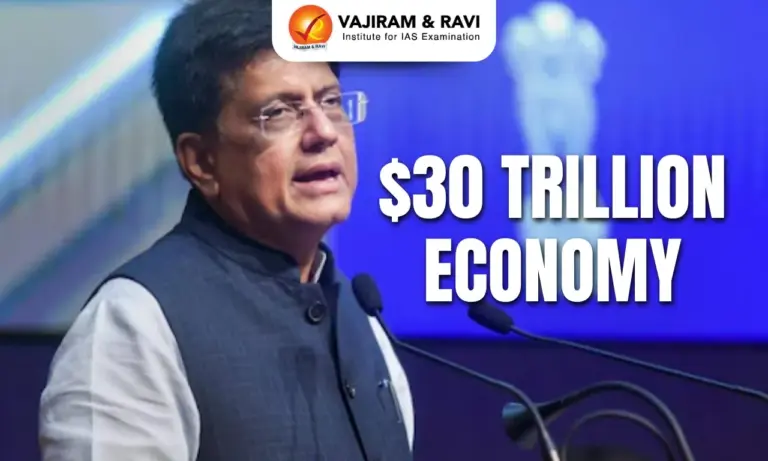
$30 Trillion Economy Latest News
- At the Berlin Global Dialogue, Commerce and Industry Minister Piyush Goyal asserted that India will be a $30 trillion economy within 20–25 years, shaping how the country negotiates trade deals.
- Goyal argued that while the US economy is currently eight times larger, the gap will narrow significantly over the next 25 years.
- His statement underlines India’s growing economic confidence and its aim to negotiate trade agreements from a position of strength, aligned with its long-term growth trajectory.
Understanding the Size of an Economy
- The size of an economy is measured by its Gross Domestic Product (GDP) — the total market value of all goods and services produced within a country in a year.
- GDP reflects a nation’s economic strength and global influence, much like a scoreboard that tracks overall performance. A larger GDP indicates greater production, spending, and prosperity.
- As of end-2024, the US GDP stood at $29.2 trillion, while India’s GDP in the 2023–24 financial year was $3.9 trillion.
- To compare, the US state of California alone had a GDP of $4.1 trillion.
- An easy analogy: GDP is like the total runs scored by a cricket team over a season — the higher the runs (output), the stronger and more successful the team (economy).





How a Country’s GDP Is Used For Comparison
- Globally, GDP is expressed in US dollar terms to allow easy comparison between countries.
- To calculate this, a nation’s GDP in local currency (rupees, in India’s case) is divided by the rupee–dollar exchange rate.
- The GDP discussed internationally is usually the nominal GDP, which includes the effect of inflation — unlike real GDP, which adjusts for it.
- Projecting future GDP, therefore, depends on two factors:
- India’s nominal GDP in rupees, and
- The rupee–dollar exchange rate.
- For example, India’s GDP in 2024 was about Rs 330 trillion. If the exchange rate had remained ₹65 per US dollar (as in 2014), India would have been a $5 trillion economy.
- However, since the rate weakened to ₹84 per dollar, the GDP in dollar terms was only $3.9 trillion.
Assessing the Validity of $30 Trillion Projection
- The Minister’s projection of India becoming a $30 trillion economy in the next 25 years appears realistic, based on past trends.
- Looking back, from 2000 to 2024, India’s nominal GDP grew at a compounded annual growth rate (CAGR) of 11.9%, while the rupee depreciated against the US dollar at a CAGR of 2.7%.
- If India maintains the same growth and currency depreciation rates over the next 25 years, its GDP would surpass $30 trillion by 2048 — around 27 years from now, which aligns closely with Goyal’s prediction.
Why $30 Trillion Target Faces Challenges
- While projecting future growth using past trends seems reasonable, India’s economic momentum has slowed since 2014.
- Over the past 11 years, India’s nominal GDP has grown at a CAGR of 10.3%, lower than the 11.9% average of the previous 25 years.
- Meanwhile, the rupee’s depreciation has slightly accelerated to 3.08%, compared to 2.7% earlier.
- This means slower economic growth combined with faster currency weakening.
- If these recent trends continue, India’s GDP would reach $30 trillion only around 2055, not by 2048, pushing Goyal’s target back by nearly a decade.
The Real Impact of a Slower Growth Rate
- The timeline difference between India reaching a $30 trillion economy by 2048 or 2055 may appear small — just 7 to 8 years — but the financial impact is huge.
- If India continues growing at the pace of the past 25 years, by 2055 its economy would be 75% larger than what it would be if it grew at the slower rate of the past 11 years.
- In short, even a slight dip in growth momentum over time can lead to massive differences in economic size when projected over decades.
India Must Sustain Higher Growth to Realize Its $30 Trillion Vision
- The analysis shows that each decade’s performance matters — even small changes in growth rates can cause huge long-term differences in economic size.
- Although it’s normal for growth to slow as economies mature, India is still relatively small compared to the US and China and cannot afford a slowdown yet.
- To make the $30 trillion goal credible, India must accelerate its growth rate and maintain strong, consistent economic momentum over the coming decades.

 Last updated on March, 2026
→ UPSC Final Result 2025 is now out.
→ UPSC has released UPSC Toppers List 2025 with the Civil Services final result on its official website.
→ Anuj Agnihotri secured AIR 1 in the UPSC Civil Services Examination 2025.
→ UPSC Marksheet 2025 is now out.
→ UPSC Notification 2026 & UPSC IFoS Notification 2026 is now out on the official website at upsconline.nic.in.
→ UPSC Calendar 2026 has been released.
→ Check out the latest UPSC Syllabus 2026 here.
→ UPSC Prelims 2026 will be conducted on 24th May, 2026 & UPSC Mains 2026 will be conducted on 21st August 2026.
→ The UPSC Selection Process is of 3 stages-Prelims, Mains and Interview.
→ Prepare effectively with Vajiram & Ravi’s UPSC Prelims Test Series 2026 featuring full-length mock tests, detailed solutions, and performance analysis.
→ Enroll in Vajiram & Ravi’s UPSC Mains Test Series 2026 for structured answer writing practice, expert evaluation, and exam-oriented feedback.
→ Join Vajiram & Ravi’s Best UPSC Mentorship Program for personalized guidance, strategy planning, and one-to-one support from experienced mentors.
→ Shakti Dubey secures AIR 1 in UPSC CSE Exam 2024.
→ Also check Best UPSC Coaching in India
$30 Trillion Economy FAQs
Q1. What did Piyush Goyal say about India’s economy?+
Q2. What does GDP measure?+
Q3. How is GDP calculated in dollar terms?+
Q4. Is the $30 trillion target realistic?+
Q5. What could delay India’s $30 trillion milestone?+
Tags: $30 trillion economy mains articles upsc current affairs upsc mains current affairs