What’s in Today’s Article?
- Why in News?
- What is the IFWCS?
- How are Forests in India Managed?
- Need for the IFWCS
- Significance of the IFWCS
Why in News?
- Amid rising international concerns on deforestation and illicit trade in timber, the Government of India has launched its own national forest certification scheme – The Indian Forest and Wood Certification Scheme (IFWCS).
- The IFWCS will validate entities that adhere to sustainable practices in management of forests and its products.





What is the IFWCS?
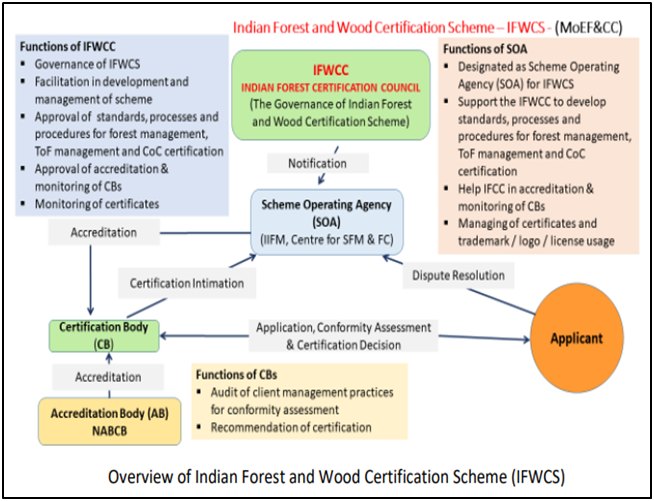
- IFWCS would offer –
- Certification for sustainable forest management,
- Sustainable management of trees outside forests like those in plantations, and
- Chain of custody which is a sort of guarantee of the traceability of a forest product throughout its supply chain, from the origins to the market.
- Certification may be of use to –
- Forest management units,
- Corporations, or wood-based industries,
- Tree growers, timber or NTFP (Non-Timber Forest Produce) traders,
- Saw millers, exporters or importers of wood-based and NTFP-based products, and
- Other end-user industries.
How are Forests in India Managed?
- Forests in India are managed according to their respective working plans.
- These working plans have now been updated with the newly-developed Indian Forest Management Standards that contain 8 criteria, 69 indicators and 254 verifiers.
- These standards will be mandatory for all forest divisions in the country to implement.
- However, getting the certification is not mandatory for the forest divisions, even though they would become eligible if they adhere to these standards.
- Obtaining the certification would depend on needs.
Need for the IFWCS
- A global investigation into deforestation by the International Consortium of Investigative Journalists (ICIJ) had revealed that there were serious questions over the integrity of forest certifications.
- This has affected acceptance of Indian products in international markets and resulted in high dropout rates among certified entities.
- Europe and the US happen to be the largest export markets for India’s forest-based products, particularly handicraft and furniture.
- These markets have been tightening the rules for import of forest products because of greater sensitivity around deforestation on climate change concerns.
- At the Glasgow climate change conference in 2021, over 100 countries had come together in a pledge to halt, and reverse, deforestation by 2030.
- Hence, the Government of India was planning to start its own certification scheme for improved regulation of the market.
Significance of the IFWCS
- It will offer an alternative to the private foreign certification agencies that have been operating in the Indian market for the last two decades.
- It will bring greater trust and transparency into the processes, and grant greater acceptability to Indian forest-based products in international markets.
- Right now, it is a government-initiated and government-backed scheme, but eventually it is likely to evolve into an independent entity like the Bureau of Indian Standards (BIS) or Quality Council of India (QCI).
Q1) What was the outcome of the Glasgow climate change conference?
At COP26 Glasgow 2021, countries ultimately agreed to a provision calling for a phase-down of coal power and a phase-out of “inefficient” fossil fuel subsidies.
Q2) What is the Quality Council of India (QCI)?
QCI was set up as a society registered under Societies Registration Act of 1860 to establish an accreditation structure in the country.
Source: Centre launches forest certification scheme to counter foreign agencies | PIB

 Last updated on March, 2026
→ UPSC Final Result 2025 is now out.
→ UPSC has released UPSC Toppers List 2025 with the Civil Services final result on its official website.
→ Anuj Agnihotri secured AIR 1 in the UPSC Civil Services Examination 2025.
→ UPSC Marksheet 2025 is now out.
→ UPSC Notification 2026 & UPSC IFoS Notification 2026 is now out on the official website at upsconline.nic.in.
→ UPSC Calendar 2026 has been released.
→ Check out the latest UPSC Syllabus 2026 here.
→ UPSC Prelims 2026 will be conducted on 24th May, 2026 & UPSC Mains 2026 will be conducted on 21st August 2026.
→ The UPSC Selection Process is of 3 stages-Prelims, Mains and Interview.
→ Prepare effectively with Vajiram & Ravi’s UPSC Prelims Test Series 2026 featuring full-length mock tests, detailed solutions, and performance analysis.
→ Enroll in Vajiram & Ravi’s UPSC Mains Test Series 2026 for structured answer writing practice, expert evaluation, and exam-oriented feedback.
→ Join Vajiram & Ravi’s Best UPSC Mentorship Program for personalized guidance, strategy planning, and one-to-one support from experienced mentors.
→ Shakti Dubey secures AIR 1 in UPSC CSE Exam 2024.
→ Also check Best UPSC Coaching in India