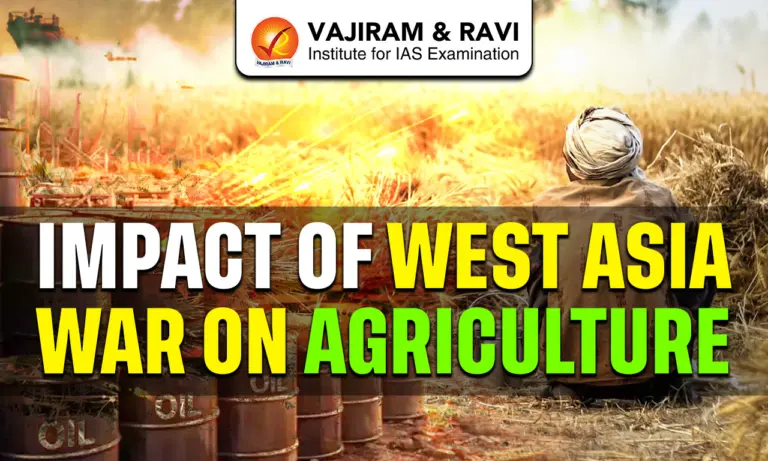
The ongoing West Asia conflict involving Israel, the United States, and Iran is triggering significant geopolitical and economic disruptions, with far-reaching consequences for global agriculture and India’s food security. The near shutdown of the Strait of Hormuz, a strategic chokepoint handling 20% of global oil shipments and nearly 30 per cent of fertilizer trade, has disrupted energy and nutrient supply chains, driving up costs and threatening crop productivity worldwide.
Global Fertilizer Crisis
The conflict has triggered an acute shortage of nitrogen and phosphate fertilizers:
- Urea, the most widely used nitrogen fertilizer, has seen a 30-40 per cent price surge since the conflict began.
- Qatar’s QAFCO urea plant (capacity 5.6 million tonnes) ceased operations due to energy supply disruptions.
- Fertilizer shipments from the Gulf, which constitute over 30 per cent of global urea trade, are delayed or blocked.
- The shortage is particularly critical as it coincides with planting season in major producing regions, including Europe, the U.S., and Asia. Delayed applications can reduce yields by 4-5 per cent, affecting both food availability and prices.
- Developing nations are highly vulnerable. For example, Ethiopia relies on Gulf imports for over 90 per cent of nitrogen fertilizers, which were already strained prior to the war.
The crisis is exacerbated by rising LNG prices, a key feedstock for urea production, and the potential long-term uncertainty in shipping insurance and security even after the conflict ends.
India’s Fertilizer Dependence and Domestic Impacts
India, where agriculture sustains over 46 per cent of the population and contributes 16 per cent to GDP, is particularly exposed:
- Fertilizer imports reached 177 LMT in 2023-24, while domestic consumption was 601 LMT, with MOP almost entirely imported and DAP meeting only 40 per cent of domestic demand.
- 63 per cent of nitrogen fertilizers and 32 per cent of DAP come from Gulf nations, especially Saudi Arabia, Oman, and Qatar. Long-term agreements now secure 3.1 million tonnes of DAP annually from Saudi Arabia from 2025-26.
- Domestic urea production remains 305-315 LMT, insufficient to meet consumption (~400 LMT), making imports essential.
- Rising input costs, coupled with climate-induced stress and higher diesel expenses, threaten smallholder farmers’ incomes, particularly in Punjab, Haryana, Uttar Pradesh, Andhra Pradesh, and Telangana, where nitrogen-intensive crops such as rice are cultivated.





Impact on India’s Agricultural Exports
The Gulf’s proximity and large Indian diaspora have historically made it a natural market, but shipping disruptions, rising insurance costs, and logistical uncertainties now threaten exports.
India’s exports to West Asia, valued at $11.8 billion in 2025, are under threat due to logistical disruptions and rising insurance costs, according to the Global Trade Research Initiative (GTRI):
- Major exports include rice ($4.43 billion), bananas, onions, spices, tea, coffee, meat, dairy, and processed foods.
- Export disruptions have already caused domestic price fluctuations, for example, coconut prices fell from ₹22,000 to ₹12,000-13,000 per 1,000 coconuts as supplies were diverted to local markets.
- Reduced fertilizer availability for export-oriented crops may lower yields, curtail export volumes, and indirectly exacerbate food inflation.
Policy and Strategic Interventions
India’s response must be multidimensional, addressing both immediate and long-term challenges:
- Domestic Production and Reserves: Expand fertilizer production capacity and maintain strategic reserves for nitrogen, phosphate, and potassium fertilizers.
- Diversification of Imports: Reduce dependence on Gulf nations by securing alternate sources and long-term procurement contracts.
- Farmer Support and Subsidies: Continue targeted subsidies (e.g., $12.7 billion for urea in 2025–26) to buffer farmers from input cost shocks.
- Sustainable Agriculture Practices: Promote organic fertilizers, balanced nutrient management, and crop diversification to reduce vulnerability to global supply shocks.
- Export Resilience and Logistics: Explore alternative shipping routes and insurance mechanisms to safeguard critical agricultural exports.

 Last updated on March, 2026
→ UPSC Final Result 2025 is now out.
→ UPSC has released UPSC Toppers List 2025 with the Civil Services final result on its official website.
→ Anuj Agnihotri secured AIR 1 in the UPSC Civil Services Examination 2025.
→ UPSC Marksheet 2025 is now out.
→ UPSC Notification 2026 & UPSC IFoS Notification 2026 is now out on the official website at upsconline.nic.in.
→ UPSC Calendar 2026 has been released.
→ Check out the latest UPSC Syllabus 2026 here.
→ UPSC Prelims 2026 will be conducted on 24th May, 2026 & UPSC Mains 2026 will be conducted on 21st August 2026.
→ The UPSC Selection Process is of 3 stages-Prelims, Mains and Interview.
→ Prepare effectively with Vajiram & Ravi’s UPSC Prelims Test Series 2026 featuring full-length mock tests, detailed solutions, and performance analysis.
→ Enroll in Vajiram & Ravi’s UPSC Mains Test Series 2026 for structured answer writing practice, expert evaluation, and exam-oriented feedback.
→ Join Vajiram & Ravi’s Best UPSC Mentorship Program for personalized guidance, strategy planning, and one-to-one support from experienced mentors.
→ Shakti Dubey secures AIR 1 in UPSC CSE Exam 2024.
→ Also check Best UPSC Coaching in India
Impact of West Asia War on Agriculture FAQs
Q1. What is the overall impact of the West Asia war on agriculture?+
Q2. How has the West Asia war affected global fertilizer supply?+
Q3. Why is India particularly affected by the West Asia war in agriculture?+
Q4. What is the impact of the West Asia war on India’s agricultural exports?+
Q5. What policy measures can mitigate the impact of the West Asia war on agriculture?+
Tags: impact of west asia war on agriculture