What’s in today’s article?
- Why in News?
- What is the US’ New Visa Policy?
- Ongoing Scenario in Bangladesh
- Relations between US and Bangladesh
- Implication of these Developments on India
Why in News?
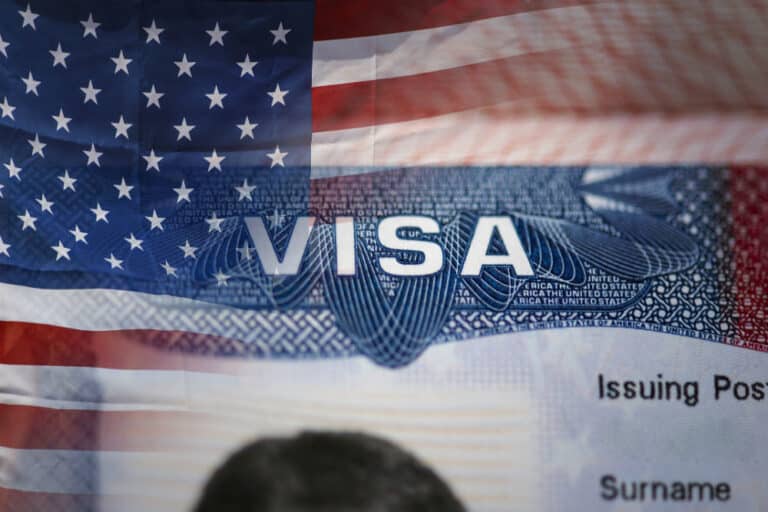
- A month after the PM of Bangladesh accused Washington DC of seeking to oust her government, the US Secretary of State announced a new visa policy supporting Bangladesh’s goal of holding free, fair and peaceful national elections.
- It could also have an impact on India’s diplomacy with Bangladesh.
What is the US’ New Visa Policy?
- The new policy, which covers current and former Bangladeshi officials, members of ruling and opposition parties, etc., would restrict issuance of visas to those who undermine the holding of a free and fair elections.
- In clarifications issued soon after the announcement, the US State Department said the actions were not targeted against the Awami League led government.





Ongoing Scenario in Bangladesh:
- Opposition is protesting and demanding that the elections be held under a caretaker government and by a “neutral” Election Commission.
- In her three terms in office, PM’s style of functioning has come to be seen as increasingly authoritarian.
- Her crackdown on former PM Khaleda Zia’s Bangladesh Nationalist Party (BNP), citing its links to Islamist parties and alleging corruption at the top, dealt a crippling blow to the Opposition.
- The space for dissent and criticism has shrunk visibly in Bangladesh. Hence, the Bangladesh opposition has welcomed the new policy.
Relations between US and Bangladesh:
- The US is the biggest destination for Bangladesh’s garment exports, and Bangladesh is the third largest exporter of garments to the US after China and Vietnam.
- As the industry is the backbone of the country’s economic growth, it is seeking a GSP-Plus status with the US and Europe for its readymade garment exports.
- The EU’s Generalised Scheme of Preferences Plus (GSP+) gives developing countries a special incentive to pursue sustainable development and good governance, in return for cuts in import duties.
- The US is the top foreign investor in Bangladesh. However, the mutual unhappiness in the US-Bangladesh relationship has been no secret for some years.
- For example, Sheikh Hasina’s recent visit to Washington to mark 50 years of diplomatic ties with the US, included no big-ticket meetings.
- The PM of Bangladesh even said in Parliament that the US was seeking regime change in Bangladesh.
- The US government, on the other hand, had conveyed its concern over democratic erosion, and also about the two previous elections in Bangladesh.
Implication of these Developments on India:
- The US position on the Bangladesh elections could complicate India’s diplomacy in Bangladesh.
- New Delhi, wants Sheikh Hasina – a leader who has acted on its security concerns swiftly, back in power in Dhaka
- She is seen as having given away too much – land transit rights to the Northeastern states, a favourable coal power deal to an Adani company, etc., while Bangladesh itself has been awaiting Teesta waters for many years.
- Over the last few years, the US and India were seen as acting in tandem in Bangladesh, especially as their security objectives converged.
- The visa policy is a sign that this may be changing. A post-Afghanistan US seems more open than India to political change in Dhaka.
- For now, India may prefer to keep silent on the linking of the US visa policy in Bangladesh to free and fair elections in the country.
Q1) Which is the first country to recognise Bangladesh as a separate and independent state?
India was the first country to recognise Bangladesh as a separate and independent state and established diplomatic relations with the country immediately after its independence in December 1971.
Q2) Which is the Generalised System of Preferences (GSP)?
GSP is a preferential tariff system (instituted in 1971 under the aegis of UNCTAD) which provides tariff reduction on various products. The concept of GSP is very different from the concept of “most favored nation” (MFN).

 Last updated on March, 2026
→ UPSC Final Result 2025 is now out.
→ UPSC has released UPSC Toppers List 2025 with the Civil Services final result on its official website.
→ Anuj Agnihotri secured AIR 1 in the UPSC Civil Services Examination 2025.
→ UPSC Marksheet 2025 is now out.
→ UPSC Notification 2026 & UPSC IFoS Notification 2026 is now out on the official website at upsconline.nic.in.
→ UPSC Calendar 2026 has been released.
→ Check out the latest UPSC Syllabus 2026 here.
→ UPSC Prelims 2026 will be conducted on 24th May, 2026 & UPSC Mains 2026 will be conducted on 21st August 2026.
→ The UPSC Selection Process is of 3 stages-Prelims, Mains and Interview.
→ Prepare effectively with Vajiram & Ravi’s UPSC Prelims Test Series 2026 featuring full-length mock tests, detailed solutions, and performance analysis.
→ Enroll in Vajiram & Ravi’s UPSC Mains Test Series 2026 for structured answer writing practice, expert evaluation, and exam-oriented feedback.
→ Join Vajiram & Ravi’s Best UPSC Mentorship Program for personalized guidance, strategy planning, and one-to-one support from experienced mentors.
→ Shakti Dubey secures AIR 1 in UPSC CSE Exam 2024.
→ Also check Best UPSC Coaching in India