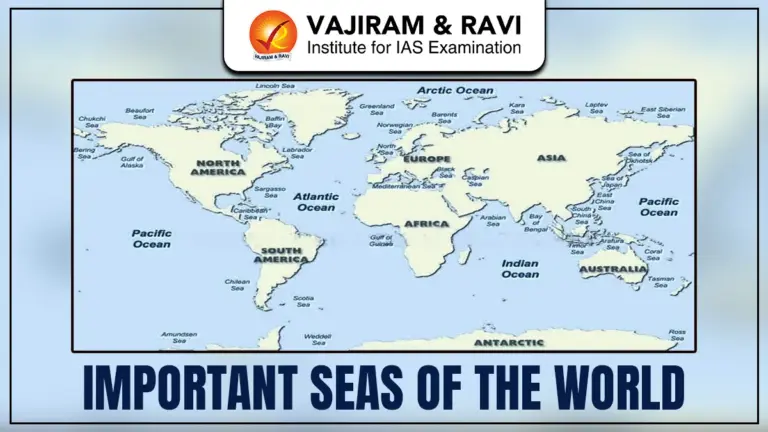
Important Seas of the World are vital components of the Earth. They regulate climate, sustain biodiversity, support trade and influence global geopolitics. From monsoon driven Arabian Sea to dispute prone South China Sea and resource rich Caspian Sea, each sea plays a distinct role. Increasing human pressure, climate change and geopolitical competition make the sustainable management of these seas critical for future global stability and environmental balance.
Important Seas of the World
A Sea is a part of the Ocean that is partly surrounded by land and connected to an ocean. Seas are generally shallower than oceans and are located where land meets water. In oceanography, many seas are classified as marginal seas because they are partially enclosed by islands, peninsulas, or archipelagos. Seas have major geographical, political and economic importance due to shipping routes, fisheries, mineral resources and climate influence. The map of Important Seas of the World is provided below.
Arabian Sea
The Arabian Sea lies in the northern Indian Ocean, bordered by India, Pakistan, Oman, Yemen and Somalia. It is strongly influenced by the monsoon winds.
- Geographical Location: The Arabian Sea connects the Indian subcontinent with the Middle East and Africa, bordered by the Gulf of Oman and Gulf of Aden.
- Monsoon Influence: Seasonal monsoon winds reverse ocean currents, influencing fisheries, navigation and nutrient upwelling.
- Trade Importance: It historically supported spice trade routes linking India with Arabia and East Africa.
- Strategic Chokepoints: Bab-el-Mandeb Strait connects it to the Red Sea and global shipping lanes.
- Marine Productivity: High plankton productivity supports tuna, sardine and mackerel fisheries.





South China Sea
The South China Sea is a marginal sea of the western Pacific Ocean and one of the busiest maritime regions globally.
- Strategic Location: It connects East Asia with the Indian Ocean via the Malacca Strait.
- Territorial Disputes: Multiple countries contest islands such as Spratly, Paracel and Scarborough Shoal.
- Trade Route: Nearly one-third of global maritime trade passes through this sea.
- Natural Resources: Contains potential oil, gas reserves and rich fishing grounds.
- Ecological Significance: Hosts coral reefs, mangroves and diverse marine biodiversity.
Bay of Bengal
The Bay of Bengal forms the northeastern part of the Indian Ocean. It is bordered by India, Bangladesh, Myanmar and Sri Lanka.
- River Inflow: Major rivers like Ganga, Brahmaputra and Irrawaddy discharge freshwater and sediments.
- Cyclone Formation: Warm waters make it one of the world’s most cyclone prone regions.
- Monsoon System: Plays a key role in South Asian monsoon rainfall patterns.
- Marine Ecosystem: Supports mangroves such as the Sundarbans and rich fisheries.
- Economic Importance: Vital for ports, energy exploration and regional trade.
Mediterranean Sea
The Mediterranean Sea is almost completely enclosed by Europe, Asia and Africa, connected to the Atlantic by the Strait of Gibraltar.
- Historical Role: Cradle of ancient civilizations including Roman, Greek and Egyptian societies.
- Salinity Levels: High evaporation rates increase salinity compared to open oceans.
- Climate Influence: Regulates Mediterranean climate with mild, wet winters and dry summers.
- Trade Network: Remains a major maritime route between Europe, Asia and Africa.
- Biodiversity Hotspot: Hosts endemic marine species and unique ecosystems.
Red Sea
The Red Sea is a seawater inlet of the Indian Ocean between Africa and the Arabian Peninsula.
- Tectonic Origin: Formed due to the Red Sea Rift, part of the Great Rift Valley.
- Salinity and Temperature: Among the warmest and saltiest seas globally.
- Coral Reefs: Contains some of the world’s most resilient coral reef systems.
- Shipping Route: Links the Indian Ocean to the Mediterranean via the Suez Canal.
- Bordering Nations: Bordered by Egypt, Saudi Arabia, Sudan, Eritrea, Yemen and Djibouti.
Black Sea
The Black Sea is an inland sea between Eastern Europe and Western Asia.
- Anoxic Layer: Deep waters lack oxygen, preventing decomposition of organic matter.
- River Inputs: Receives freshwater from Danube, Dnieper and Don rivers.
- Trade Route: Connects Europe to the Caucasus and Central Asia.
- Strategic Importance: Linked to the Mediterranean through the Bosporus Strait.
- Fisheries: Supports anchovy and other commercial fish species.
Caspian Sea
The Caspian Sea is the world’s largest enclosed inland body of water.
- Geographical Status: Considered both a sea and a lake due to enclosure.
- Energy Resources: Contains significant oil and natural gas reserves.
- Bordering Countries: Russia, Iran, Kazakhstan, Azerbaijan and Turkmenistan.
- Biodiversity: Home to sturgeon species producing most of the world’s caviar.
- Legal Disputes: Ongoing debates over maritime boundaries and resource rights.
Caribbean Sea
The Caribbean Sea lies southeast of the Gulf of Mexico and is part of the Atlantic Ocean.
- Island Chains: Bordered by Greater and Lesser Antilles.
- Tourism Hub: Known for clear waters, coral reefs and tropical climate.
- Marine Life: Rich in coral species and tropical fish.
- Shipping Importance: Connects Panama Canal to Atlantic routes.
- Hurricane Activity: Frequently affected by tropical cyclones.
North Sea
The North Sea lies between Great Britain and continental Europe.
- Energy Production: Major offshore oil and gas extraction zone.
- Wind Energy: Rapid expansion of offshore wind farms.
- Fishing Grounds: Important for cod, herring and haddock.
- Trade Routes: Connects major European ports.
- Environmental Concerns: Pollution and overfishing pressures.
Sargasso Sea
The Sargasso Sea is the only sea defined by ocean currents rather than land boundaries.
- Current Boundaries: Enclosed by North Atlantic Gyre currents.
- No Coastline: Unique among seas with no land borders.
- Sargassum Mats: Floating seaweed supports marine ecosystems.
- Spawning Ground: Critical for eel reproduction.
- Climate Role: Influences Atlantic weather systems.
Bering Sea
The Bering Sea lies between Alaska and Russia, connecting the Pacific and Arctic Oceans.
- Marine Biodiversity: Supports large populations of fish, seals and seabirds.
- Commercial Fisheries: Among the world’s most productive fishing zones.
- Bering Strait: Narrow passage linking Arctic and Pacific waters.
- Seasonal Ice: Extensive ice cover in winter.
- Climate Sensitivity: Rapid warming affects ecosystems.
Baltic Sea
The Baltic Sea is a shallow inland sea in Northern Europe, surrounded by Scandinavia and mainland Europe.
- Low Salinity: Limited connection with the Atlantic results in brackish water.
- Glacial Origin: Formed due to post glacial processes.
- Economic Role: Supports shipping, fisheries and offshore energy.
- Environmental Stress: Suffers from eutrophication and pollution.
- Bordering Nations: Sweden, Finland, Russia, Poland, Germany, Denmark.
Aegean Sea
The Aegean Sea lies between Greece and Turkey and is part of the Mediterranean region.
- Island Dominated: Contains thousands of islands and archipelagos.
- Historical Importance: Centre of ancient Greek civilization.
- Tectonic Activity: Region prone to earthquakes and volcanism.
- Maritime Disputes: Ongoing Greece – Turkey territorial issues.
- Tourism Hub: Important for cruise routes and coastal tourism.
Adriatic Sea
The Adriatic Sea separates the Italian Peninsula from the Balkan Peninsula.
- Elongated Shape: Narrow and long sea basin.
- Shallow Northern Part: Suitable for fishing and ports.
- Cultural History: Important during Roman and Venetian periods.
- Marine Biodiversity: Rich coastal ecosystems.
- Bordering Countries: Italy, Croatia, Montenegro, Albania.
Ionian Sea
The Ionian Sea is part of the Mediterranean Sea, south of the Adriatic Sea.
- Deep Waters: Contains some of the deepest parts of the Mediterranean.
- Seismic Zone: Lies in an active tectonic region.
- Navigation Route: Connects Eastern and Western Mediterranean.
- Fisheries: Supports tuna and sardine populations.
- Coastal Nations: Italy, Greece, Albania.
Sea of Japan (East Sea)
The Sea of Japan lies between Japan, Korea and Russia.
- Semi Enclosed Basin: Limited water exchange with the Pacific.
- Cold and Warm Currents: Interaction influences climate and fisheries.
- Economic Importance: Major fishing and shipping region.
- Political Sensitivity: Naming dispute between Japan and Korea.
- Seasonal Ice: Northern areas freeze in winter.
Sea of Okhotsk
The Sea of Okhotsk lies north of Japan in the northwest Pacific Ocean.
- Cold Sea: Experiences heavy seasonal ice cover.
- Rich Fisheries: Supports salmon and pollock fishing.
- River Input: Receives freshwater from the Amur River.
- Energy Potential: Offshore oil and gas reserves.
- Strategic Location: Important for Russian maritime access.
East China Sea
The East China Sea lies between China, Japan and Taiwan.
- Continental Shelf: Broad and shallow sea.
- Fishing Grounds: One of Asia’s richest marine zones.
- Territorial Disputes: Senkaku or Diaoyu Islands conflict.
- Trade Route: Key passage for East Asian shipping.
- River Sediments: Influenced by Yangtze River discharge.
Yellow Sea
The Yellow Sea is a marginal sea of the western Pacific Ocean.
- Sediment Rich: Yellow color due to river borne loess sediments.
- Shallow Basin: Average depth is low.
- Tidal Flats: Extensive mudflats along coastlines.
- Fishing Pressure: Overexploitation concerns.
- Bordering Regions: China and the Korean Peninsula.
Sea of Azov
The Sea of Azov is connected to the Black Sea by the Kerch Strait.
- Very Shallow: One of the shallowest seas in the world.
- High Freshwater Input: Fed by Don and Kuban rivers.
- Low Salinity: Due to river inflow.
- Strategic Importance: Regional shipping and fisheries.
- Bordering Countries: Russia and Ukraine.
Dead Sea
The Dead Sea is a salt lake bordered by Israel, Jordan and the West Bank.
- Extreme Salinity: Nearly ten times saltier than oceans.
- Lowest Elevation: Earth’s lowest land surface.
- No Outlet: Water leaves only through evaporation.
- Mineral Resources: Rich in potash and bromine.
- Environmental Decline: Rapid shrinking due to water diversion.
Timor Sea
The Timor Sea lies between Australia and Southeast Asia.
- Energy Resources: Major offshore oil and gas fields.
- Continental Shelf: Part of Australia’s northern margin.
- Maritime Boundaries: Subject to Australia – Timor-Leste agreements.
- Marine Biodiversity: Coral reefs and deep sea habitats.
- Trade Link: Connects Indian and Pacific Oceans.

 Last updated on March, 2026
→ UPSC Final Result 2025 is now out.
→ UPSC has released UPSC Toppers List 2025 with the Civil Services final result on its official website.
→ Anuj Agnihotri secured AIR 1 in the UPSC Civil Services Examination 2025.
→ UPSC Marksheet 2025 is now out.
→ UPSC Notification 2026 & UPSC IFoS Notification 2026 is now out on the official website at upsconline.nic.in.
→ UPSC Calendar 2026 has been released.
→ Check out the latest UPSC Syllabus 2026 here.
→ UPSC Prelims 2026 will be conducted on 24th May, 2026 & UPSC Mains 2026 will be conducted on 21st August 2026.
→ The UPSC Selection Process is of 3 stages-Prelims, Mains and Interview.
→ Prepare effectively with Vajiram & Ravi’s UPSC Prelims Test Series 2026 featuring full-length mock tests, detailed solutions, and performance analysis.
→ Enroll in Vajiram & Ravi’s UPSC Mains Test Series 2026 for structured answer writing practice, expert evaluation, and exam-oriented feedback.
→ Join Vajiram & Ravi’s Best UPSC Mentorship Program for personalized guidance, strategy planning, and one-to-one support from experienced mentors.
→ Shakti Dubey secures AIR 1 in UPSC CSE Exam 2024.
→ Also check Best UPSC Coaching in India
Important Seas of the world FAQs
Q1. Why are Seas important for global trade?+
Q2. How are Seas different from Oceans?+
Q3. Which Sea has no coastline?+
Q4. Which Sea is the saltiest?+
Q5. Which Sea is most affected by geopolitical disputes?+
Tags: important seas of the world