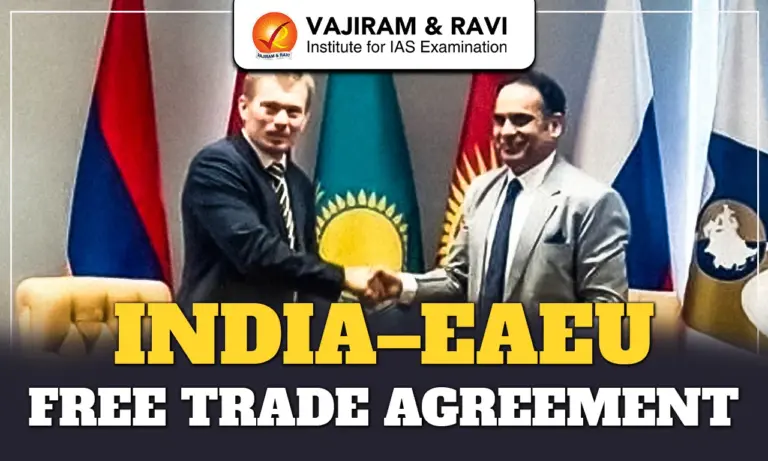
India and the Eurasian Economic Union (EAEU) FTA talks gained momentum after President Vladimir Putin’s State Visit to India on 4-5 December 2025. During the 23rd India-Russia Summit, both sides pushed for accelerating the India-EAEU Free Trade Agreement as part of their new 2030 Economic Roadmap.
What is the Eurasian Economic Union (EAEU)?
The EAEU is a regional economic union created to promote economic integration among member countries. It ensures free movement of goods, services, capital, and labour, and supports coordinated economic policies for stable development.
- Established: 2015 (via the Treaty on the Eurasian Economic Union)
- Members: Armenia, Belarus, Kazakhstan, Kyrgyzstan, Russia
- Headquarters: Moscow, Russia
- Aim: Strengthen economic cooperation, modernize economies, raise competitiveness, and improve living standards.
Also Read: RELOS Agreement
India-EAEU Free Trade Agreement Significance
- Big Market Access: The FTA will open access to a USD 6.5 trillion Eurasian market, helping India increase exports in pharmaceuticals, engineering goods, textiles, and agriculture.
- Reduced Dependence on the West: India-EAEU trade touched USD 69 billion in 2024, growing 7% from 2023. This helps India diversify away from the US and EU amid rising tariff pressures.
- Stronger Energy Security: Russia already supplies 35-40% of India’s crude oil imports. An FTA can ensure stable and long-term access to oil, gas, coal, and other minerals at competitive prices.
- Lower Costs for Indian Businesses: Removing or reducing tariffs across EAEU countries can make Indian MSME exports cheaper and more competitive, especially in textiles, pharma, and machine parts.
- Boost to Connectivity: The FTA will support major trade routes like the International North-South Transport Corridor (INSTC), which can reduce transit time between India and Russia from 40 days to nearly 20 days.





India-EAEU Free Trade Agreement Challenges
- Complex Tariff Structures: India and EAEU (Russia, Belarus, Kazakhstan, Armenia & Kyrgyzstan) have very different tariff regimes; harmonizing these across 5 countries slows negotiations.
- Sanctions on Russia: Over 14,000+ Western sanctions on Russia complicate payment systems, logistics, and compliance for Indian companies.
- Trade Imbalance: India’s trade with EAEU is about $16-17 billion, and over 85% is dominated by Russia, creating dependency and imbalance.
- Connectivity Barriers: INSTC and Chabahar routes are still not fully operational; cargo movement takes 35-45 days, increasing cost and reducing competitiveness.
- Regulatory & Standards Issues: India and EAEU follow different standards for pharma, engineering goods, and food products, requiring alignment before tariff cuts.
- Limited Market Awareness: Indian exporters have low awareness of EAEU demand patterns; only 3-4% of India’s global exports currently go to this region, limiting immediate gains.
How India-EAEU Engagement Can Be Strengthened
- India and EAEU should quickly implement the 2025-2030 economic cooperation plan to boost trade and investment.
- India should increase exports like medicines, textiles, machinery, and food products to reduce its trade gap.
- Both sides should expand local currency trade to reduce dependence on the US dollar and avoid payment problems.
- Strengthen ties through groups like BRICS and SCO to improve coordination and build wider economic links.
- Improve transport routes such as INSTC and the Chennai-Vladivostok Corridor to make trade faster and cheaper.
- Reduce customs delays and strict standards by simplifying rules and recognizing each other’s certificates for smoother trade.

 Last updated on April, 2026
→ UPSC Final Result 2025 is now out.
→ UPSC has released UPSC Toppers List 2025 with the Civil Services final result on its official website.
→ Anuj Agnihotri secured AIR 1 in the UPSC Civil Services Examination 2025.
→ UPSC Marksheet 2025 is now out.
→ UPSC Notification 2026 & UPSC IFoS Notification 2026 is now out on the official website at upsconline.nic.in.
→ UPSC Calendar 2026 has been released.
→ Check out the latest UPSC Syllabus 2026 here.
→ UPSC Prelims 2026 will be conducted on 24th May, 2026 & UPSC Mains 2026 will be conducted on 21st August 2026.
→ The UPSC Selection Process is of 3 stages-Prelims, Mains and Interview.
→ Prepare effectively with Vajiram & Ravi’s UPSC Prelims Test Series 2026 featuring full-length mock tests, detailed solutions, and performance analysis.
→ Enroll in Vajiram & Ravi’s UPSC Mains Test Series 2026 for structured answer writing practice, expert evaluation, and exam-oriented feedback.
→ Join Vajiram & Ravi’s Best UPSC Mentorship Program for personalized guidance, strategy planning, and one-to-one support from experienced mentors.
→ Shakti Dubey secures AIR 1 in UPSC CSE Exam 2024.
→ Also check Best UPSC Coaching in India
India-EAEU Free Trade Agreement FAQs
Q1. What is the India–EAEU Free Trade Agreement (FTA)?+
Q2. Which countries are part of the Eurasian Economic Union (EAEU)?+
Q3. Why is the India–EAEU FTA important?+
Q4. What connectivity projects support India–EAEU trade?+
Q5. How can the FTA boost India’s energy security?+
Tags: india eaeu free trade agreement