Defence Framework Latest News
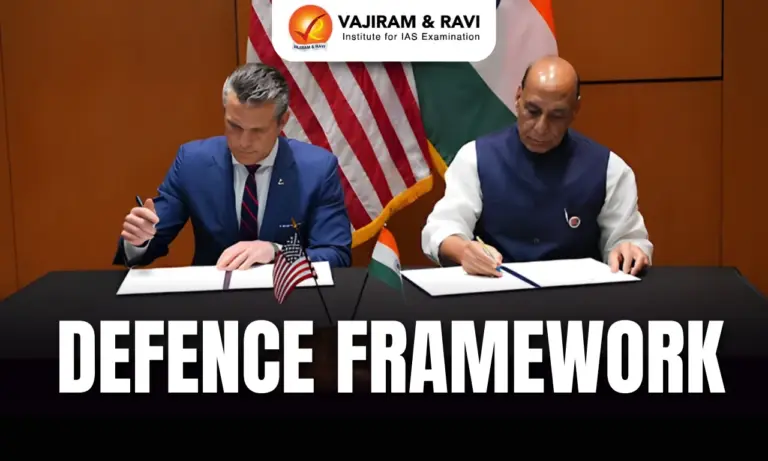
- India and the United States have entered a new phase in their strategic and defence partnership with the signing of a 10-year “Framework for the India-U.S. Major Defence Partnership”.
- The agreement was formalised on the sidelines of the 12th ASEAN Defence Ministers’ Meeting-Plus (ADMM-Plus) in Kuala Lumpur.
Background of India-U.S. Defence Cooperation
- Defence cooperation between India and the U.S. has been one of the strongest pillars of their bilateral relationship, evolving steadily over the past two decades.
- The partnership began taking concrete shape with the 2005 Defence Framework Agreement, renewed in 2015, which emphasised joint military exercises, maritime security, and defence trade.
- Since then, both countries have established foundational agreements to enhance interoperability and information sharing:
- LEMOA (2016): Enabled reciprocal access to military facilities for logistics support.
- COMCASA (2018): Facilitated secure communications between the two militaries.
- BECA (2020): Enabled the exchange of geospatial intelligence and mapping data.
- SOSA (2024): Ensured the security of supply chains in critical defence materials.
- The signing of the 2025 Framework extends this cooperation into the next decade, institutionalising long-term collaboration in defence manufacturing, joint technology development, and strategic coordination in the Indo-Pacific.





Highlights of the 10-Year Defence Framework
- The newly signed framework outlines an ambitious roadmap for comprehensive defence collaboration between India and the United States. Key highlights include:
- Unified Policy Direction: The framework provides a structured policy roadmap to enhance collaboration across military, industrial, and technological domains.
- Technology and Industrial Cooperation: Both sides have agreed to expand cooperation in co-production and co-development of advanced defence systems, with an emphasis on indigenous manufacturing in India under the “Make in India, Make for the World” initiative.
- Information and Intelligence Sharing: Strengthening intelligence exchange and coordination mechanisms to counter emerging security threats, including cyber and maritime challenges.
- Joint Military Exercises: Continuation and expansion of regular bilateral and multilateral exercises such as Yudh Abhyas, Malabar, and Tiger Triumph.
- Regional Security Commitment: Reinforcing a joint vision for a free, open, and rules-based Indo-Pacific, with deterrence against coercive activities in the region.
Significance of the Defence Partnership
- The new defence framework comes at a crucial juncture in global geopolitics.
- The Indo-Pacific has become the epicentre of strategic competition, with China’s assertive posturing and growing influence prompting deeper security cooperation among like-minded nations. The framework thus serves multiple strategic purposes:
- Enhancing Regional Stability: Reinforces India’s position as a net security provider in the Indo-Pacific.
- Boosting Defence Technology Transfer: Encourages U.S. firms to invest and collaborate in India’s defence production ecosystem, particularly under the Initiative on Critical and Emerging Technology (iCET).
- Mitigating Supply Chain Risks: Reduces dependence on singular sources of defence imports by diversifying technology and production partnerships.
- Countering Trade Tensions: Despite Washington’s imposition of 50% tariffs on Indian goods, both countries have demonstrated that strategic and defence cooperation remain insulated from trade-related friction.
The Indo-Pacific and Strategic Convergence
- The 10-year defence roadmap aligns closely with the shared vision of maintaining peace, freedom of navigation, and sovereignty in the Indo-Pacific region.
- Both nations, along with partners in the Quad (India, U.S., Japan, and Australia), aim to ensure that the region remains free from coercive dominance.
- By integrating India more deeply into global defence supply chains and security dialogues, the framework enhances New Delhi’s strategic leverage while contributing to the U.S. vision of integrated deterrence in Asia.

 Last updated on March, 2026
→ UPSC Final Result 2025 is now out.
→ UPSC has released UPSC Toppers List 2025 with the Civil Services final result on its official website.
→ Anuj Agnihotri secured AIR 1 in the UPSC Civil Services Examination 2025.
→ UPSC Marksheet 2025 is now out.
→ UPSC Notification 2026 & UPSC IFoS Notification 2026 is now out on the official website at upsconline.nic.in.
→ UPSC Calendar 2026 has been released.
→ Check out the latest UPSC Syllabus 2026 here.
→ UPSC Prelims 2026 will be conducted on 24th May, 2026 & UPSC Mains 2026 will be conducted on 21st August 2026.
→ The UPSC Selection Process is of 3 stages-Prelims, Mains and Interview.
→ Prepare effectively with Vajiram & Ravi’s UPSC Prelims Test Series 2026 featuring full-length mock tests, detailed solutions, and performance analysis.
→ Enroll in Vajiram & Ravi’s UPSC Mains Test Series 2026 for structured answer writing practice, expert evaluation, and exam-oriented feedback.
→ Join Vajiram & Ravi’s Best UPSC Mentorship Program for personalized guidance, strategy planning, and one-to-one support from experienced mentors.
→ Shakti Dubey secures AIR 1 in UPSC CSE Exam 2024.
→ Also check Best UPSC Coaching in India
Defence Framework FAQs
Q1. What is the new India-U.S. Defence Framework about?+
Q2. Where was the 10-year Defence Framework signed?+
Q3. What are the key focus areas of the framework?+
Q4. How does the framework impact India’s defence industry?+
Q5. How does this framework strengthen the Indo-Pacific strategy?+
Tags: defence framework mains articles upsc current affairs upsc mains current affairs