Key Facts about Indian Mouse Deer
- The Indian Mouse Deer or Spotted Chevrotain is the smallest deer in India and is highly nocturnal.
- Scientific Name: Moschiola indica
- Distribution:
- It is endemic to the Indian Subcontinent.
- It is mainly found in peninsular India, with some old records from Nepal.
- Sri Lanka has a separate species called the spotted chevrotain (Moschiola meminna).
- Within India, it is commonly encountered in a number of forest areas along the Western Ghats, in the Eastern Ghats up to Orissa, and in the forests of central India.
- Features:
- It is small, 25-30 cm at shoulder height, and weighs from two to four kg.
- The fur color of the Indian spotted chevrotain is dark brown with white underparts.
- There are four or five light rows of white spots on the back. Males of this species have tusk-like upper canines.
- A unique feature of this group is that instead of a four-chambered stomach like in other ruminants, they have a three-chambered stomach.
- It forages on the forest floor for fruits, roots, leaves, and herbs.
- It has occasionally been observed eating insects, crustaceans, and even small mammals.
- Conservation Status:
- IUCN: Least Concern
Key Facts about Chousingha
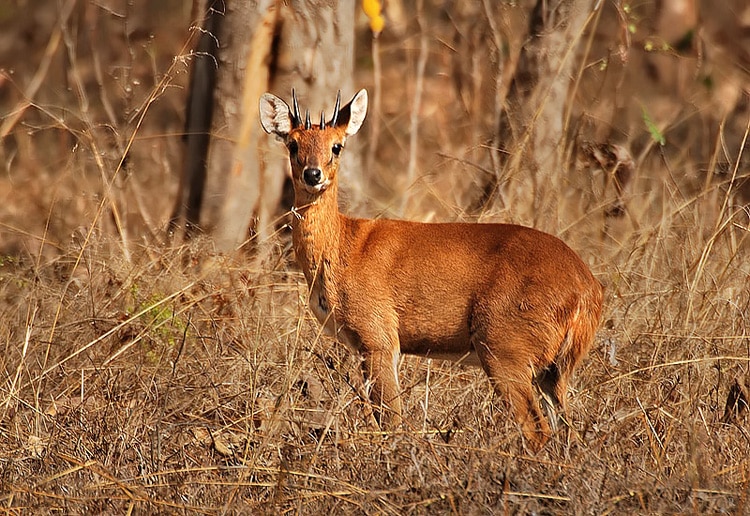
- The four-horned antelope, or chousingha, is a small antelope found in India and Nepal.
- Scientific Name: Tetracerus quadricornis
- Distribution:
- It is endemic to the Indian subcontinent.
- They are found in woodland areas throughout India.
- Features:
- They are the smallest antelopes found in Asia.
- As the name suggests, Chousingha can be identified by the four horns, as against other bovids, which have two horns.
- They are usually diurnal and solitary by nature; however they can be spotted in loose groups of three to four.
- Animals are sedentary, inhabiting more-or-less the same region throughout their lives.
- They have a yellowish-brown to reddish coat and are slender, with small legs and a short tail.
- Conservation Status:
- IUCN Red List: Vulnerable
Q1) What are crustaceans?
Crustaceans are invertebrates with a hard exoskeleton (carapace), a segmented body that is bilaterally symmetrical, more than four pairs of jointed appendages (“legs”) and an open circulatory system (the “blood” does not flow in a closed loop). Crustaceans make up a very large group of the Arthropods which include the crabs, lobsters, crayfish, shrimp, krill etc. Crustaceans are found in a wide range of habitats – most are free-living freshwater or marine animals, but some are terrestrial (e.g. woodlice), some are parasitic (e.g. fish lice) and some do not move (e.g. barnacles).
Source: Visakhapatnam zoo gets new species from Warangal zoo as part of animal exchange programme


 Last updated on Oct, 2026
→ UPSC 2027 Notification will be released on 13 January 2027 at upsconline.nic.in.
→ Check Nobel Prize 2026 Winners List here.
→ Download PIB PRiSM Monthly Magazine 2026 here.
→ Check UPSC Monthly Current Affairs Magazine The Recitals here.
→ Check out the latest UPSC Syllabus here.
→ Download UPSC Model Answers for Mains 2026
→ UPSC Mains Question Paper 2026 is out now for Essay & GS Paper 1, 2, 3 & 4.
→ UPSC Calendar 2027 has been released.
→ Enroll in Vajiram & Ravi’s UPSC Mains Test Series 2027 for structured answer writing practice, expert evaluation, and exam-oriented feedback.
→ Join Vajiram & Ravi’s UPSC Mentorship Program 2027 for personalized guidance, strategy planning, and one-to-one support from experienced mentors.
→ Go through the UPSC Mains Previous Year Papers to enhance your preparation.
→ UPSC has released UPSC Toppers List 2025 with the Civil Services final result on its official website.
→ Also check Best UPSC Coaching in India