E-Waste Recycling Latest News
- While the Union government promotes local electronics manufacturing through initiatives like semiconductor fabs and the Electronics Component Manufacturing Scheme, e-waste recycling remains a weak link.
- Millions of tonnes of discarded consumer electronics and appliances have piled up in recent years.
- Policymakers see recycling as crucial to extract scarce and valuable metals, especially as electronics consumption is projected to surge in the coming years.
E-Waste
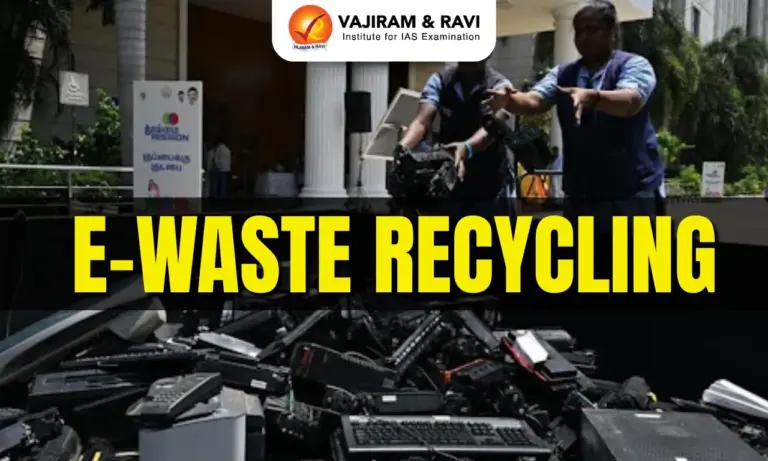
- E-waste refers to discarded electronic devices such as smartphones, laptops, TVs, fridges, and chargers.
- While these often contain valuable materials, they are usually dumped instead of being reused or recycled.
Need for Effective e-Waste Management
- Health Risks – E-waste contains toxic substances like lead, mercury, and cadmium. Improper handling leads to contamination of soil and water, causing neurological disorders, kidney failure, and long-term chronic diseases.
- Environmental Damage – Hazardous recycling practices pollute air, soil, and water. They also release greenhouse gases, worsening climate change and harming ecosystems.
- Economic Loss – Inefficient recycling causes wastage of valuable resources such as gold, silver, and copper, which could otherwise be recovered and reused in production.
Link with Environmental, Gocial, and Governance (ESG) and SDGs
- E-waste management aligns with global sustainability frameworks:
- SDG 12: Responsible Consumption and Production.
- SDG 13: Climate Action.
- It strengthens India’s ESG commitments by integrating resource efficiency and environmental protection into growth.





Electronics Consumption and Indigenous Push
- India, despite having over 93.9 crore mobile broadband connections, accounts for only 4% of global electronics consumption.
- Fragile global supply chains have pushed the government to expand domestic manufacturing and raw material access, including a ₹1,500 crore mineral recycling scheme announced in September.
E-Waste Volumes and Processing
- According to the Global E-Waste Monitor 2020, India is the world’s third-largest e-waste generator after China and the USA.
- With India being one of the fastest-growing electronics markets, this trend is expected to rise further.
- As per one report, India’s electronics industry to grow at a CAGR of 16.6%, from USD 215 billion in FY19 to USD 540 billion by FY25.
- This rapid expansion will add significantly to e-waste volumes.
- India generated an estimated 4.17 million metric tonnes of e-waste in 2022, but only one-third was processed through proper channels.
Legal Framework for E-Waste Management
- Improper disposal of end-of-life EEE products has severe negative externalities, including risks to human health and environmental degradation. Effective management is essential to mitigate these harms.
- E-waste in India is regulated by the E-Waste (Management) Rules, 2022, published by the Ministry of Environment, Forest and Climate Change (MoEFCC). These rules came into force on April 1, 2023.
- State Pollution Control Boards, responsible for inventorying, use inconsistent methods, causing discrepancies between Indian and international data.
- The Central Pollution Control Board has begun auditing recyclers, with over 50 firms checked in recent months.
- Companies are working to aggregate informal operations into formal “mandi”-style streams, recovering metals such as gold, copper, aluminium, and steel.
Extended Producer Responsibility (EPR) Framework and Associated Concerns
- The government has introduced EPR rules requiring manufacturers to collect end-of-life appliances for recycling metals like copper, aluminium, nickel, cobalt, and lithium.
- This move is partly driven by geopolitical risks, such as China’s export restrictions on rare earth elements.
Dominance of Informal Sector
- A 2023 Indian Cellular and Electronics Association report flagged the dominance of the informal sector in India’s recycling ecosystem.
- These operators focus on repairing and harvesting components, but remain outside formal frameworks, hindering the creation of a circular economy.
- Even within EPR, issues like “paper trading” persist, with recyclers overstating volumes for financial incentives.
Concerns on Traceability and Best Practices
- Experts stress that malpractices plague the sector, with many players lacking true metal extraction capacity.
- They highlighted the need for third-party audits, better environmental safeguards, and life-cycle visibility of products.
- Inventorying remains weak in India, unlike Western countries that count products as potential e-waste from the point of sale.
Future Potential
- While the share of recycled precious metals in India’s supply chains remains negligible, industry leaders argue that with the right policy push, India could meet up to 70% of its rare earth requirements within 18 months.
- Recycling’s impact is growing each year, highlighting its potential as a key pillar in India’s electronics ecosystem.

 Last updated on March, 2026
→ UPSC Final Result 2025 is now out.
→ UPSC has released UPSC Toppers List 2025 with the Civil Services final result on its official website.
→ Anuj Agnihotri secured AIR 1 in the UPSC Civil Services Examination 2025.
→ UPSC Marksheet 2025 is now out.
→ UPSC Notification 2026 & UPSC IFoS Notification 2026 is now out on the official website at upsconline.nic.in.
→ UPSC Calendar 2026 has been released.
→ Check out the latest UPSC Syllabus 2026 here.
→ UPSC Prelims 2026 will be conducted on 24th May, 2026 & UPSC Mains 2026 will be conducted on 21st August 2026.
→ The UPSC Selection Process is of 3 stages-Prelims, Mains and Interview.
→ Prepare effectively with Vajiram & Ravi’s UPSC Prelims Test Series 2026 featuring full-length mock tests, detailed solutions, and performance analysis.
→ Enroll in Vajiram & Ravi’s UPSC Mains Test Series 2026 for structured answer writing practice, expert evaluation, and exam-oriented feedback.
→ Join Vajiram & Ravi’s Best UPSC Mentorship Program for personalized guidance, strategy planning, and one-to-one support from experienced mentors.
→ Shakti Dubey secures AIR 1 in UPSC CSE Exam 2024.
→ Also check Best UPSC Coaching in India
E-Waste Recycling FAQs
Q1. What is e-waste recycling in India?+
Q2. Why is e-waste recycling important in India?+
Q3. What are India’s e-waste rules?+
Q4. What challenges exist in e-waste recycling?+
Q5. What is the future of e-waste recycling in India?+
Tags: e-waste recycling mains articles upsc current affairs upsc mains current affairs