What’s in Today’s Article?
- Shipping Emissions Latest News
- Introduction
- The Evolution of the Emissions Framework
- The Geopolitical Dynamics
- Significance of Green Transition in Shipping
- India’s Strategic Advantages
- Conclusion
- Global Shipping Emissions FAQs
Shipping Emissions Latest News
- Recently, the 83rd session of the International Maritime Organization’s Marine Environment Protection Committee, at IMO Headquarters in London.





Introduction
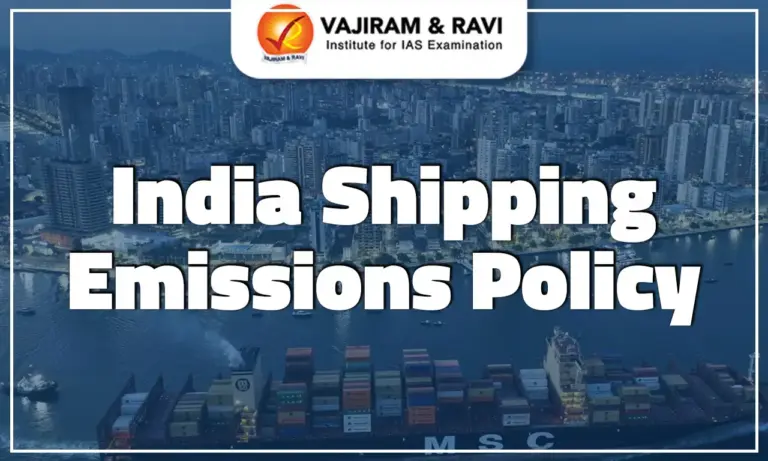
- In a landmark move towards tackling climate change, the International Maritime Organization (IMO) has moved closer to implementing a Market-Based Measure (MBM) framework for reducing global shipping emissions.
- This comes after a decade of intense negotiations. India, alongside Singapore, played a crucial role in formulating a consensus-driven solution during the IMO’s 83rd Marine Environment Protection Committee (MEPC-83) session.
- This initiative marks a significant step in regulating emissions from the global shipping sector, which accounts for nearly 2.8% of worldwide greenhouse gas (GHG) emissions, making it the sixth-largest emitter if treated as a nation.
The Evolution of the Emissions Framework
- At the MEPC-83 session, five proposals were presented:
- International Chamber of Shipping: Proposed a fixed levy per tonne of CO₂ emitted.
- China: Advocated for a market-driven approach allowing ships to trade compliance units.
- European Union: Suggested a fixed GHG levy managed by an IMO-administered fund.
- India: Proposed a ‘bridging mechanism’ that penalizes under-compliant ships and rewards those using Zero or Near-Zero (ZNZ) fuels.
- Singapore: Built upon India’s model, suggesting a GHG Fuel Standard (GFS) with tiered incentives.
- Ultimately, Singapore’s hybrid model, inspired by India’s proposal, was approved with a 63-16 vote.
- However, the decision is pending final ratification under the MARPOL convention’s Annex VI amendment process.
The Geopolitical Dynamics
- The discussions saw sharp divides:
- Oil Exporting Nations (Saudi Arabia and Others): Opposed significant reforms to protect fossil fuel markets.
- Small Island Nations and Least Developed Countries: Demanded steep carbon levies to fund green development.
- China and Other Major Shipping Nations: Favoured minimal levies to remain competitive.
- Scandinavian Countries: Advocated for rewards for their early investments in decarbonization.
- Brazil: Pushed for methanol as a primary marine fuel.
- Despite these differences, the adoption of the MBM framework has set a powerful precedent, even though scepticism remains among shipowners, especially in Greece.
Significance of Green Transition in Shipping
- Though often invisible to consumers, the shipping industry is a major contributor to global emissions. Without immediate reforms, emissions from this sector could rise by 50% to 250% by 2050.
- To align with the UN’s Sustainable Development Goals and the Paris Agreement, the IMO introduced several measures:
- Energy Efficiency Design Index (EEDI)
- Ship Energy Efficiency Management Plan (SEEMP)
- Mandatory Fuel Oil Consumption Reporting
- By 2030, the IMO targets a 40% reduction in carbon intensity compared to 2008 levels, aiming for net-zero emissions by 2050.
India’s Strategic Advantages
- While the new emission levies may increase India’s maritime logistics costs marginally (up to 7.29% on imports and 8.09% on exports by 2030), the long-term benefits outweigh the short-term challenges.
- Key opportunities for India:
- India’s coastal fleet remains unaffected as the MBMs apply only to international shipping.
- India spends about $400 million annually on fuel for its international fleet, projected to rise by just $108 million by 2030 under the MBM, manageable considering the economy’s scale.
- India is poised to become a global leader in green hydrogen exports through its National Hydrogen Mission. Companies like Reliance, Adani, and JSW are heavily investing in this sector.
- The IMO’s framework aligns perfectly with India’s clean fuel targets. Indian green hydrogen meets IMO’s emission standards, opening lucrative markets for export.
Conclusion
- The adoption of the MBM framework marks a transformative moment for the shipping industry.
- It not only addresses a critical sector in the global fight against climate change but also opens up vast economic opportunities for India in green energy exports.
- If fully implemented, this could make global shipping the first truly regulated sector under binding climate goals, setting an example for others to follow.
Global Shipping Emissions FAQs
Q1. What is the Market-Based Measure (MBM) framework?
Ans. It is a new global policy to reduce shipping emissions through financial penalties and rewards, promoting the use of clean fuels.
Q2. How did India contribute to the IMO’s new emissions policy?
Ans. India proposed a balanced emissions framework that influenced the final hybrid model adopted by the IMO.
Q3. How will the new framework impact India’s economy?
Ans. It will have a modest short-term cost impact but offer significant long-term benefits through green fuel exports.
Q4. What is India doing to leverage this opportunity?
Ans. India is heavily investing in green hydrogen production and aims to become a global hub for clean energy exports.
Q5. Why is the shipping industry crucial for climate action?
Ans. Shipping contributes nearly 2.8% of global emissions; without reforms, these emissions could increase by 250% by 2050.
Source: TH

 Last updated on March, 2026
→ UPSC Final Result 2025 is now out.
→ UPSC has released UPSC Toppers List 2025 with the Civil Services final result on its official website.
→ Anuj Agnihotri secured AIR 1 in the UPSC Civil Services Examination 2025.
→ UPSC Marksheet 2025 is now out.
→ UPSC Notification 2026 & UPSC IFoS Notification 2026 is now out on the official website at upsconline.nic.in.
→ UPSC Calendar 2026 has been released.
→ Check out the latest UPSC Syllabus 2026 here.
→ UPSC Prelims 2026 will be conducted on 24th May, 2026 & UPSC Mains 2026 will be conducted on 21st August 2026.
→ The UPSC Selection Process is of 3 stages-Prelims, Mains and Interview.
→ Prepare effectively with Vajiram & Ravi’s UPSC Prelims Test Series 2026 featuring full-length mock tests, detailed solutions, and performance analysis.
→ Enroll in Vajiram & Ravi’s UPSC Mains Test Series 2026 for structured answer writing practice, expert evaluation, and exam-oriented feedback.
→ Join Vajiram & Ravi’s Best UPSC Mentorship Program for personalized guidance, strategy planning, and one-to-one support from experienced mentors.
→ Shakti Dubey secures AIR 1 in UPSC CSE Exam 2024.
→ Also check Best UPSC Coaching in India