India’s Water-Energy-Food Nexus Latest News
- The World Bank (WB) report “Nourish and Flourish” highlights a global misalignment between food systems and hydrological realities.
- Simultaneously, the International Energy Agency (IEA) report “Sheltering from Oil Shocks” (2026) warns of energy disruptions cascading into food and water crises.
- For India, striving for high economic growth and food security for 1.4 billion nexus presents an immediate structural challenge.
The Core Problem
- Mismanagement, not absolute scarcity:
- Agricultural water systems can sustainably support only about 1/3rd of the global population by 2050 if inefficiencies persist.
- India exemplifies the paradox –
- A water-stressed food exporter
- Produces water-intensive crops (rice, sugarcane) in depleted regions
- This leads to export of “virtual water”, worsening domestic water stress.
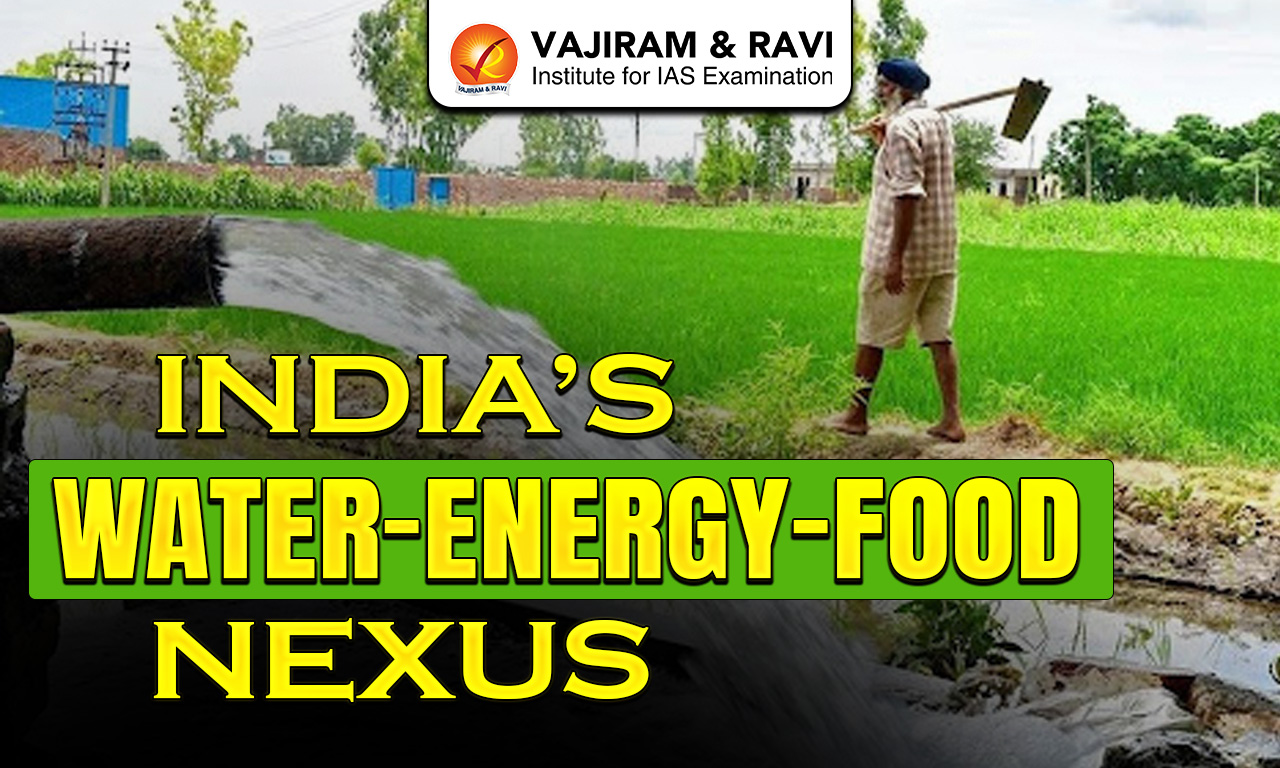
- Regional hotspots of groundwater crisis – Punjab–Haryana model:
- Groundwater depletion exceeding 1 metre/year, driven by free or subsidised or solar electricity for irrigation, which leads to near-zero marginal cost energy, resulting in over-extraction.
- This drives nexus failure, for example, energy policy (free power) distorting water usage and agricultural incentives (MSP, procurement) reinforcing unsustainable cropping patterns.


Worsening Energy-Water-Food Interlinkages
- Energy shocks and agriculture:
- Food security is deeply dependent on energy stability.
- For example, modern economies like India remain deeply vulnerable to energy disruptions, because it imports nearly 85–90% of its crude oil.
- Oil shocks increase diesel prices, and irrigation and transport costs. Power shortages disrupt agricultural operations.
- IEA’s insight: Demand-side measures (remote work, reduced transport) indirectly stabilize energy systems, and reduce inflationary pressures on food systems.
- Fiscal and policy distortions:
- India spends ₹1.5 lakh crore annually on electricity subsidies for agriculture. Yet, a significant share of this expenditure perpetuates inefficiency.
- Globally, out of approximately ₹55 lakh crore spent on agriculture in 2023, only about ₹2.2 lakh crore was directed toward irrigation infrastructure.
- Also, rising oil prices during global shocks place additional pressure on India’s import bill, fiscal deficit, and inflation.
- The linkage is clear: inefficient water use amplifies energy vulnerability and energy shocks exacerbate food insecurity.
- Climate change as a risk multiplier:
- Erratic monsoons, droughts, and extreme rainfall disrupt agricultural cycles.
- Combined with oil shock—triggering higher fuel costs and supply disruptions—can compound existing vulnerabilities.
Key Challenges
- Structural: Fragmented governance (water, energy, agriculture in silos), and distorted price signals (free electricity).
- Economic: High subsidy burden, rising import bill and inflation during oil shocks.
- Environmental: Groundwater depletion and unsustainable cropping patterns.
- Technological and institutional: Lack of water accounting systems, and weak integration of renewable energy with regulation.
Way Forward – Integrated Nexus Approach
- Crop diversification:
- Shifting away from water-intensive crops in stressed regions is simultaneously a water strategy, an energy-saving measure, and a hedge against fuel price shocks.
- It must move from pilot schemes to mainstream agricultural policy.
- Energy-water pricing reform:
- Transitioning from blanket electricity subsidies to targeted Direct Benefit Transfers (DBT) combined with smart metering would restore rational economic signals while protecting small farmers.
- This aligns with both WB efficiency principles and IEA demand-side management logic.
- Precision irrigation and solar-powered systems: Promote drip or sprinkler systems, scale up schemes like PM-KUSUM. Add smart controls, and water-use regulation to prevent overuse.
- Urban energy demand management:
- Promoting public transport, remote work, and efficient logistics.
- This will reduce oil dependence, stabilise energy systems, and indirectly eases inflationary pressure on food supply chains — connecting urban policy to rural resilience.
- Nexus-based institutional framework: A dedicated institutional architecture integrating the Ministries of Agriculture, Jal Shakti, and Power — with unified data systems and joint planning processes — is the structural prerequisite for everything else.
Conclusion
- India’s challenge is not merely about water scarcity or energy dependence, but about managing their deep interdependence.
- Therefore, a nexus-based approach is essential to ensure sustainable agriculture, energy security, and long-term economic resilience.
- Without transitioning from sectoral policymaking to systems approach (aligning incentives, reforming subsidies, and leveraging technology), India cannot build a robust and future-ready development model.
Source: TH

 Last updated on Oct, 2026
→ UPSC 2027 Notification will be released on 13 January 2027 at upsconline.nic.in.
→ Check Nobel Prize 2026 Winners List here.
→ Download PIB PRiSM Monthly Magazine 2026 here.
→ Check UPSC Monthly Current Affairs Magazine The Recitals here.
→ Check out the latest UPSC Syllabus here.
→ Download UPSC Model Answers for Mains 2026
→ UPSC Mains Question Paper 2026 is out now for Essay & GS Paper 1, 2, 3 & 4.
→ UPSC Calendar 2027 has been released.
→ Enroll in Vajiram & Ravi’s UPSC Mains Test Series 2027 for structured answer writing practice, expert evaluation, and exam-oriented feedback.
→ Join Vajiram & Ravi’s UPSC Mentorship Program 2027 for personalized guidance, strategy planning, and one-to-one support from experienced mentors.
→ Go through the UPSC Mains Previous Year Papers to enhance your preparation.
→ UPSC has released UPSC Toppers List 2025 with the Civil Services final result on its official website.
→ Also check Best UPSC Coaching in India
India’s Water-Energy-Food Nexus FAQs
Q1. What is the concept of the Water–Energy–Food Nexus?+
Q2. Why is India described as a “water-stressed food exporter”?+
Q3. How energy shocks can impact food security in India?+
Q4. What is the role of electricity subsidies in India’s groundwater crisis?+
Q5. What policy measures are required to address the water–energy–food nexus?+
Tags: india’s water-energy-food nexus mains articles upsc current affairs upsc mains current affairs