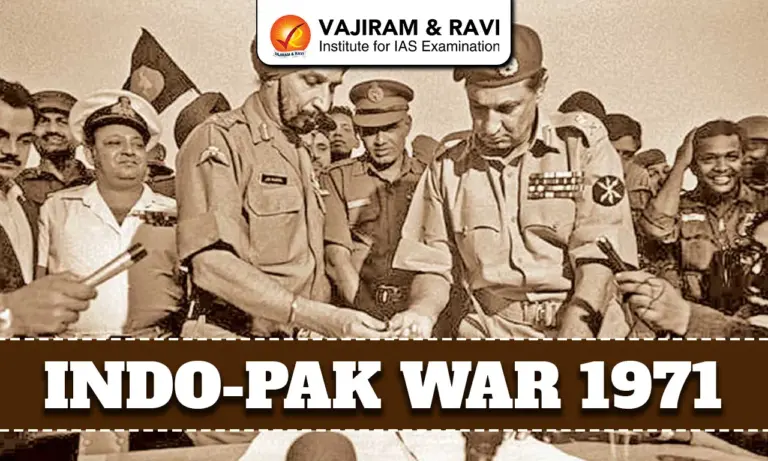
The Indo-Pak War 1971 was the third major conflict between India and Pakistan after independence, but unlike the wars of 1947-48 and 1965, it was not primarily about Kashmir. It was rooted in the political, economic and cultural crisis within Pakistan itself, which culminated in the creation of Bangladesh. The war ended in a decisive Indian victory and the surrender of Pakistani forces in East Pakistan on 16 December 1971.
Indo-Pak War Background
The background of the Indo-Pak War 1971 is rooted in the historical, political, economic, and cultural disparities between East and West Pakistan. When Pakistan was created in 1947, it consisted of two geographically and culturally distinct regions separated by over 1,600 km of Indian territory. West Pakistan dominated the political and military institutions, while East Pakistan, despite having a larger population, was systematically marginalized.
Economically, East Pakistan contributed nearly 50% of Pakistan’s export earnings, primarily through jute, tea, and textiles, yet received far less investment in infrastructure and industrial development. Culturally and linguistically, the Bengali-speaking population faced attempts at assimilation, including the imposition of Urdu as the state language, which fueled longstanding resentment.
Politically, the 1970 general elections saw the Awami League, led by Sheikh Mujibur Rahman, win a clear majority, but West Pakistan’s ruling elite refused to transfer power, leading to mass protests. The situation escalated when the Pakistani army launched Operation Searchlight in March 1971, a brutal crackdown on Dhaka and other cities, resulting in widespread killings, displacement, and a refugee crisis that spilled into India.
These political, economic, and humanitarian pressures created a volatile environment that ultimately triggered India’s intervention and the war that led to the liberation of Bangladesh.
Read about: India Pakistan Relations
India’s Response
India’s response to the escalating crisis in East Pakistan was shaped by humanitarian concerns, strategic interests, and geopolitical calculations. As millions of refugees (over 10 million) fled into India, primarily to West Bengal, Assam, and Tripura, the country faced severe economic, social, and logistical pressures. Initially, India pursued diplomatic channels, urging Pakistan to grant political autonomy to East Pakistan and supporting negotiations mediated by the United States and other nations.
When diplomacy failed and reports of widespread atrocities by the Pakistani military intensified, India began providing training, arms, and logistical support to the Mukti Bahini, the Bengali liberation forces fighting for independence.
This support included guerrilla training, intelligence, and coordinated operations to weaken the Pakistani military. By early December 1971, India launched a full-scale military intervention, combining land, air, and naval operations, swiftly achieving strategic victories in East Pakistan.





About Mukti Bahini
- The Mukti Bahini, or “Freedom Fighters,” was the main guerrilla force that led the Bengali liberation struggle in 1971 against the Pakistani military in East Pakistan.
- It consisted of defected Bengali soldiers from the Pakistan Army, students, civilians, and political activists, united by the goal of achieving Bangladesh’s independence.
- The Mukti Bahini carried out guerrilla warfare, sabotage operations, and intelligence gathering, targeting Pakistani military installations, supply routes, and communication lines to weaken enemy control.
- They also mobilized the local population, fostering resistance and maintaining morale during the conflict.
India played a critical role in supporting the Mukti Bahini, providing weapons, training, and logistical assistance, which significantly enhanced their operational effectiveness.
International Response
The war drew global attention and became intertwined with Cold War politics:
United States:
- President Richard Nixon and Secretary of State Henry Kissinger supported Pakistan to maintain influence in South Asia and counter Soviet expansion.
- The US deployed the USS Enterprise as a show of support, though no direct combat occurred.
Soviet Union:
- India signed the Treaty of Friendship and Cooperation with the USSR on September 9, 1971, securing political, military, and diplomatic support.
- The Soviet Union vetoed UN resolutions that sought to pressure India to stop its intervention.
China:
- Expressed political backing for Pakistan, warning India against military intervention, but avoided direct involvement due to geographical distance and strategic considerations.
United Nations:
- The UN called for ceasefire and dialogue, but global power politics limited its effectiveness.
Other Countries:
- Many non-aligned nations observed cautiously, with countries like the UK and France taking neutral stances, focusing on humanitarian concerns.
Consequences and Significance for India
The 1971 Indo-Pak War had far-reaching consequences and strategic importance for India:
- Creation of Bangladesh: The war ended with the surrender of Pakistan’s Eastern Command on 16 December 1971, leading to the independence of Bangladesh.
- Boost to Indian military prestige: India’s military demonstrated operational efficiency and strategic planning, gaining international recognition.
- Humanitarian impact: India alleviated the refugee crisis by supporting the liberation movement.
- Geopolitical shift in South Asia: India emerged as a dominant regional power, while Pakistan suffered a major territorial and psychological setback.
- Strengthened Indo-Soviet ties: The war solidified India’s strategic relationship with the Soviet Union, influencing Cold War dynamics in the region.
Domestic morale and political gains: The victory enhanced national pride and reinforced confidence in India’s defense capabilities.

 Last updated on March, 2026
→ UPSC Final Result 2025 is now out.
→ UPSC has released UPSC Toppers List 2025 with the Civil Services final result on its official website.
→ Anuj Agnihotri secured AIR 1 in the UPSC Civil Services Examination 2025.
→ UPSC Marksheet 2025 is now out.
→ UPSC Notification 2026 & UPSC IFoS Notification 2026 is now out on the official website at upsconline.nic.in.
→ UPSC Calendar 2026 has been released.
→ Check out the latest UPSC Syllabus 2026 here.
→ UPSC Prelims 2026 will be conducted on 24th May, 2026 & UPSC Mains 2026 will be conducted on 21st August 2026.
→ The UPSC Selection Process is of 3 stages-Prelims, Mains and Interview.
→ Prepare effectively with Vajiram & Ravi’s UPSC Prelims Test Series 2026 featuring full-length mock tests, detailed solutions, and performance analysis.
→ Enroll in Vajiram & Ravi’s UPSC Mains Test Series 2026 for structured answer writing practice, expert evaluation, and exam-oriented feedback.
→ Join Vajiram & Ravi’s Best UPSC Mentorship Program for personalized guidance, strategy planning, and one-to-one support from experienced mentors.
→ Shakti Dubey secures AIR 1 in UPSC CSE Exam 2024.
→ Also check Best UPSC Coaching in India
Indo-Pak War FAQs
Q1. What was the main cause of the Indo-Pak War of 1971?+
Q2. Who were the Mukti Bahini?+
Q3. How did India respond to the 1971 crisis?+
Q4. What was the role of international powers during the war?+
Q5. What were the outcomes and significance of the 1971 war for India?+
Tags: indo pak war 1971