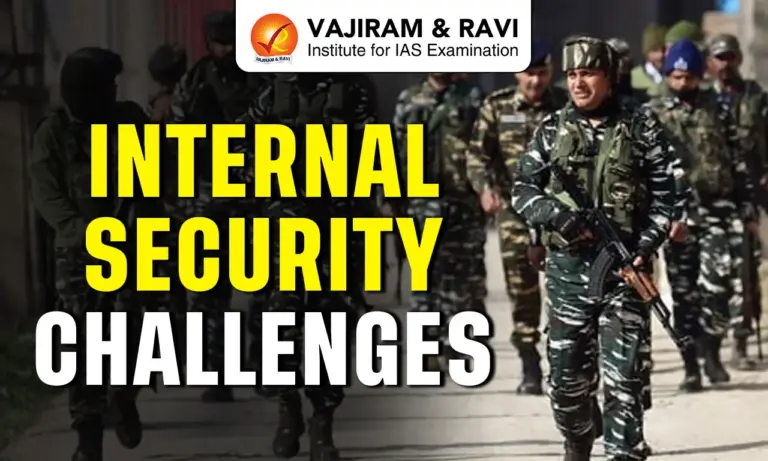
Internal security is a critical component of India’s national security framework. It encompasses threats from within the country that can disrupt law and order, endanger citizens, destabilize governance, or undermine economic and strategic interests. India’s internal security environment is highly complex, shaped by historical, socio-political, economic, and geographical factors, as well as developments in the region and globally.
Internal security challenges in India can broadly be classified into conventional (traditional) and non-conventional (emerging/modern) threats.
Conventional Internal Security Challenges
Conventional challenges are mainly physical, immediate, and directly threaten law and order, territorial integrity, and political stability. They include issues like terrorism, insurgency, Naxalism, communal violence, organized crime, and cross-border militancy.
Left-Wing Extremism
Left-Wing Extremism, commonly called Naxalism, refers to the armed struggle carried out by groups inspired by Maoist ideology. These groups aim to overthrow the government using violence, often targeting security forces, government officials, and infrastructure.
It is mainly concentrated in central and eastern India, covering areas in Chhattisgarh, Jharkhand, Odisha, Bihar, and Maharashtra. Maoist groups exploit socio-economic deprivation, tribal alienation, and governance deficits to mobilize support.
Terrorism
Terrorism in India refers to the use of violence and intimidation by individuals or groups to achieve political, religious, or ideological objectives, often targeting civilians, government institutions, or strategic assets. Terrorism in India takes many forms: attacks on public places, infiltration attempts, targeted killings, and bombings.
Terrorism in India includes cross-border, domestic, and homegrown threats. Groups like Lashkar-e-Taiba (LeT) and Jaish-e-Mohammed (JeM) continue to target civilian and strategic sites. Recent examples include the Pahalgam terror attack that killed 26 civilians.
Militancy in Jammu & Kashmir
Insurgency in Kashmir is primarily motivated by separatism and cross-border terrorism. Although there has been a decline in militant incidents after enhanced security operations and the abrogation of Article 370 in 2019, sporadic attacks and infiltration attempts, such as the August 2024 grenade attack in Srinagar, underline the continued risk.
Insurgency in North-East India
Insurgency refers to organized armed rebellion against the state by groups aiming to achieve political, ethnic, or separatist goals. In India’s North-East, several ethnic insurgent movements have operated for decades, primarily in Nagaland, Manipur, Assam, and Tripura.
Groups like NSCN (IM) in Nagaland and ULFA in Assam historically demanded separatist or greater autonomy. While large‑scale armed conflicts have declined in the Northeast, ethnic tensions and localized violence continue to pose serious security challenges. A stark example is the Manipur ethnic crisis of May–June 2023, where prolonged clashes between Meitei and Kuki communities resulted in hundreds of deaths, displacement of over 50,000 people,
Difficult and Hostile Neighbourhood
India shares long and porous borders with Pakistan, China, Nepal, Bangladesh, Bhutan, and Myanmar, and events in these countries can spill over into Indian territory, creating security challenges that are often beyond India’s direct control.
The Indo‑Bangladesh border sees regular illegal migration and smuggling, with over 1,100 infiltration attempts recorded in 2025. Bangladesh’s political changes in 2024 have created law-and-order challenges affecting cross-border security. Nepal’s frequent regime changes add to border vulnerabilities, enabling trafficking and illegal movement. In Myanmar, the ongoing conflict post-2021 coup has displaced refugees into Manipur and Mizoram and provides safe havens for insurgent.
Organised Crime
Organised Crime refers to illegal activities carried out by structured groups for profit, often across regions or borders. In India, it includes drug trafficking, human trafficking, arms smuggling, money laundering, and cybercrime, frequently exploiting coastal, border, and urban networks. These crimes not only threaten law and order but also undermine economic stability and fuel terrorism and other security challenges.
Maritime and Coastal Security
India’s coastline of over 11,098.81 km with 13 major and 200 minor ports, is vulnerable to terrorism, piracy, smuggling, and illegal migration. Incidents like the 26/11 Mumbai attacks exploited coastal vulnerabilities.
Communalism, Casteism, Ethnic Conflicts, and Linguistic Disputes
India’s diversity makes it prone to social tensions. Communal riots, caste-based violence, and ethnic conflicts disrupt harmony and law and order. Incidents such as the Hathras unrest (2020) and inter-ethnic violence in Manipur (2023) highlight the persistent nature of these challenges.
Non-Conventional / Modern Internal Security Challenges
While traditional threats such as insurgency, terrorism, and organized crime are well-recognized and largely physical, India increasingly faces non-conventional or modern security challenges. These threats are often less visible, transnational, technology-driven, and multi-dimensional. They do not always involve direct violence but can destabilize governance, disrupt economic and social systems, and challenge national security indirectly.
Cyber Attacks
Cybersecurity has emerged as one of the most critical aspects of India’s internal security. Attacks can target government databases, financial institutions, critical infrastructure like power grids, railways, and telecommunications, or even hospitals. Cyber-attacks may involve hacking, ransomware, phishing, or state-sponsored espionage.
In 2024, several Indian government websites, including those of state revenue departments, faced ransomware attacks, highlighting vulnerabilities in critical IT infrastructure. Cybercrime also facilitates terrorism, fake news, and financial fraud, making it an indirect threat to internal stability.
Informational Warfare
The rise of social media, messaging apps, and deepfake technologies has transformed the information space into a potential battlefield. Misinformation, fake news, and propaganda campaigns can exacerbate communal tensions, influence elections, spread panic during crises, and radicalize vulnerable populations.
During the 2023 Manipur ethnic crisis, misinformation spread via WhatsApp and social media amplified clashes between Meitei and Kuki communities. This challenge requires monitoring online platforms, digital literacy campaigns, and swift counter-narratives.
Energy and Resource Insecurity
Energy and resource security is crucial for a growing economy like India’s. Non-conventional threats include attacks or sabotage on oil pipelines, gas terminals, renewable energy infrastructure, and electricity grids. Disruptions in energy supply can impact industry, transport, and daily life, indirectly threatening social stability.
Example: The 2023 fire at a major refinery in Gujarat caused temporary power and fuel disruptions, showing how energy insecurity can ripple through the economy. Cyber-attacks on smart grids and water distribution networks are emerging threats in this domain.
Food and Pandemic Security
Non-conventional threats include challenges to public health and food security. Pandemics, bioterrorism, and contamination of food or water supplies can destabilize communities and create economic and political pressure.
The COVID-19 pandemic demonstrated how a health crisis could impact internal security by straining healthcare systems, causing migrant distress, and triggering economic instability. Future concerns include antimicrobial resistance, bioterror attacks, and disruptions to supply chains due to natural disasters or conflicts.
Biological and Chemical Threats
The accidental or deliberate release of biological or chemical agents is a serious non-conventional threat. Such attacks can cause mass casualties, panic, and long-term environmental harm. They require specialized detection systems, rapid response teams, and inter-agency coordination.
Example: Although India has not faced large-scale bioterror attacks, incidents like the 2022 Nipah virus outbreak in Kerala show the importance of preparedness.






 Last updated on April, 2026
→ UPSC Final Result 2025 is now out.
→ UPSC has released UPSC Toppers List 2025 with the Civil Services final result on its official website.
→ Anuj Agnihotri secured AIR 1 in the UPSC Civil Services Examination 2025.
→ UPSC Marksheet 2025 is now out.
→ UPSC Notification 2026 & UPSC IFoS Notification 2026 is now out on the official website at upsconline.nic.in.
→ UPSC Calendar 2026 has been released.
→ Check out the latest UPSC Syllabus 2026 here.
→ UPSC Prelims 2026 will be conducted on 24th May, 2026 & UPSC Mains 2026 will be conducted on 21st August 2026.
→ The UPSC Selection Process is of 3 stages-Prelims, Mains and Interview.
→ Prepare effectively with Vajiram & Ravi’s UPSC Prelims Test Series 2026 featuring full-length mock tests, detailed solutions, and performance analysis.
→ Enroll in Vajiram & Ravi’s UPSC Mains Test Series 2026 for structured answer writing practice, expert evaluation, and exam-oriented feedback.
→ Join Vajiram & Ravi’s Best UPSC Mentorship Program for personalized guidance, strategy planning, and one-to-one support from experienced mentors.
→ Shakti Dubey secures AIR 1 in UPSC CSE Exam 2024.
→ Also check Best UPSC Coaching in India
Internal Security Challenges FAQs
Q1. What are internal security challenges in India?+
Q2. What are the conventional internal security challenges?+
Q3. What is Left-Wing Extremism and why is it a challenge?+
Q4. How does terrorism feature in India’s internal security challenges?+
Q5. How does India’s neighborhood contribute to internal security challenges?+
Tags: internal security challenges