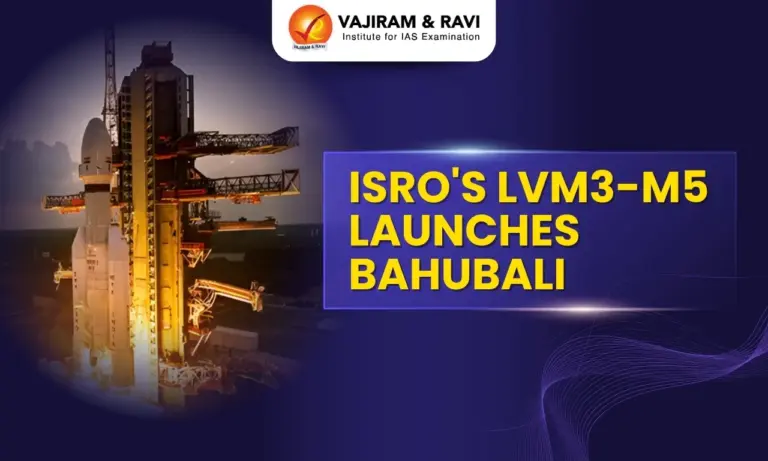
The LVM3 (formerly GSLV Mk III) is the heavy-lift launch vehicle of the Indian Space Research Organisation (ISRO). With a three-stage design combining solid, liquid and cryogenic propulsion, LVM3 has established a stellar track record of seven consecutive successful missions. The LVM3 M5 flight, its fifth operational mission, aims to place the 4,410 kg multi-band communication satellite CMS‑03 into a Geosynchronous Transfer Orbit (GTO), marking a significant milestone in India’s space capability.
LVM3 M5 Launch
The LVM3 M5 Mission will launch from the Second Launch Pad at the Satish Dhawan Space Centre (SDSC) SHAR, Sriharikota. Key mission highlights are given below:
- Launch Date: November 2, 2025 at 17:26 IST
- Payload: CMS-03, weighing ~4,410 kg, the heaviest communication satellite to be launched to GTO from Indian soil.
- Vehicle: LVM3 M5, the fifth operational flight of LVM3 series.
- Launch site: SLP at SDSC-SHAR (Satish Dhawan Space Centre in Sriharikota)
- Flight sequence: ignition of strap-ons (S200), core (L110) ignition, strap-on separation, Payload Fairing (PLF) separation, L110 separation, C25 ignition, C25 shut-off, vehicle insertion and spacecraft separation.
Bahubali Rocket
The nickname “Bahubali Rocket” was affectionately given to ISRO’s LVM3 (Launch Vehicle Mark-3) by the public and media, inspired by the popular Indian film Baahubali, which symbolizes immense strength and power. The name reflects the rocket’s status as India’s most powerful and heavy-lift launcher, capable of carrying satellites weighing over 4,000 kg to geosynchronous orbit. Its successful missions, including Chandrayaan-2 and OneWeb, strengthened its image as India’s mighty “Bahubali” of space exploration





LVM3 M5 Vehicle Details
The key details of the Launch Vehicle Mark 3 (LVM3) has been highlighted below:
- Strap-On Stage: 2 × S200
- Length: 26.22 m, Diameter: 3.2 m
- Solid propellant (HTPB) approx. 204.5 t each.
- Provide the massive thrust required for liftoff and early ascent.
- Core Stage: L110
- Length: 21.4 m, Diameter: 4.0 m
- Liquid propellants (UH25 + N₂O₄) approx. 115.9 t.
- Operates after strap-on burnout to continue the ascent.
- Upper Stage: C25
- Length: 13.5 m, Diameter: 4.0 m
- Cryogenic propellants (LH₂ & LOX) approx. 28.6 t.
- Final insertion stage into GTO; provides the precision required for the complex orbit.
LVM3 Rocket Features
LVM3 has established itself as India’s operational heavy-lift launch vehicle. ISRO lists its height at 43.5 m, payload fairing diameter at 5.0 m and lift-off mass around 640 t.
- Designed capability to place ~4,000 kg into GTO and ~8,000 kg into Low Earth Orbit (LEO).
- The LVM3-M2 mission carried 5,796 kg to LEO, showing the vehicle’s growing performance margin.
- ISRO is working on a semi-cryogenic engine upgrade (SE-2000) to raise GTO payload from ~4 to ~5 tonnes and LEO to ~10 tonnes.
- The vehicle stands 43.5 m tall and has a lift-off mass of 642 t.
- The configurable stack is (2 × S200 strap-ons + L110 core + C25 cryogenic upper stage + 5 m Payload Fairing) and is designated “2S200+L110(HTVE)+C25+5 m OPLF”.
- The mission’s target orbit is a GTO of apogee ~29,970 ± 3,700 km, perigee 170 ± 3.5 km, inclination 21.4° ± 0.1°, and argument of perigee 178° ± 0.3°, launch azimuth 107°.
- Thus, LVM3 M5 is built on a solid foundation and positions India towards self-reliance in heavy-payload launches.
CMS-03 Satellite
CMS-03 (also referred to as GSAT-7R) is a multi-band communication satellite designed to serve a wide oceanic region including the Indian landmass. Weighing 4,410 kg, it is the heaviest communications satellite to be launched from Indian soil into GTO. The mission underscores ISRO’s capability to launch large communication satellites indigenously and reduces dependency on foreign launch services.
LVM3 M5 Launch Sequence
The mission LVM3 M5 Launch from the Second Launch Pad at SDSC-SHAR, Sriharikota. The flight sequence comprises:
- Ignition of the two S200 strap-ons → lift-off
- Core stage L110 ignition at ~106.94 s (altitude ~41 km)
- Strap-on separation at ~131.14 s, PLF separation at ~198.86 s
- L110 separation at ~304.70 s and C25 ignition at ~307.10 s
- C25 shut-off at ~950.94 s and CMS-03 spacecraft separation at 965.94 s with altitude ~179.8 km and inertial velocity ~10.15 km/s
Naval Communication through the CMS-03 Satellite
The CMS-03 satellite, launched aboard LVM3 M5, plays a vital role in strengthening naval communication and maritime surveillance across India’s vast oceanic region. It provides secure, high-bandwidth links essential for the Indian Navy’s real-time communication, navigation, and data-sharing between ships, submarines, and coastal command centers. Covering the Indian Ocean and nearby maritime zones, CMS-03 enhances defense readiness, situational awareness, and operational coordination, supporting India’s goal of achieving reliable and indigenous space-based communication infrastructure for maritime security.
LVM3-M5 Launch Significance
The LVM3 M5 Launch has multiple strategic implications:
- Marks India’s ability to launch over 4 tonnes into GTO from Indian soil, a capability formerly outsourced.
- Paves the way for future human-rated missions (Gaganyaan) and large space station modules.
- Enhances India’s commercial launch offering and global competitiveness.
- Reinforces national security and communication infrastructure via CMS-03.
LVM3-M5 Launch Impact
With LVM3’s maturity, ISRO and its commercial arm (NewSpace India Limited- NSIL) can offer heavy-lift services. The LVM3-M2 mission for OneWeb (36 satellites, ~5.8 t) marked a commercial debut. By launching CMS-03 entirely on-house, India saves costs, retains payload autonomy, and strengthens its global position as a launch provider. This bodes well for future export of launch services.
LVM3 M5 Mission Challenges
Despite success, some challenges remain:
- LVM3’s nominal payload to GTO is ~4 t; to compete globally, ISRO seeks to raise it to ~5 t via semi-cryogenic engine.
- Increased mission rate, cost-efficiency and market competition require further innovation.
- Human-rated version HLVM3 (derived from LVM3) suggests further reliability and safety focus.
- Way forward: accelerated engine development, modularisation, increased production capability and strong commercial strategy.
LVM3 M5 Launch Future Aspects
Looking ahead, the LVM3-M5 mission sets the precedent for:
- Gaganyaan crewed mission (using human-rated version).
- Large modules for India’s planned space station (BAS).
- Enhanced commercial launches of heavy payloads into GTO and LEO.
- Strengthened global market share for launch services. The technology upgrades underway (semi-cryogenic, higher thrust cryo, modular launchers) position ISRO well for the next decade.
LVM3 M5 Mission Marks Atmanirbhar Bharat Space
Earlier, India had to rely on foreign launch providers for heavy satellites over ~4 t to GTO, such as GSAT-11 (5,854 kg) and GSAT-20 (4,700 kg). With LVM3 M5 Launch undertaking the CMS-03 mission entirely with Indian hardware and infrastructure, it marks a shift towards self-reliance in heavy-lift capabilities. This boosts India’s autonomy in space access and strengthens its position in the global launch services market.
LVM3 M5 Launch Prime Minister on ‘X’
The Indian Space Research Organisation’s LVM3 M5 Launch with the CMS‑03 satellite sparked widespread celebration on social platforms. Prime Minister Narendra Modi tweeted on the Social Platform – ‘X’ (formerly Twitter) his congratulations to ISRO, calling the mission a symbol of India’s scientific excellence and innovation. Hashtags like #Bahubali, #LVM3M5, #AtmanirbharBharatSpace, and #IndiaInSpace trended across X, Instagram and Facebook, capturing global attention.

LVM3 M5 Launch UPSC
The LVM3 M5 Launch is a landmark for India’s space ambitions, a culmination of years of engineering, testing and vision. With its heavy payload, GTO success and operational readiness, LVM3 empowers India’s pursuit of space self-reliance, commercial viability and strategic capability. As the “Bahubali” of Indian rockets, LVM3 is ready to carry the nation to its next frontier.
Following the LVM3 M5 Mission, the Indian Space Research Organisation announced that the C25 cryogenic stage performed an in-orbit test burn post-separation, demonstrating enhanced performance and readiness for future missions. This represents a key technological upgrade for the launch vehicle family and lays the groundwork for future human-rated (Gaganyaan) and heavy-module launches.

 Last updated on March, 2026
→ UPSC Final Result 2025 is now out.
→ UPSC has released UPSC Toppers List 2025 with the Civil Services final result on its official website.
→ Anuj Agnihotri secured AIR 1 in the UPSC Civil Services Examination 2025.
→ UPSC Marksheet 2025 is now out.
→ UPSC Notification 2026 & UPSC IFoS Notification 2026 is now out on the official website at upsconline.nic.in.
→ UPSC Calendar 2026 has been released.
→ Check out the latest UPSC Syllabus 2026 here.
→ UPSC Prelims 2026 will be conducted on 24th May, 2026 & UPSC Mains 2026 will be conducted on 21st August 2026.
→ The UPSC Selection Process is of 3 stages-Prelims, Mains and Interview.
→ Prepare effectively with Vajiram & Ravi’s UPSC Prelims Test Series 2026 featuring full-length mock tests, detailed solutions, and performance analysis.
→ Enroll in Vajiram & Ravi’s UPSC Mains Test Series 2026 for structured answer writing practice, expert evaluation, and exam-oriented feedback.
→ Join Vajiram & Ravi’s Best UPSC Mentorship Program for personalized guidance, strategy planning, and one-to-one support from experienced mentors.
→ Shakti Dubey secures AIR 1 in UPSC CSE Exam 2024.
→ Also check Best UPSC Coaching in India
LVM3 M5 Launch FAQs
Q1. What is the LVM3-M5 Launch vehicle? +
Q2. Why is the CMS-03 Satellite significant? +
Q3. What is the payload capacity of LVM3? +
Q4. Where is the LVM3-M5 Mission launching from? +
Q5. What future missions will use LVM3? +
Tags: lvm3 m5 lvm3 m5 launch