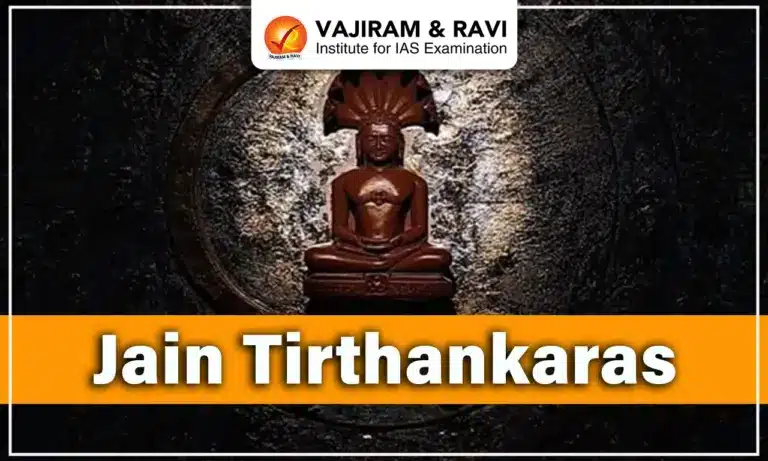
In Jainism, Tirthankaras are referred as spiritual teachers who have attained liberation and guide others on the path to salvation. They are also called Jina, meaning “conquerors of all inclinations,” as they have overcome worldly desires and attachments.
There are 24 Jain Tirthankaras. The term “Tirthankara” is derived from Teertha (a sacred ford or pilgrimage place) and Samsara (the cycle of worldly existence). A Tirthankara is one who has transcended samsara and attained Kevala Jnana (perfect knowledge).
Jain Tirthankaras
A Jain Tirthankara is not a divine incarnation (Avatar). He is an ordinary soul born as a human who attains the status of Tirthankara through severe penance, inner serenity, and deep meditation. The position of a Tirthankara represents the highest, purest state of the soul, achieved through self-effort rather than divine intervention.
Unlike prophets or founders of religions, Tirthankaras were not creators of a new faith. Instead, they were omniscient teachers who appeared at different stages of human history. They achieved the ultimate spiritual goal of existence, liberation (moksha) and then guided others to walk the same path.
A Jain Tirthankara is described as one who helps others cross the ocean of samsara (worldly existence) to the safe shores of spiritual purity and freedom.
List of Jain Tirthankaras
Over thousands of years, 24 Jain Tirthankaras have been born to teach the path of Dharma (righteousness). Each Tirthankara is associated with a unique emblem or symbol, which makes them easily identifiable in Jain iconography.
These symbols serve as spiritual markers, reminding devotees of the Tirthankara’s teachings and virtues.
Jain Tirthankaras of the Present Cosmic Age
In the current cosmic age, Jainism recognizes 24 Tirthankaras, spiritual teachers who have attained Kevala Jnana (omniscience). The first Jain Tirthankara is Rishabhanatha, credited with establishing the foundations of Jain teachings. The 24th and last Tirthankara is Mahavira, who is the most widely known and whose teachings form the core of modern Jain practice.
| Jain Tirthankaras of the Present Cosmic Age | ||||
|
Sl. No. |
Tirthankara Name |
Symbol |
Birthplace |
Colour |
|
1 |
Rishabhanatha (Adinatha) |
Bull |
Ayodhya |
Golden |
|
2 |
Ajitanatha |
Elephant |
Ayodhya |
Golden |
|
3 |
Sambhavanatha |
Horse |
Shravasti |
Golden |
|
4 |
Abhinandananatha |
Monkey |
Samet Sikhar |
Golden |
|
5 |
Sumatinatha |
Heron |
Ayodhya |
Golden |
|
6 |
Padmaprabha |
Padma |
Samet Sikhar |
Red |
|
7 |
Suparshvanatha |
Swastika |
Samet Sikhar |
Golden |
|
8 |
Chandraprabha |
Crescent Moon |
Chandrapuri |
White |
|
9 |
Pushpadanta |
Crocodile |
Kakandi |
White |
|
10 |
Shitalanatha |
Shrivatsa |
Bhadrak Puri |
Golden |
|
11 |
Shreyanasanatha |
Rhinoceros |
Samet Sikhar |
Golden |
|
12 |
Vasupujya |
Buffalo |
Champapuri |
Red |
|
13 |
Vimalanatha |
Boar |
Kampilya |
Golden |
|
14 |
Anantanatha |
Falcon |
Ayodhya |
Golden |
|
15 |
Dharmanatha |
Vajra |
Ratnapuri |
Golden |
|
16 |
Shantinatha |
Antelope or deer |
Hastinapur |
Golden |
|
17 |
Kunthunatha |
Goat |
Hastinapur |
Golden |
|
18 |
Aranatha |
Nandyavarta or fish |
Hastinapur |
Golden |
|
19 |
Māllīnātha |
Kalasha |
Mithila |
Blue |
|
20 |
Munisuvrata |
Tortoise |
Kusagranagar |
Black |
|
21 |
Naminatha |
Blue lotus |
Mithila |
Golden |
|
22 |
Neminatha |
Shankha |
Dvaraka |
Black |
|
23 |
Parshvanatha |
Snake |
Kashi |
Blue |
|
24 |
Mahavira |
Lion |
Kshatriyakund |
Golden |
Jain Tirthankaras of the Next Cosmic Age
In Jain cosmology, the next cosmic age is known as the Utsarpiṇī (ascending half-cycle). During this half-cycle, it is believed that 24 Jain Tīrthaṅkaras will be born. The names of these Tīrthaṅkaras in the upcoming cosmic age are as follows:
| Jain Tirthankaras of the Next Cosmic Age | ||
|
Sl. No. |
Tīrthankara |
Previous Human Birth |
|
1 |
Rishabhanatha |
Nabhi Raja |
|
2 |
Ajitanātha |
Muni Suvrata |
|
3 |
Sambhavanātha |
King Jitāri |
|
4 |
Abhinandananātha |
King Samvaranaraja |
|
5 |
Sumatinātha |
King Megha |
|
6 |
Padmaprabhā |
King Vishvasena |
|
7 |
Suparśvanātha |
King Pratishtha Raja |
|
8 |
Candraprabhā |
King Mahasena |
|
9 |
Pushpadanta |
King Sugriva |
|
10 |
Śītalanātha |
King Dridharatha |
|
11 |
Śreyāṃsanātha |
King Shubhanasa |
|
12 |
Vāsupūjya |
King Vasupujya |
|
13 |
Vimala |
King Chandra |
|
14 |
Anantanātha |
King Dharanendra |
|
15 |
Dharmanātha |
King Bhojaka |
|
16 |
Śāntinātha |
King Nami |
|
17 |
Kunthunātha |
King Vijaya |
|
18 |
Aranātha |
King Taara |
|
19 |
Mallinātha |
King Siddhartha |
|
20 |
Neminātha |
King Samudravijaya |
|
21 |
Pārśvanātha |
King Ashvasena |
|
22 |
Mahāvīra |
King Siddhartha |
|
23 |
Nandi Vardhana |
King Yasas |
|
24 |
Mahābala |
King Rishabha |





Jain Tirthankaras Significant
Jain Tirthankaras are spiritual teachers who have attained Kevala Jnana (omniscience) and guide others on the path to liberation. There are 24 Tirthankaras in the current cosmic age, each representing a symbol and inspiring followers with their teachings. Among them, five Tirthankaras, Rishabhdev, Parshvanath, Mahavira, Mallinath, and Neminatha are considered particularly significant for their contributions to Jain philosophy, ethics, and spiritual practice. The table below summarizes key details about these Tirthankaras.
| Jain Tirthankaras Significant | |||||
|
Tirthankara |
Order |
Birthplace / Parents |
Key Contributions & Facts |
Emblem / Symbol |
Nirvana Location |
|
Rishabhdev (Adinatha) |
1st |
Ayodhya; King Nabhi & Queen Marudevi |
First Tirthankara; inspired Jain ethics; sons Bharata & Bahubali; daughter Brahmi linked to Brahmi script |
Bull |
Mount Kailasa (Digambar) / Ashtapad (Shwetambar) |
|
Parshvanath |
23rd |
Varanasi; King Ashvasena & Queen Vama |
Became ascetic at 30; founded four Ganas; taught peaceful living; only Tirthankara depicted with naga hood |
Snake |
Sammet Sikhar (Parshvanatha) |
|
Mahavira |
24th |
Born Vardhamana Mahavir; King Siddhartha & Queen Trishala |
Left home at 30; attained Kaivalya at 42; taught five major vows; divided disciples into monks, nuns, laymen, laywomen; celebrated on Deepavali |
Lion |
Pavapuri |
|
Mallinath |
19th |
Mithila |
Only female Tirthankara; also called Malli |
Not specified |
Not specified |
|
Neminatha |
22nd |
Cousin of Lord Krishna |
Known as Nemi; depicted with dark complexion; taught spiritual liberation |
Not specified |
Not specified |
Jain Tirthankaras Naam Karma
Jain Tirthankaras Naam Karma is a special type of karma that elevates a soul to the supreme status of a Tirthankara, a spiritual teacher and savior who has conquered saṃsara (the cycle of birth and death) and shown the path to liberation for others. Upon attaining complete self-realization, the Tirthankara achieves Kevala Gyana (omniscience).
The Tattvartha Sutra, an important Jain text, identifies sixteen key observances that cultivate the Tirthankara Naam Karma, guiding aspirants toward spiritual purity and ultimate liberation.
| Jain Tirthankaras Naam Karma | |
|
Observance |
Description |
|
Purity of right faith |
Maintaining correct understanding and faith in Jain principles. |
|
Reverence |
Showing deep respect for enlightened beings and spiritual practices. |
|
Observance of vows and supplementary vows without transgressions |
Strictly following ethical and spiritual vows without violations. |
|
Ceaseless pursuit of knowledge |
Constantly seeking spiritual and worldly understanding. |
|
Perpetual fear of the cycle of existence |
Awareness of the suffering inherent in birth, death, and rebirth. |
|
Giving gifts (charity) |
Selfless acts of generosity to aid others and reduce attachment. |
|
Practising austerities according to one’s capacity |
Performing penances and self-discipline appropriate to personal ability. |
|
Removal of obstacles that threaten the equanimity of ascetics |
Ensuring ascetics can pursue spiritual practices unhindered. |
|
Self-control |
Mastering desires, impulses, and emotions. |
|
Purity of conduct |
Maintaining ethical and moral behavior in all actions. |
|
Avoidance of injury to living beings |
Practicing Ahimsa in thought, word, and deed. |
|
Patience |
Cultivating tolerance and endurance in all circumstances. |
|
Truthfulness |
Speaking and acting in accordance with truth. |
|
Non-attachment |
Avoiding emotional or material attachment to worldly possessions or relationships. |
|
Celibacy |
Observing chastity and controlling sexual desires. |
|
Contemplation on the true nature of the self |
Deep meditation on the soul’s essence to realize its pure state. |

 Last updated on March, 2026
→ UPSC Final Result 2025 is now out.
→ UPSC has released UPSC Toppers List 2025 with the Civil Services final result on its official website.
→ Anuj Agnihotri secured AIR 1 in the UPSC Civil Services Examination 2025.
→ UPSC Marksheet 2025 is now out.
→ UPSC Notification 2026 & UPSC IFoS Notification 2026 is now out on the official website at upsconline.nic.in.
→ UPSC Calendar 2026 has been released.
→ Check out the latest UPSC Syllabus 2026 here.
→ UPSC Prelims 2026 will be conducted on 24th May, 2026 & UPSC Mains 2026 will be conducted on 21st August 2026.
→ The UPSC Selection Process is of 3 stages-Prelims, Mains and Interview.
→ Prepare effectively with Vajiram & Ravi’s UPSC Prelims Test Series 2026 featuring full-length mock tests, detailed solutions, and performance analysis.
→ Enroll in Vajiram & Ravi’s UPSC Mains Test Series 2026 for structured answer writing practice, expert evaluation, and exam-oriented feedback.
→ Join Vajiram & Ravi’s Best UPSC Mentorship Program for personalized guidance, strategy planning, and one-to-one support from experienced mentors.
→ Shakti Dubey secures AIR 1 in UPSC CSE Exam 2024.
→ Also check Best UPSC Coaching in India
Jain Tirthankaras FAQs
Q1. Who are the 24 Jain Tirthankaras?+
Q2. Who is the most famous Jain Tirthankar?+
Q3. Who is the 21st Tirthankara of Jainism?+
Q4. Who is the only female Jain Tirthankar?+
Q5. Why is Bahubali not a Tirthankara?+
Tags: jain tirthankaras