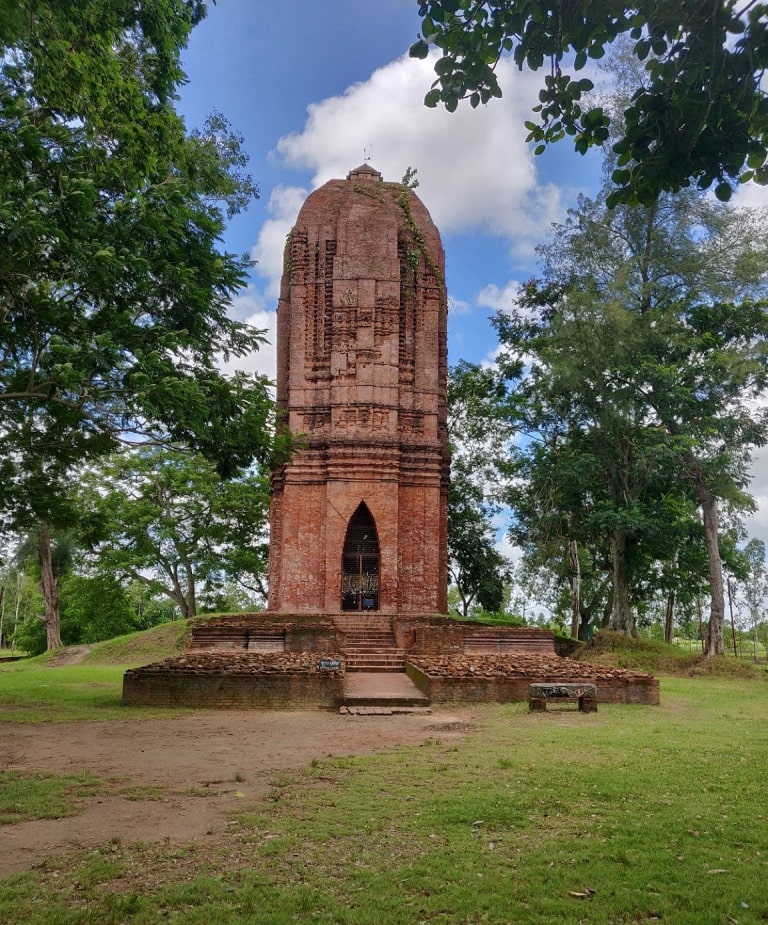
About Jatar Deul Temple:
- It is a Hindu Temple dedicated to Lord Shiva.
- Location: Located at Kanakan Dighi Village in South 24 Parganas District in West Bengal.
- The Temple stands on a small hill in the landscape of the southern Sundarbans settlements.
- A copper plate found near the temple in 1875 suggests that Raja Joychandra constructed the temple in 975 AD.
- The temple has been classified as a Monument of National Importance by the Archaeological Survey of India (ASI).
- Structure of Jatar Deul Temple:
- This temple is facing towards the east and follows the Kalingan style of architecture.
- The temple is built over a raised platform.
- It has an arched gateway leading to the sanctum.
- The sanctum is situated below the ground level.
- The sanctum houses Lingas, pictures and idols of various gods & goddesses of Hindu pantheon.
- The walls of the temple were intricately decorated with decorative bricks, but most of it is lost due to unplanned reconstruction.
Kalingan Style of Architecture:
- It is a style of Hindu architecture which flourished in the ancient Kalinga previously known as Utkal and part of the kingdom of Magadha or present eastern Indian state of Odisha.
- In Kalinga style – the temple is made up of two structures: a tower and hall. The Tower is called ‘Deula’, and the hall is called ‘Jagmohan’.
- The style consists of three distinct types of temples: Rekha Deula, Pidha Deula and Khakhara Deula. .
- Rekha Deula: It is a tall building with a sikhara. The Rekha Deula means a shrine with different parts in a line.Eg: Rekha Deula in the Lingraj Temple of Bhubneshwar.
- Pidha Deula: Pidha Deula refers to the square building with a pyramid-shaped roof, like the vimanas. Eg: The assembly hall of the Konark Sun Temple.
- Khakhara Deula: It is altogether a different style of architecture closely appearing similar to the Dravidian Gopuran design.The temples of the feminine deities as Shakti are temple of this type. Eg: Baitala temple of Bhubneshwar dedicated to Chamunda.
Q1) What is a terracotta structure?
It is formed by a mixture of clay and water that is fired and then either be left unglazed, or painted, slip glazed or glazed. If terracotta is to be painted, gesso (a type of primer) is applied first. Terracotta can be used structurally or non-structurally on both the exterior and interior of buildings.
Source: Sea winds erode 11th century Sundarbans temple


 Last updated on Oct, 2026
→ UPSC 2027 Notification will be released on 13 January 2027 at upsconline.nic.in.
→ Check Nobel Prize 2026 Winners List here.
→ Download PIB PRiSM Monthly Magazine 2026 here.
→ Check UPSC Monthly Current Affairs Magazine The Recitals here.
→ Check out the latest UPSC Syllabus here.
→ Download UPSC Model Answers for Mains 2026
→ UPSC Mains Question Paper 2026 is out now for Essay & GS Paper 1, 2, 3 & 4.
→ UPSC Calendar 2027 has been released.
→ Enroll in Vajiram & Ravi’s UPSC Mains Test Series 2027 for structured answer writing practice, expert evaluation, and exam-oriented feedback.
→ Join Vajiram & Ravi’s UPSC Mentorship Program 2027 for personalized guidance, strategy planning, and one-to-one support from experienced mentors.
→ Go through the UPSC Mains Previous Year Papers to enhance your preparation.
→ UPSC has released UPSC Toppers List 2025 with the Civil Services final result on its official website.
→ Also check Best UPSC Coaching in India