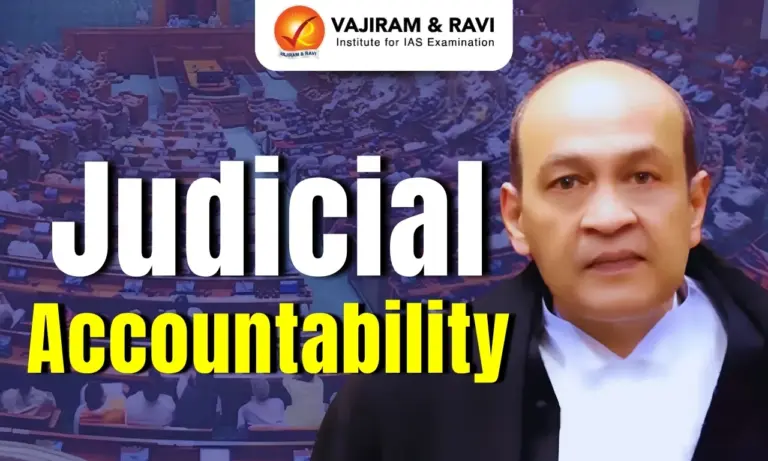
Judicial Accountability Latest News
- Lok Sabha Speaker Om Birla has decided to table the report of the parliamentary investigative committee against former Allahabad High Court judge Yashwant Varma.
- This is significant because Justice Varma had already resigned in April 2026, and it was widely believed that his resignation had ended the impeachment process.
- The Speaker’s move challenges this long-held assumption and raises fresh questions on whether resignation can help judges escape accountability.
Background of the Case
- In 2025, wads of burnt and partially destroyed currency notes were recovered from Justice Varma’s official residence in New Delhi.
- This triggered an in-house inquiry by the Supreme Court, which reportedly found him culpable.
- Following this, over 146 Lok Sabha MPs moved a motion for his removal, leading the Speaker to constitute a three-member investigative committee under the Judges (Inquiry) Act, 1968.
- However, before the committee could complete its hearings, Justice Varma resigned by writing to President Droupadi Murmu.


Legal Position on a Judge’s Resignation
- Under Article 217 of the Constitution, a High Court judge may resign by writing to the President.
- A 1978 Supreme Court judgment held that such resignation is a unilateral act, taking effect immediately from the date chosen by the judge, without requiring formal acceptance.
- Legal scholars, however, point out that neither the Constitution nor this judgment explicitly states that a pending misconduct inquiry must lapse merely because the judge resigns.
Precedents: How Past Impeachment Probes Lapsed
- No judge has ever been impeached in India till date. Two precedents shape the current debate:
- Justice P D Dinakaran (2011): The Sikkim High Court Chief Justice resigned while the probe committee was still investigating him. The Rajya Sabha secretariat reasoned that since the goal was removal, resignation made the process infructuous.
- Justice Soumitra Sen (2011): The Calcutta High Court judge resigned even after the Rajya Sabha had passed the impeachment motion against him. The Lok Sabha subsequently dropped its vote.
- Both cases established a practice where resignation effectively ended accountability proceedings, even though the law does not mandate this outcome.
The Dissenting View
- During the Dinakaran episode, jurist G. Mohan Gopal, a member of the inquiry panel, opposed dropping the probe.
- He distinguished between two separate stages under the Judges (Inquiry) Act: the “investigation and proof” of misbehaviour, and the actual “removal from office” by Parliament.
- He argued that establishing the truth of charges is valuable in itself, regardless of removal.
- He warned that letting judges halt inquiries through resignation would create an “absurd situation” and erode public faith in the system.
Why Tabling the Report Matters Now
- Legal experts highlight two major implications of tabling the Varma report:
- Public accountability: The inquiry was constitutionally mandated and taxpayer-funded.
- Tabling the report would bring its findings into the public domain and could overturn the precedent set in the Dinakaran case, signalling that judges cannot escape scrutiny simply by resigning.
- Financial and legal consequences: Judges who resign are usually entitled to the same pensionary benefits as those who retire normally.
- If the report establishes misconduct, experts argue the judge’s removal could theoretically be backdated to the start of the process.
- A formal parliamentary impeachment could stop pension benefits and potentially open the door to criminal action.
- Public accountability: The inquiry was constitutionally mandated and taxpayer-funded.
Conclusion
- The Justice Varma case tests whether resignation can shield judges from accountability despite credible misconduct findings.
- Tabling the report would break from past precedent, reaffirm that judicial inquiries serve public interest beyond mere removal, and could have real consequences for pension and future legal action, strengthening India’s judicial accountability framework.

 Last updated on Oct, 2026
→ UPSC 2027 Notification will be released on 13 January 2027 at upsconline.nic.in.
→ Check Nobel Prize 2026 Winners List here.
→ Download PIB PRiSM Monthly Magazine 2026 here.
→ Check UPSC Monthly Current Affairs Magazine The Recitals here.
→ Check out the latest UPSC Syllabus here.
→ Download UPSC Model Answers for Mains 2026
→ UPSC Mains Question Paper 2026 is out now for Essay & GS Paper 1, 2, 3 & 4.
→ UPSC Calendar 2027 has been released.
→ Enroll in Vajiram & Ravi’s UPSC Mains Test Series 2027 for structured answer writing practice, expert evaluation, and exam-oriented feedback.
→ Join Vajiram & Ravi’s UPSC Mentorship Program 2027 for personalized guidance, strategy planning, and one-to-one support from experienced mentors.
→ Go through the UPSC Mains Previous Year Papers to enhance your preparation.
→ UPSC has released UPSC Toppers List 2025 with the Civil Services final result on its official website.
→ Also check Best UPSC Coaching in India
Judicial Accountability FAQ
Q1. Why has the Justice Varma case become important for Judicial Accountability?+
Q2. What constitutional issue does the Justice Varma case raise regarding Judicial Accountability?+
Q3. How do previous impeachment cases influence the debate on Judicial Accountability?+
Q4. Why is tabling the inquiry report significant for Judicial Accountability?+
Q5. How could the Justice Varma case reshape Judicial Accountability in India?+
Tags: judicial accountability upsc current affairs upsc mains current affairs