What’s in Today’s Article?
- Judicial Activism Latest News
- Judiciary’s Role in a Constitutional Democracy
- Recent Remarks by Vice-President Dhankhar
- Mixed Reactions and Constitutional Interpretation
- Judicial Independence and Constitutional Sovereignty
- Judicial Independence and Constitutional Balance FAQs
Judicial Activism Latest News
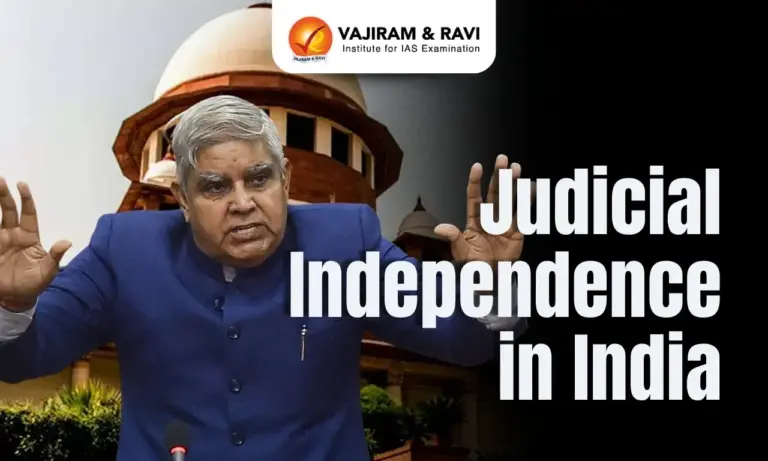
- Vice-President Jagdeep Dhankhar recently raised certain issues with respect to the independence of the judiciary, its powers of judicial review and the judgment prescribing timelines to the President and Governor for their actions.





Judiciary’s Role in a Constitutional Democracy
- India’s judiciary is constitutionally placed as the guardian of the Constitution and the rights of citizens.
- It exercises wide powers through mechanisms such as judicial review and Article 142 to uphold justice and ensure accountability, including for the executive.
- However, its role has occasionally sparked debate, particularly concerning its perceived lack of transparency and the scope of its powers.
Recent Remarks by Vice-President Dhankhar
- At a recent public event, Vice-President Jagdeep Dhankhar voiced serious concerns regarding various facets of the Indian judiciary’s functioning, leading to widespread discussion. His observations covered five core aspects:
- Transparency in Judicial Inquiries: He criticized the opaque nature of internal inquiries into judicial misconduct, especially referencing an incident involving recovery of large amounts of cash from a Delhi High Court judge’s residence.
- Judicial Directives to Constitutional Authorities: Dhankhar questioned a recent Supreme Court judgment that directed timelines for action by Governors and the President on pending state legislation. The court had issued a writ of mandamus, holding high constitutional offices accountable in cases of undue delay.
- Accountability Deficit: The Vice-President emphasized that unlike the executive and legislature, the judiciary lacks a mechanism to be directly answerable to the public.
- Size of Constitution Benches: He suggested re-evaluating the provision under Article 145(3), which mandates a minimum of five judges to adjudicate constitutional questions, noting the current strength of the Supreme Court is 34, unlike just 8 when the Article was framed.
- Use of Article 142: The Vice-President opined that the sweeping powers under Article 142 are sometimes used in ways that undermine the principles of representative democracy.
Mixed Reactions and Constitutional Interpretation
- The Vice-President’s statements have triggered divided reactions across the political and legal spectrum.
- While some see this as overreach from a high constitutional office, others view it as a long overdue criticism reflecting broader public sentiment.
- Arguments in Favour of Greater Transparency
- There is widespread public concern regarding the secrecy surrounding inquiries into alleged judicial misconduct.
- Many experts believe the Chief Justice of India should institutionalize a transparent inquiry mechanism to reinforce public trust.
- Judicial Activism: Justified or Overstepped?
- Judicial activism through Article 142 has played a crucial role in landmark decisions, such as:
- Bhopal gas tragedy compensation (1989)
- Vishaka guidelines on sexual harassment (1997)
- Cancellation of illegal coal-block allocations (2014)
- Granting permanent commission to women officers in armed forces (2024)
- Guidelines on unlawful demolitions (2024)
- These rulings illustrate the judiciary’s evolving role in ensuring justice where administrative or legislative mechanisms fall short.
- Judicial activism through Article 142 has played a crucial role in landmark decisions, such as:
- On Judicial Review and Timeline Mandates
- The judiciary’s power of judicial review has been repeatedly upheld as part of the Constitution’s basic structure.
- Legal scholars have noted that the Supreme Court’s ruling to prescribe action timelines for the President and Governors was derived from precedents and supported by government guidelines (Home Ministry’s Office Memorandum of 2016).
- Constitutional Bench Composition
- While Article 145(3) specifies a minimum of five judges to decide constitutional matters, current pendency levels and the increased strength of the bench suggest this number may still be optimal, considering logistical constraints.
Judicial Independence and Constitutional Sovereignty
- The Indian constitutional system blends British-style Parliamentary sovereignty and American-style judicial supremacy.
- The Indian judiciary, through judicial review, upholds constitutional supremacy, enabling it to examine the legality of legislative and executive actions.
- This synthesis is foundational to Indian democracy. While transparency and inclusiveness in appointments (via a potential reformed National Judicial Appointments Commission) may help restore public faith, it must not come at the cost of judicial independence.
Judicial Independence and Constitutional Balance FAQs
Q1. What prompted the Vice-President’s recent criticism of the judiciary?
Ans. He raised concerns over lack of transparency in judicial inquiries and overreach in mandating timelines to the President and Governors.
Q2. What is Article 142 of the Indian Constitution?
Ans. It empowers the Supreme Court to pass any order necessary to deliver “complete justice” in any case.
Q3. Why is judicial review considered a basic structure of the Constitution?
Ans. Because it ensures laws and executive actions adhere to constitutional values and can be struck down if found violative.
Q4. What was the Supreme Court’s directive to the Governors and President?
Ans. It mandated timelines for action on State legislation to prevent indefinite delays.
Q5. What reform has been suggested for judicial appointments?
Ans. A broader-based National Judicial Appointments Commission with veto power for the CJI to ensure transparency and inclusiveness.
Source: TH

 Last updated on April, 2026
→ UPSC Final Result 2025 is now out.
→ UPSC has released UPSC Toppers List 2025 with the Civil Services final result on its official website.
→ Anuj Agnihotri secured AIR 1 in the UPSC Civil Services Examination 2025.
→ UPSC Marksheet 2025 is now out.
→ UPSC Notification 2026 & UPSC IFoS Notification 2026 is now out on the official website at upsconline.nic.in.
→ UPSC Calendar 2026 has been released.
→ Check out the latest UPSC Syllabus 2026 here.
→ UPSC Prelims 2026 will be conducted on 24th May, 2026 & UPSC Mains 2026 will be conducted on 21st August 2026.
→ The UPSC Selection Process is of 3 stages-Prelims, Mains and Interview.
→ Prepare effectively with Vajiram & Ravi’s UPSC Prelims Test Series 2026 featuring full-length mock tests, detailed solutions, and performance analysis.
→ Enroll in Vajiram & Ravi’s UPSC Mains Test Series 2026 for structured answer writing practice, expert evaluation, and exam-oriented feedback.
→ Join Vajiram & Ravi’s Best UPSC Mentorship Program for personalized guidance, strategy planning, and one-to-one support from experienced mentors.
→ Shakti Dubey secures AIR 1 in UPSC CSE Exam 2024.
→ Also check Best UPSC Coaching in India