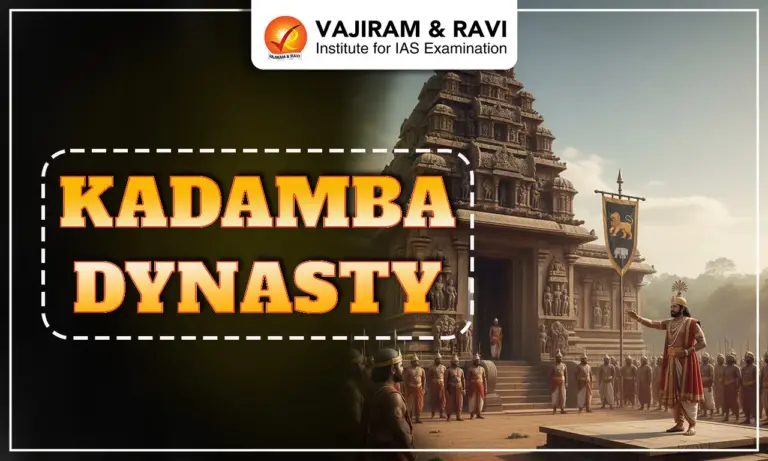
The Kadamba dynasty was an ancient ruling dynasty of South India that emerged in the Western Ghats region, with its capital at Banavasi in present-day Karnataka. Established around 345 CE, the Kadambas ruled large parts of South India until approximately 525 CE, though some sources extend their influence to 540 CE. The dynasty is credited with laying the foundations of Kannada political and cultural identity, shaping early South Indian polity, literature, religion, and art. The founder of the Kadamba dynasty was Mayurasarma, also known as Mayurasharma. Regardless of their origins, the Kadambas established a stable political framework and contributed significantly to the socio-cultural development of South India. In this article, we are going to cover the Kadamba Dynasty, its origin, its rulers, administration, art and architecture and its legacy.
Kadamba Dynasty
The Kadamba dynasty occupies a critical place in South Indian history, marking the emergence of Kannada identity and regional governance. From a modest chieftaincy in Banavasi, the Kadambas established a lasting kingdom, promoted art and literature, advanced agriculture and trade, and fostered social and religious harmony.
The dynasty exemplifies the evolution of early medieval South Indian polity, showing the interplay of decentralization, military organization, cultural patronage, and economic development. Its contributions to Kannada literature, temple architecture, and societal organization remain relevant for understanding the historical foundations of Karnataka and the broader South Indian context.
Kadamba Dynasty Overview
| Aspect | Details |
|
Name of Dynasty |
Kadamba Dynasty |
|
Founder |
Mayurasarma (Mayurasharma) |
|
Period of Rule |
345 CE – 525 CE (some sources extend to 540 CE) |
|
Capital |
Banavasi (later shifted to Kolar) |
|
Region of Origin |
Banavasi, Karnataka (Western Ghats region) |
|
Major Ruler |
Kakusthavarma (reigned c. 425–450 CE) |
|
Extent of Kingdom |
Parts of present-day Karnataka, Goa, and northern Tamil Nadu |
|
Political Features |
Decentralized administration; local chieftains and governors (Vishayapatis) had autonomy |
|
Military Strength |
Army of cavalry, infantry, elephants, and chariots |
|
Economy |
Agrarian, based on rice cultivation, land revenue, internal and external trade; issued coins |
|
Main Occupations |
Agriculture, cattle rearing, trade, artisan industries (weaving, pottery, metalwork) |
|
Society |
Varna-based; Brahmins held high status; women had property rights and educational access |
|
Religion |
Hinduism and Jainism; known for religious tolerance |
|
Language and Literature |
Promoted Sanskrit, Prakrit, and early Kannada; earliest Kannada writings emerged |
|
Art and Architecture |
Built Hindu temples and Jain basadis, e.g., Kolaramma and Kedareshwara temples |
|
Cultural Contribution |
Patronized art, sculpture, music, and dance; promoted Kannada culture and literature |
|
Decline |
Attacks from Chalukyas, Pallavas, and Gangas in the 6th century CE |
|
Legacy |
Foundation for later Kannada dynasties like the Chalukyas, Rashtrakutas, and Hoysalas |
Kadamba Dynasty Origin
The Kadamba dynasty’s rise is related with the story of Mayurasarma, who, according to legend, did not belong to a priestly caste. Despite this, his courage, strategic vision, and leadership abilities allowed him to carve out an independent kingdom in the rugged terrain of Banavasi in the Western Ghats. Banavasi was already an important cultural and religious center, hosting Hindu temples and Jain monasteries even before the Kadambas established their rule.
Under Kakusthavarma, arguably the most illustrious Kadamba ruler, the kingdom reached its territorial and political zenith. His reign saw the extension of the kingdom into Malnad, coastal Karnataka, and northern Tamil Nadu. Kakusthavarma moved the capital from Banavasi to Kolar, reflecting the growing administrative and strategic significance of the region. Kakusthavarma provided patronage to Jain scholars and constructed numerous Jain basadis, reflecting the dynasty’s policy of religious tolerance and intellectual cultivation. The Kadambas expanded their kingdom both militarily and diplomatically, forging alliances and consolidating control over neighboring territories. The stability they achieved allowed for the flourishing of culture, literature, and administrative innovations.





Kadamba Dynasty Rulers
The Kadamba dynasty had nearly 18 identified rulers over approximately four centuries:
- Mayurasarma (c. 345 CE): Founder of Kadamba Dynasty. He established Banavasi as the capital and laid the foundation of the dynasty. Little is known about his military campaigns or administrative achievements, but his ability to establish a lasting kingdom marks him as an important figure.
- Kakusthavarma (c. 425-450 CE): Considered the greatest Kadamba ruler. He extended the kingdom, shifted the capital to Kolar, promoted Jainism, and patronized scholars. His court poet, Durvinita, documented his reign in Kakusthava Charite, offering invaluable historical insight.
- Kakusthavarma II: Ruled for over 30 years; led military campaigns against the Gangas of Talakad and Vokkaligas of Balipete.
- Shivachitta I : Known for military campaigns against the Pallavas and Gangas. He resisted invasions by Chalukya king Pulakeshin II.
- Butihalla Kadamba : Ruled in the early to mid-7th century CE.
Other rulers include Ruttaraja, Madhava, Jayaraja, and Mayurasharma II. Successive attacks by the Chalukyas, Pallavas, and Gangas gradually weakened the Kadamba dynasty, leading to its decline. Initially defensive in their military approach, later rulers adopted more aggressive campaigns but could not withstand combined pressures from emerging regional powers.
Kadamba Dynasty Administration
The Kadamba administration was decentralized, allowing local chieftains significant autonomy. The kingdom was divided into vishayas, each governed by a Vishayapati, who reported directly to the king. Villages (gramas) were managed by gramapatis, while towns (nagaras) were led by Nagareikas.
Officials such as adhikarana, kara, and maha-kara maintained records, assessed taxes, and supervised state projects. Local rulers collected bali, a form of tax, from towns and villages, which varied based on agricultural output or economic activity.
The Kadamba army, including cavalry, infantry, chariots, and elephants, protected the kingdom. Generals were integral to both military and administrative functions, enjoying land grants and honorifics.
The rulers encouraged trade, commerce, and artisan activities. Guilds and associations flourished, suggesting a vibrant internal and external trade network. Religious tolerance was a hallmark of Kadamba rule, with support extended to both Hindu and Jain institutions.
Kadamba Dynasty Economy
Agriculture dominated the Kadamba economy, primarily rice cultivation. Land grants (agraharas) were given to landlords and temples. Other agricultural produce included coffee and chili peppers. Taxes formed the main revenue source, supplemented by cattle rearing and minor forest products such as honey and wax.
Trade flourished via land and sea routes, encompassing internal commerce (agricultural surplus) and external trade (luxury goods). Artisans engaged in weaving, metalwork, pottery, oil extraction, salt production, and betel nut processing. Coin issuance facilitated commerce, while artisans and traders often enjoyed high social status.
The Kadambas actively supported industries and crafts to meet royal, military, and commercial demands. Taxes on trades, artisans, and industries provided further revenue.
Kadamba Dynasty Society
Kadamba society followed a varna-based system:
- Brahmins: Priestly class; high status, tax privileges, key advisors.
- Kshatriyas: Rulers, soldiers, and administrators.
- Vaishyas: Merchants, traders, and landowners; economically influential.
- Shudras: Majority population; engaged in manual and service occupations.
Other artisan castes enjoyed privileges and were supported by the state. Women had property rights, access to education, and sometimes acted as donors or authors. Religious tolerance between Hinduism and Jainism was prevalent. Slavery existed but in limited numbers.
Kadamba Dynasty Culture and Religion
The Kadambas patronized Hinduism and Jainism, constructing temples and basadis. Notable structures include the Kolaramma and Kedareshwara temples and Jain temples at Shravanabelagola and Halebid.
The dynasty promoted art, music, dance, literature, and sculpture. Court poets like Durvinita and Ravikirti composed Sanskrit and Prakrit works, while early Kannada writings emerged during this period. Pala-style paintings and murals flourished, reflecting a blend of regional and pan-Indian artistic traditions.
Performing arts, music, and dance were integral to court life. Religious and cultural tolerance attracted scholars and artists, creating a cross-pollination of ideas and strengthening the Kannada cultural identity.
Kadamba Dynasty Art and Architecture
Kadamba architecture featured Hindu temples with early South Indian style, later influencing Chalukya and Hoysala designs. Jain basadis reflected simplicity and spiritual aesthetics. Stone sculptures and inscriptions provide insight into the socio-political, religious, and economic life of the period.
The Kadambas encouraged the creation of artisan guilds, which advanced metalwork, pottery, weaving, and craft industries, integrating art with economic activity.
Kadamba Dynasty Decline and Legacy
The decline of the Kadambas resulted from continuous invasions and pressure from Chalukyas, Pallavas, and Gangas. By the mid-6th century CE, Kadamba political dominance waned. However, their cultural, literary, and administrative legacies persisted.
The Kadambas laid the foundation for later Kannada dynasties such as the Chalukyas, Rashtrakutas, and Hoysalas. They fostered early Kannada literature, promoted religious tolerance, and initiated administrative systems that influenced South Indian polity for centuries.

 Last updated on March, 2026
→ UPSC Final Result 2025 is now out.
→ UPSC has released UPSC Toppers List 2025 with the Civil Services final result on its official website.
→ Anuj Agnihotri secured AIR 1 in the UPSC Civil Services Examination 2025.
→ UPSC Marksheet 2025 is now out.
→ UPSC Notification 2026 & UPSC IFoS Notification 2026 is now out on the official website at upsconline.nic.in.
→ UPSC Calendar 2026 has been released.
→ Check out the latest UPSC Syllabus 2026 here.
→ UPSC Prelims 2026 will be conducted on 24th May, 2026 & UPSC Mains 2026 will be conducted on 21st August 2026.
→ The UPSC Selection Process is of 3 stages-Prelims, Mains and Interview.
→ Prepare effectively with Vajiram & Ravi’s UPSC Prelims Test Series 2026 featuring full-length mock tests, detailed solutions, and performance analysis.
→ Enroll in Vajiram & Ravi’s UPSC Mains Test Series 2026 for structured answer writing practice, expert evaluation, and exam-oriented feedback.
→ Join Vajiram & Ravi’s Best UPSC Mentorship Program for personalized guidance, strategy planning, and one-to-one support from experienced mentors.
→ Shakti Dubey secures AIR 1 in UPSC CSE Exam 2024.
→ Also check Best UPSC Coaching in India
Kadamba Dynasty FAQs
Q1. Who was the founder of the Kadamba dynasty?+
Q2. What is the timeline of the Kadamba dynasty?+
Q3. Who defeated the Kadamba dynasty?+
Q4. Who were the rulers of the Kadamba dynasty?+
Tags: kadamba dynasty