About Asur Community:
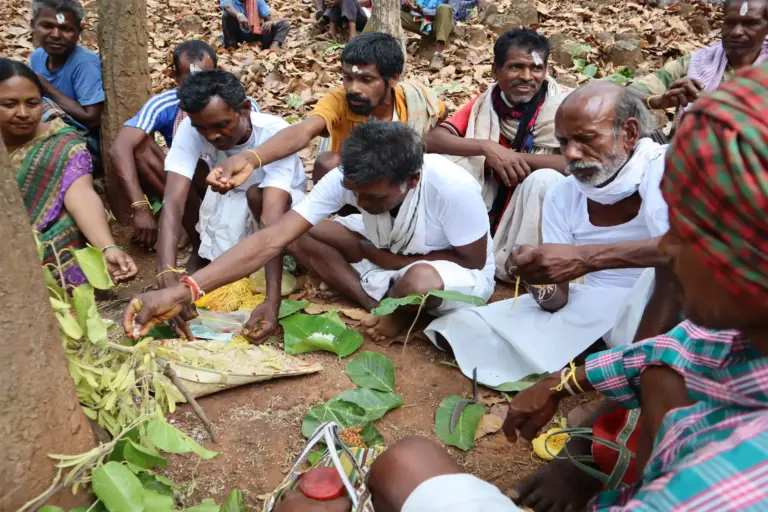
- The Asurs are a very small Austro-Asiatic ethnic group living primarily in the Indian state of Jharkhand, mostly in the Gumla, Lohardaga, Palamu, and Latehar districts.
- A small minority lives in the neighbouring states.
- They are included in the list of Particularly Vulnerable Tribal Groups (PVTGs).
- As per the 2011 census, the tribe has a population of around 23,000.
- They speak the Asur language, which belongs to the Munda family of Austro-asiatic languages.
- Occupations:
- Asurs are traditionally iron-smelters.
- They were once hunter-gatherers, having also involved in shifting agriculture. However, majority of them shifted into agriculture, with 91.19 percent enlisted as cultivators in the 2011 census.
- Their indigenous technology of iron smelting gives them a distinct identity, as they claim to have descended from the ancient Asuras, who were associated with the art of metal craft.
- When smelting, the Asur women sing a song relating the furnace to an expectant mother, encouraging the furnace to give a healthy baby, i.e., good quality and quantity of iron from the ore, and were thence, according to Bera, associated with the fertility cult.
- But now a days, a major section of the population is also attached with mining work.
- Society:
- The Asur society is divided into 12 clans. These Asur clans are named after different animals, birds, and food grains.
- Family is second-most prominent institution after the clan.
- They have their own community council (jati panch) where disputes are settled.
- They maintain putative kinship ties with Kharwar, Munda, and other neighbouring tribes.
- Except for the burial site, they share all other public spaces with their neighbours.
- Traditional male clothing is dhoti, while females wear tattoo marks (depicting totemic objects) upon their bodies as ornaments.
- The Asur follow the rule of monogamy, but in cases of barrenness, widower and widow hood, they follow the rule of bigamy or even Polygamy. At the time of marriage, they follow the rule of tribe endogamy.
- Religion: The Asur religion is a mixture of animism, animatism, naturalism, and ancestral worships.
Q1: Who are Particularly Vulnerable Tribal Groups (PVTGs)?
PVTGs are a more vulnerable group among tribal groups in India. These groups have primitive traits, geographical isolation, low literacy, zero to negative population growth rate and backwardness. Moreover, they are largely dependent on hunting for food and a pre-agriculture level of technology. Currently, there are 2.8 million PVTGs belonging to 75 tribes across 22,544 villages in 220 districts across 18 states and Union Territories in India. According to the 2011 Census, Odisha has the largest population of PVTGs at 866,000. It is followed by Madhya Pradesh at 609,000 and Andhra Pradesh (including Telangana) at 539,000.
Source: Asur tribes in Netarhat to get forest land rights: Gumla admin






 Last updated on April, 2026
→ UPSC Final Result 2025 is now out.
→ UPSC has released UPSC Toppers List 2025 with the Civil Services final result on its official website.
→ Anuj Agnihotri secured AIR 1 in the UPSC Civil Services Examination 2025.
→ UPSC Marksheet 2025 is now out.
→ UPSC Notification 2026 & UPSC IFoS Notification 2026 is now out on the official website at upsconline.nic.in.
→ UPSC Calendar 2026 has been released.
→ Check out the latest UPSC Syllabus 2026 here.
→ UPSC Prelims 2026 will be conducted on 24th May, 2026 & UPSC Mains 2026 will be conducted on 21st August 2026.
→ The UPSC Selection Process is of 3 stages-Prelims, Mains and Interview.
→ Prepare effectively with Vajiram & Ravi’s UPSC Prelims Test Series 2026 featuring full-length mock tests, detailed solutions, and performance analysis.
→ Enroll in Vajiram & Ravi’s UPSC Mains Test Series 2026 for structured answer writing practice, expert evaluation, and exam-oriented feedback.
→ Join Vajiram & Ravi’s Best UPSC Mentorship Program for personalized guidance, strategy planning, and one-to-one support from experienced mentors.
→ Shakti Dubey secures AIR 1 in UPSC CSE Exam 2024.
→ Also check Best UPSC Coaching in India