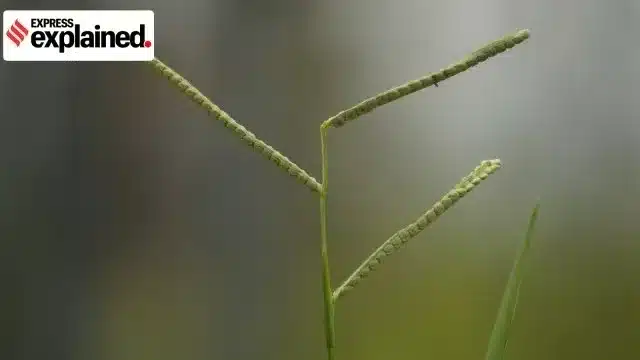
About Kodo millet:
- Kodo millet (Paspalum scrobiculatum) is also known as Kodra and Varagu in India.
- It is one of the “hardiest crops, drought tolerant with high yield potential and excellent storage properties,” It is rich in vitamins and minerals.
- It is a staple food for many tribal and economically weaker sections in India.
- Required climatic condition:
- The tropical and subtropical regions are best suited for Kodo millet cultivation.
- It is grown on poor soils, and widely distributed in arid and semi-arid regions.
- The millet is believed to have originated in India and Madhya Pradesh is one of the largest producers of the crop, according to a 2020 research paper.
- Apart from MP, the millet is cultivated in Gujarat, Karnataka, Chhattisgarh, and parts of Tamil Nadu.
- The crop is grown in India, Pakistan, the Philippines, Indonesia, Vietnam, Thailand, and West Africa.
- According to the research paper, “CPA (Cyclopiazonic acid) is one of the major mycotoxins associated with the kodo millet seeds causing kodo poisoning which was first recognised during the mid-eighties”.
- Kodo poisoning occurs mainly due to the consumption of kodo grains, when “maturing and harvesting if the grains had encountered with rainfall, resulting in a fungal infection leading to ‘poisoned kodo’ which is locally known as ‘Matawna Kodoo’ or ‘Matona Kodo’ in northern India.”
- Kodo poisoning mainly affects the nervous and cardiovascular systems and the chief symptoms include “vomiting, giddiness, and unconsciousness, small and rapid pulse, cold extremities, shaking of limbs and tremors.”
Q1: What are Millets?
Millets are a highly varied group of small-seeded grasses, widely grown around the world as cereal crops or grains for fodder and human food. This crop is favoured due to its productivity and short growing season under dry, high-temperature conditions (hardy and drought-resistant crops).
Source: How consumption of kodo millet led to the death of 10 elephants in MP






 Last updated on April, 2026
→ UPSC Final Result 2025 is now out.
→ UPSC has released UPSC Toppers List 2025 with the Civil Services final result on its official website.
→ Anuj Agnihotri secured AIR 1 in the UPSC Civil Services Examination 2025.
→ UPSC Marksheet 2025 is now out.
→ UPSC Notification 2026 & UPSC IFoS Notification 2026 is now out on the official website at upsconline.nic.in.
→ UPSC Calendar 2026 has been released.
→ Check out the latest UPSC Syllabus 2026 here.
→ UPSC Prelims 2026 will be conducted on 24th May, 2026 & UPSC Mains 2026 will be conducted on 21st August 2026.
→ The UPSC Selection Process is of 3 stages-Prelims, Mains and Interview.
→ Prepare effectively with Vajiram & Ravi’s UPSC Prelims Test Series 2026 featuring full-length mock tests, detailed solutions, and performance analysis.
→ Enroll in Vajiram & Ravi’s UPSC Mains Test Series 2026 for structured answer writing practice, expert evaluation, and exam-oriented feedback.
→ Join Vajiram & Ravi’s Best UPSC Mentorship Program for personalized guidance, strategy planning, and one-to-one support from experienced mentors.
→ Shakti Dubey secures AIR 1 in UPSC CSE Exam 2024.
→ Also check Best UPSC Coaching in India