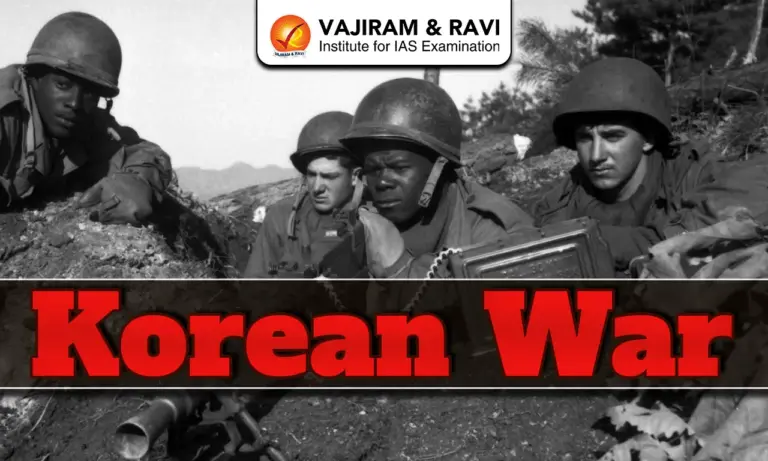
The Korean War (1950-1953) was an armed conflict on the Korean Peninsula fought between North Korea (Democratic People’s Republic of Korea) and South Korea (Republic of Korea) and their allies. North Korea was supported by China and the Soviet Union, while South Korea was supported by the United Nations Command (UNC) led by the United States. The conflict was one of the first major proxy wars of the Cold War.
Korean War Background
At the end of World War II, Korea, which had been under Japanese occupation since 1910, was liberated. However, instead of becoming unified, it was divided along the 38th parallel. The northern part came under Soviet influence and the southern part came under American influence.
Two separate governments were formed in 1948 – North Korea, officially the Democratic People’s Republic of Korea, led by Kim Il-sung and South Korea, officially the Republic of Korea, led by Syngman Rhee.
Both governments claimed to be the legitimate authority over the entire Korean Peninsula. The division, which was initially meant to be temporary, soon became permanent due to Cold War tensions between the United States and the Soviet Union.
Korean War Causes
Causes of the Korean War were as follows:
- Forced Division of Korea: The Korean War was primarily caused by the forced division of Korea after World War II, when the United States and the Soviet Union split the peninsula at the 38th Parallel without consulting the Korean people. The division was supposed to be temporary, but it gradually became permanent. Over time, the North and South developed different political systems and ideologies, which created deep tensions between them.
- Ideological Conflict: By 1948, two separate governments emerged. In the North, Kim Il Sung established a communist state and in the South, Syngman Rhee led an anti-communist government. Both leaders believed they were the rightful ruler of the entire peninsula. Reunification was their shared goal but each wanted it under their own ideology. This made conflict almost inevitable.
- Cold War Rivalry: The Korean Peninsula became a strategic battleground in the emerging Cold War. The United States feared the spread of communism after China became communist in 1949. The Soviet Union, on the other hand, wanted to expand its influence in Asia.
- Failure of Unification: Attempts were made to create a united Korea through joint US-Soviet discussions and later through United Nations-supervised elections. However, disagreements between the superpowers prevented any settlement. The Soviet Union rejected UN elections in the North, which led to the formal division into two states.
- Military Imbalance and Overconfidence: North Korea was heavily armed and trained with Soviet support, including tanks and aircraft. South Korea had limited military strength, as the United States had reduced its support and withdrawn troops in 1949. This imbalance gave North Korea confidence that it could win quickly.
- Support from Soviet Union and China: Kim Il Sung received approval from Stalin and assurance of support from China if the United States intervened. This external backing encouraged North Korea to launch the invasion in June 1950, believing the war would be short and successful.
- Immediate Trigger: On 25 June 1950, North Korean forces crossed the 38th Parallel and invaded South Korea in a planned military attack. The matter was taken to the United Nations Security Council, where the Soviet Union was absent due to its boycott. In its absence, the Security Council passed resolutions condemning North Korea and called for military assistance to South Korea. This marked the beginning of full-scale international involvement in the Korean War.
In 1953, an armistice agreement was signed, creating the Demilitarized Zone (DMZ) between North and South Korea. However, no formal peace treaty was signed.





Korean War Consequences
- Permanent Division of Korea: The war solidified the division of the Korean Peninsula. Even today, North and South Korea remain technically at war.
- Militarization of the Cold War: The Korean War transformed the Cold War from a political and diplomatic rivalry into an armed global confrontation. The United States increased defense spending and strengthened military alliances like NATO.
- Rise of China as a Military Power: China’s intervention demonstrated its willingness to challenge the United States militarily in Asia, establishing it as a major regional power.
- Strengthening of US Containment Policy: The war reinforced the American policy of containment, which later influenced US involvement in Vietnam and other regions.
- Human and Economic Costs: Millions of Korean civilians and soldiers died. Infrastructure in both North and South Korea was severely damaged. Families were permanently divided across the DMZ.
Korean War Significance
The Korean War holds lasting significance for several reasons:
- First, it was the first major armed conflict of the Cold War and set the pattern for future proxy wars.
- Second, it demonstrated the role of the United Nations in collective security, although in practice the war was largely US-led.
- Third, it led to the continued militarization of East Asia. The presence of US troops in South Korea continues even today.
- Fourth, the unresolved nature of the conflict has contributed to ongoing tensions, especially with North Korea’s nuclear ambitions in recent decades.
Conclusion
The Korean War was more than a conflict between two neighbouring states; it became the first major military clash of the Cold War. It permanently divided the Korean peninsula and deepened mistrust between communist and capitalist blocs. Since the war ended only with an armistice and not a peace treaty, tensions continue even today. In this sense, the Korean War remains a lasting reminder of the unresolved legacy of the Cold War.

 Last updated on March, 2026
→ UPSC Final Result 2025 is now out.
→ UPSC has released UPSC Toppers List 2025 with the Civil Services final result on its official website.
→ Anuj Agnihotri secured AIR 1 in the UPSC Civil Services Examination 2025.
→ UPSC Marksheet 2025 is now out.
→ UPSC Notification 2026 & UPSC IFoS Notification 2026 is now out on the official website at upsconline.nic.in.
→ UPSC Calendar 2026 has been released.
→ Check out the latest UPSC Syllabus 2026 here.
→ UPSC Prelims 2026 will be conducted on 24th May, 2026 & UPSC Mains 2026 will be conducted on 21st August 2026.
→ The UPSC Selection Process is of 3 stages-Prelims, Mains and Interview.
→ Prepare effectively with Vajiram & Ravi’s UPSC Prelims Test Series 2026 featuring full-length mock tests, detailed solutions, and performance analysis.
→ Enroll in Vajiram & Ravi’s UPSC Mains Test Series 2026 for structured answer writing practice, expert evaluation, and exam-oriented feedback.
→ Join Vajiram & Ravi’s Best UPSC Mentorship Program for personalized guidance, strategy planning, and one-to-one support from experienced mentors.
→ Shakti Dubey secures AIR 1 in UPSC CSE Exam 2024.
→ Also check Best UPSC Coaching in India
Korean War FAQs
Q1. When and between whom was the Korean War fought?+
Q2. Why did the Korean War begin?+
Q3. What role did the United Nations play in the war?+
Q4. How did the Korean War end?+
Q5. Why is the Korean War important today?+
Tags: korean war