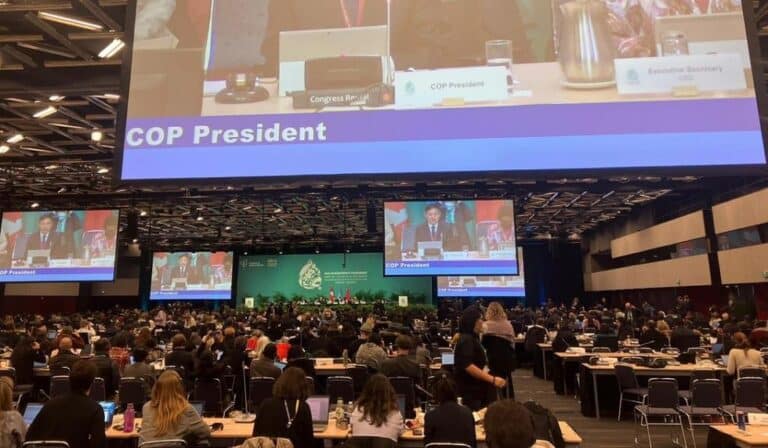
What is Kunming-Montreal Global Biodiversity Framework (GBF)?
- The framework has 23 targets that the world needs to achieve by 2030.
- The countries will monitor and report every five years or less on a large set of indicators related to progress.
- The Global Environment Facility has been requested to establish a Special Trust Fund to support the implementation of the Global Biodiversity Framework (“GBF Fund”).
What are the key provisions?
Conservation, protection and restoration:
- Countries committed to protecting 30% of land and 30% of coastal and marine areas by 2030, fulfilling the deal’s highest-profile goal, known as 30-by-30.
- The deal also aspires to restore 30% of degraded lands and waters throughout the decade, up from an earlier aim of 20%.
- And the world will strive to prevent destroying intact landscapes and areas with a lot of species, bringing those losses “close to zero by 2030”.
Money for nature:
- Signatories aim to ensure $200 billion per year is channelled to conservation initiatives, from public and private sources.
- Wealthier countries should contribute at least $20 billion of this every year by 2025, and at least $30 billion a year by 2030.
Big companies report impacts on biodiversity:
- Companies should analyse and report how their operations affect and are affected by biodiversity issues.
- The parties agreed to large companies and financial institutions being subject to “requirements” to make disclosures regarding their operations, supply chains and portfolios.
- This reporting is intended to progressively promote biodiversity, reduce the risks posed to business by the natural world, and encourage sustainable production.
Harmful subsidies:
- Countries committed to identify subsidies that deplete biodiversity by 2025, and then eliminate, phase out or reform them.
- They agreed to slash those incentives by at least $500 billion a year by 2030, and increase incentives that are positive for conservation.
Pollution and pesticides:
- One of the deal’Ss more controversial targets sought to reduce the use of pesticides by up to two-thirds.
- But the final language to emerge focuses on the risks associated with pesticides and highly hazardous chemicals instead, pledging to reduce those threats by “at least half”, and instead focusing on other forms of pest management.
- Overall, the Kunming-Montreal agreement will focus on reducing the negative impacts of pollution to levels that are not considered harmful to nature, but the text provides no quantifiable target here.
Monitoring and reporting progress:
- All the agreed aims will be supported by processes to monitor progress in the future, in a bid to prevent this agreement meeting the same fate as similar targets that were agreed in Aichi, Japan, in 2010, and never met.
- National action plans will be set and reviewed, following a similar format used for greenhouse gas emissions under U.N.-led efforts to curb climate change.
Q1) When is the International day for Biological diversity celebrated?
The United Nations has proclaimed May 22 , The International Day for Biological Diversity (IDB) to increase understanding and awareness of biodiversity issues.
Source: COP15: Kunming-Montreal Global Biodiversity Framework adopted








 Last updated on April, 2026
→ UPSC Final Result 2025 is now out.
→ UPSC has released UPSC Toppers List 2025 with the Civil Services final result on its official website.
→ Anuj Agnihotri secured AIR 1 in the UPSC Civil Services Examination 2025.
→ UPSC Marksheet 2025 is now out.
→ UPSC Notification 2026 & UPSC IFoS Notification 2026 is now out on the official website at upsconline.nic.in.
→ UPSC Calendar 2026 has been released.
→ Check out the latest UPSC Syllabus 2026 here.
→ UPSC Prelims 2026 will be conducted on 24th May, 2026 & UPSC Mains 2026 will be conducted on 21st August 2026.
→ The UPSC Selection Process is of 3 stages-Prelims, Mains and Interview.
→ Prepare effectively with Vajiram & Ravi’s UPSC Prelims Test Series 2026 featuring full-length mock tests, detailed solutions, and performance analysis.
→ Enroll in Vajiram & Ravi’s UPSC Mains Test Series 2026 for structured answer writing practice, expert evaluation, and exam-oriented feedback.
→ Join Vajiram & Ravi’s Best UPSC Mentorship Program for personalized guidance, strategy planning, and one-to-one support from experienced mentors.
→ Shakti Dubey secures AIR 1 in UPSC CSE Exam 2024.
→ Also check Best UPSC Coaching in India