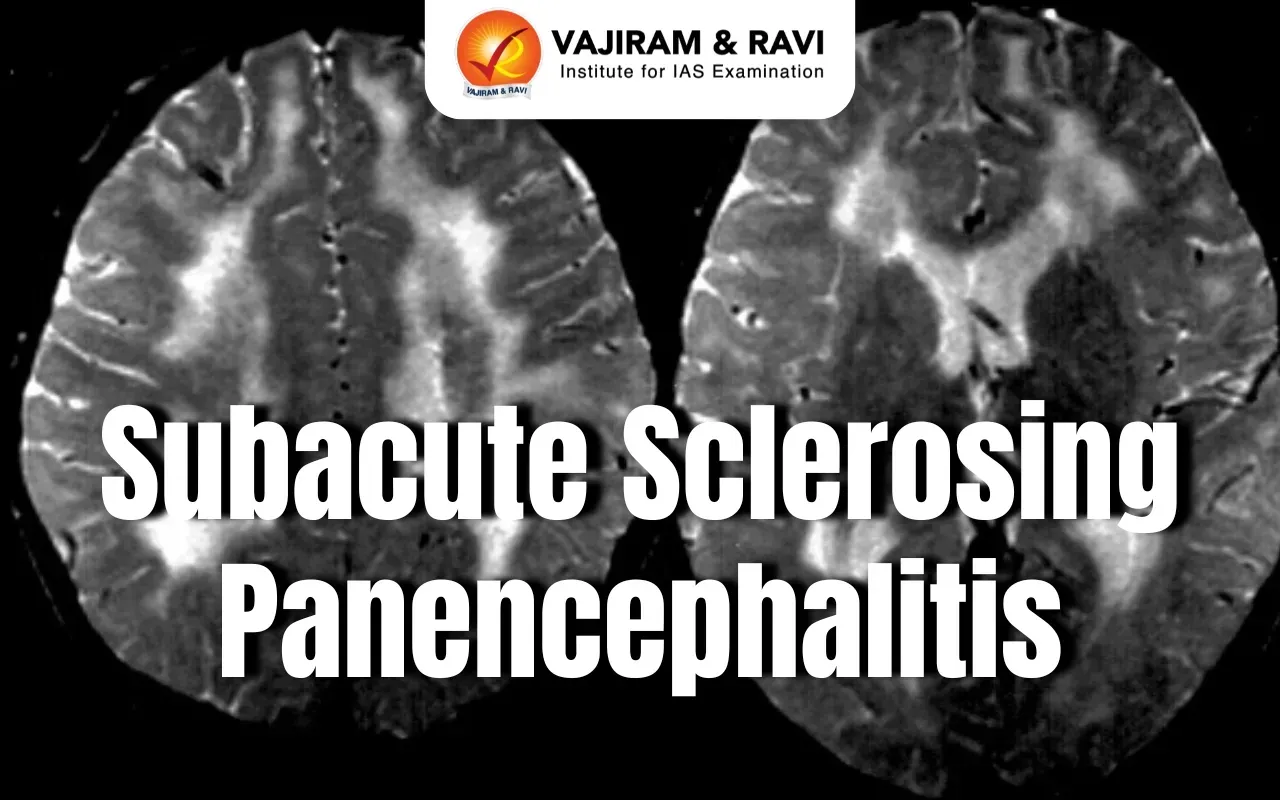
Subacute sclerosing panencephalitis Latest News
The Maharashtra state government recently informed the Bombay High Court that it is yet to frame a policy to deal with Subacute Sclerosing Panencephalitis (SSPE), an extremely rare but fatal neurodegenerative disease affecting children that has a fatality rate of 95%.
About Subacute sclerosing panencephalitis
- SSPE, also known as Dawson disease, is a progressive, disabling, and deadly brain disorder related to measles (rubeola) infection.
- The disease develops many years after the measles infection, even though the person seems to have fully recovered from the illness.
- SSPE has been reported in all parts of the world, but in western countries it is a rare disease.
- Males are more often affected than females. The disease generally occurs in children and adolescents.
- SSPE is a rare condition. It occurs in about 1 per 50,000 cases of natural measles.


Subacute sclerosing panencephalitis Cause
- Normally, the measles virus does not cause brain damage.
- However, an abnormal immune response to measles or, possibly, certain variant forms of the virus may cause severe illness and death.
- This response leads to brain inflammation (swelling and irritation) that may last for years.
Subacute sclerosing panencephalitis Symptoms
- The first symptoms of SSPE may be poor performance in schoolwork, forgetfulness, temper outbursts, distractibility, sleeplessness, and hallucinations.
- Sudden muscular jerks of the arms, head, or body may occur.
- Eventually, seizures may occur, together with abnormal uncontrollable muscle movements. Intellect and speech continue to deteriorate.
- Later, the muscles become increasingly rigid, and swallowing may become difficult.
- The swallowing difficulty sometimes causes people to choke on their saliva, resulting in pneumonia. People may become blind.
- In the final phases, the body temperature may rise, and the blood pressure and pulse become abnormal.
Subacute sclerosing panencephalitis Treatment
- High mortality rates are associated with SSPE, and there is no cure for SSPE.
- Treatment is generally aimed at regulating symptoms.
- Certain antiviral medicines and medicines that boost the immune system may be tried to slow the progression of the disease.
Source: HT

 Last updated on Oct, 2026
→ UPSC 2027 Notification will be released on 13 January 2027 at upsconline.nic.in.
→ Check Nobel Prize 2026 Winners List here.
→ Download PIB PRiSM Monthly Magazine 2026 here.
→ Check UPSC Monthly Current Affairs Magazine The Recitals here.
→ Check out the latest UPSC Syllabus here.
→ Download UPSC Model Answers for Mains 2026
→ UPSC Mains Question Paper 2026 is out now for Essay & GS Paper 1, 2, 3 & 4.
→ UPSC Calendar 2027 has been released.
→ Enroll in Vajiram & Ravi’s UPSC Mains Test Series 2027 for structured answer writing practice, expert evaluation, and exam-oriented feedback.
→ Join Vajiram & Ravi’s UPSC Mentorship Program 2027 for personalized guidance, strategy planning, and one-to-one support from experienced mentors.
→ Go through the UPSC Mains Previous Year Papers to enhance your preparation.
→ UPSC has released UPSC Toppers List 2025 with the Civil Services final result on its official website.
→ Also check Best UPSC Coaching in India
Subacute sclerosing panencephalitis (SSPE) FAQ's
Q1. What is Subacute Sclerosing Panencephalitis?+
Q2. Which age group is most affected by Subacute Sclerosing Panencephalitis?+
Q3. What is the main pathological effect in Subacute Sclerosing Panencephalitis?+
Q4. Is there a cure for Subacute Sclerosing Panencephalitis?+
Tags: Subacute Sclerosing Panencephalitis (SSPE)