



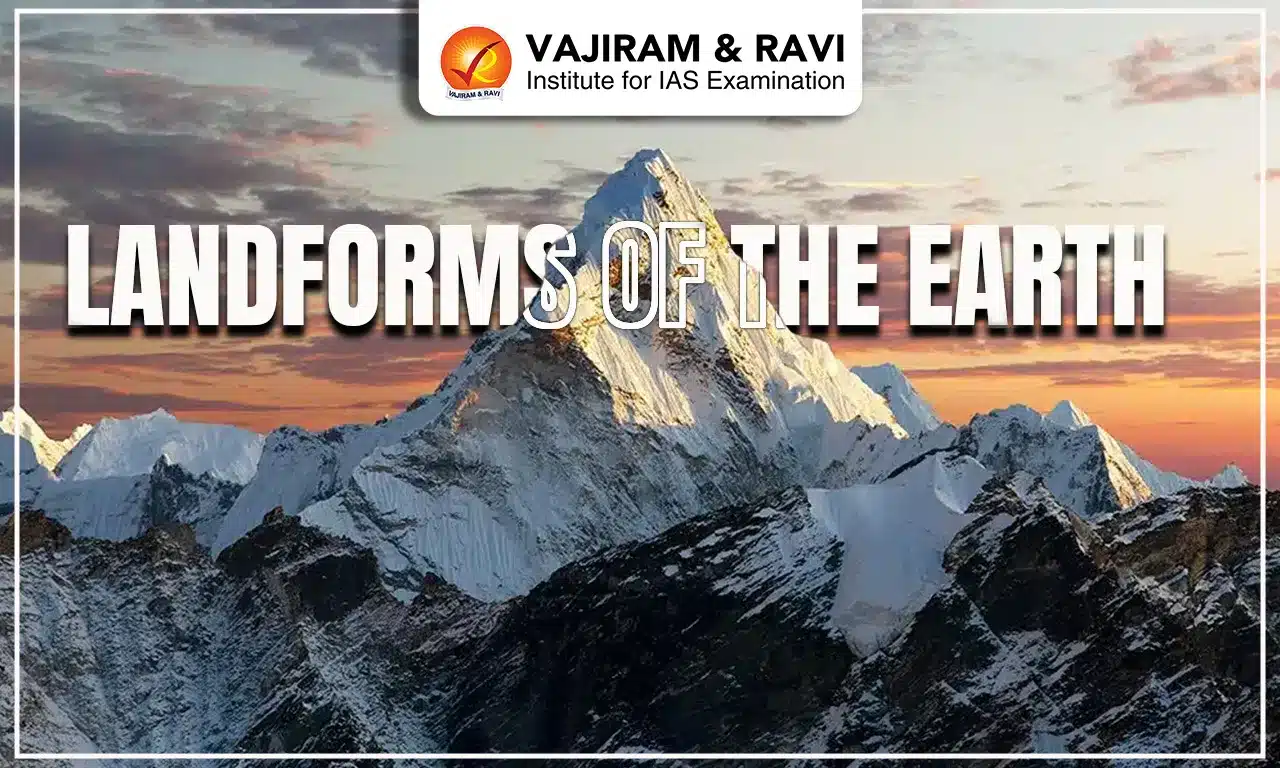
Landforms of the Earth are the natural physical features found on the Earth’s surface, shaped over time by geomorphic processes such as tectonic movements, weathering, erosion, and deposition. They include a wide variety of features, from mountains, valleys, and plateaus to plains, deserts, and coastal formations. Landforms of the Earth not only reflect the geological history of the planet but also influence climate, biodiversity, resource availability, and patterns of human settlement. Studying them is essential for understanding Earth’s evolution, managing natural resources, and planning sustainable development.
Landforms of the Earth
Landforms of the Earth are the natural physical features of the Earth’s surface, shaped by the continuous interaction of internal and external forces. They range from vast plains, high mountain ranges, and extensive plateaus to smaller features like valleys, sand dunes, and coastal formations. Even the ocean floor hosts striking landforms such as ridges, trenches, and seamounts.
Endogenic forces, including tectonic plate movements and volcanic activity, create primary landforms like mountains, rift valleys, and volcanic islands. On the other hand, exogenic processes such as weathering, erosion, and deposition modify these features into secondary landforms like deltas, beaches, floodplains, and canyons.
Landforms directly influence climate, ecosystems, and human life. They determine soil fertility, water flow, vegetation cover, and settlement patterns, making them central to agriculture, infrastructure, and resource use.
Landforms of the Earth Types
Landforms are classified based on their origin, structure, and the processes that shape them. Broadly, they can be grouped into the following categories:
| Landforms of the Earth Types | ||
|
Category |
Types |
Examples |
|
Major Landforms |
Mountains, Plateaus, Plains |
Himalayas, Deccan Plateau (India), Great Plains (USA) |
|
Minor Landforms |
Hills, Valleys, Canyons |
Aravalli Hills (India), Rhine Valley (Europe), Grand Canyon (USA) |
|
Fluvial Landforms (River Action) |
Erosional: V-shaped valleys, waterfalls, gorges Depositional: Floodplains, deltas, levees |
Nile Delta, Mississippi Floodplains |
|
Aeolian Landforms (Wind Action) |
Erosional: Deflation hollows, yardangs Depositional: Sand dunes, loess deposits |
Thar Desert dunes, Chinese Loess Plateau |
|
Glacial Landforms (Ice Action) |
Erosional: Cirques, U-shaped valleys, fjords Depositional: Moraines, drumlins, eskers |
Fjords of Norway, Moraines in the Alps |
|
Coastal Landforms (Wave Action) |
Erosional: Sea cliffs, arches, stacks Depositional: Beaches, spits, barrier islands |
White Cliffs of Dover (UK), Long Beach (USA) |
|
Karst Landforms (Solution Action) |
Sinkholes, caves, limestone pavements |
Carlsbad Caverns (USA), Chocolate Hills (Philippines) |
|
Volcanic Landforms |
Extrusive: Lava plateaus, volcanic cones Intrusive: Batholiths, dykes |
Mount Kilimanjaro (Tanzania), Deccan Traps (India), Sierra Nevada Batholiths |
|
Man-Made Landforms |
Terraces, dams, mines |
Tehri Dam (India), Bingham Canyon Mine (USA) |





Landforms of the Earth Significance
Landforms of the Earth are significant because they shape the environment, economy, and human life in multiple ways.
- They create diverse habitats that support a wide range of plant and animal species, and they influence climate by acting as barriers to winds and rainfall or by moderating temperatures in plains and plateaus.
- Fertile river valleys and plains provide the foundation for agriculture, while plateaus and flatlands serve as stable grounds for cities and infrastructure. Mountains and plateaus are rich in minerals, coal, and ores, while rivers and lakes supply vital water resources for drinking, farming, and hydropower.
- Landforms also contribute to economic activities, tourism thrives around unique landscapes like the Grand Canyon or Mount Everest, while forestry and fishing are supported by coastal and forested regions.
- Studying landforms helps in predicting and managing natural hazards such as floods, landslides, and earthquakes.
- Beyond practical uses, they serve as natural laboratories for scientific study, hold cultural and spiritual significance for many communities, and enhance the bond between humans and nature.
Landforms of the Earth Process
Landforms of the Earth are shaped by a combination of internal and external processes that continuously modify the Earth’s surface. These geomorphic processes range from tectonic activity deep within the Earth to surface actions like weathering, erosion, and deposition. To understand them clearly, the following table summarizes the key processes, their mechanisms, and the landforms they produce.
| Landforms of the Earth Process | |||
|
Process Type |
Sub-Process |
Description |
Examples of Resulting Landforms |
|
Endogenic Processes (Internal forces) |
Folding |
Compression of Earth’s crust forms ridges and mountains. |
Himalayas, Alps |
|
Faulting |
Movement of crustal blocks along fractures creates rift valleys or escarpments. |
East African Rift, Narmada Rift Valley |
|
|
Volcanism |
Eruption of magma forms volcanic cones and lava plateaus. |
Mount Fuji, Deccan Plateau |
|
|
Isostatic Movements |
Crust adjusts due to loading/unloading (e.g., glaciers). |
Glacial rebound in Scandinavia |
|
|
Exogenic Processes (External forces) |
Weathering |
Breakdown of rocks by physical, chemical, or biological means. |
Limestone caves (chemical), frost-shattered rocks (physical) |
|
Fluvial Processes |
Rivers erode, transport, and deposit sediments. |
Deltas (Nile Delta), floodplains, V-shaped valleys |
|
|
Aeolian Processes |
Wind action shapes landscapes in arid regions. |
Sand dunes, yardangs, loess deposits |
|
|
Glacial Processes |
Ice erodes and deposits material, carving landscapes. |
U-shaped valleys, fjords, moraines |
|
|
Marine Processes |
Waves erode and deposit material along coasts. |
Sea cliffs, beaches, spits |
|
|
Mass Wasting |
Downslope movement of material due to gravity. |
Landslides, talus slopes, debris flows |
|
|
Biological & Human Influence |
Biological Processes |
Living organisms form or modify landforms. |
Coral reefs, mangroves |
|
Human Activities |
Mining, deforestation, and construction reshape landscapes. |
Terraces, reservoirs, mines |
|

 Last updated on May, 2026
→ UPSC Prelims 2026 will be conducted on 24th May, 2026 & UPSC Mains 2026 will be conducted on 21st August 2026.
→ UPSC Prelims Admit Card 2026 will be released 10–15 days before prelims 2026 exam.
→ Prepare effectively with Vajiram & Ravi’s UPSC Prelims Test Series 2026 featuring full-length mock tests, detailed solutions, and performance analysis.
→ UPSC Final Result 2025 is now out.
→ UPSC has released UPSC Toppers List 2025 with the Civil Services final result on its official website.
→ Anuj Agnihotri secured AIR 1 in the UPSC Civil Services Examination 2025.
→ UPSC Notification 2026 & UPSC IFoS Notification 2026 is now out on the official website at upsconline.nic.in.
→ UPSC Calendar 2026 has been released.
→ Check out the latest UPSC Syllabus 2026 here.
→ The UPSC Selection Process is of 3 stages-Prelims, Mains and Interview.
→ Enroll in Vajiram & Ravi’s UPSC Mains Test Series 2026 for structured answer writing practice, expert evaluation, and exam-oriented feedback.
→ Join Vajiram & Ravi’s Best UPSC Mentorship Program for personalized guidance, strategy planning, and one-to-one support from experienced mentors.
→ Shakti Dubey secures AIR 1 in UPSC CSE Exam 2024.
→ Also check Best UPSC Coaching in India
Landforms of the Earth FAQs
Q1. What are the 5 landforms of the earth?+
Q2. What are the main major landforms?+
Q3. What are the 5 types of landforms class 6 answer?+
Q4. What are the 1st, 2nd, and 3rd order landforms?+
Q5. How many landforms are there on Earth?+
Tags: landforms of the earth