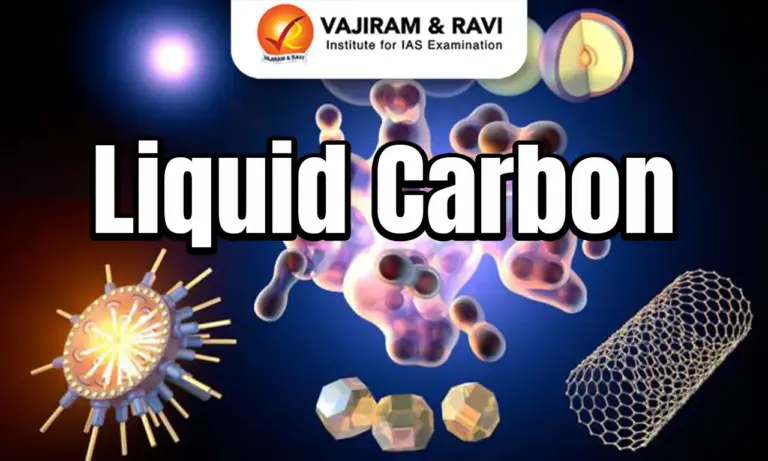
Liquid Carbon Latest News
Scientists have for the first time observed the atomic structure of liquid carbon using the high-power DIPOLE 100-X laser and ultrashort X-ray pulses from the European XFEL (X-ray Free Electron Laser) in Germany.
About Liquid Carbon
- Liquid carbon refers to carbon in a liquid state, which is not naturally stable under normal temperature and pressure conditions.
- Carbon typically exists in solid forms like graphite, diamond, or as gas (CO₂) when oxidised.
- Liquid carbon is a transient phase, and its study is important for understanding:
- Planetary core compositions (e.g., carbon-rich exoplanets),
- High-energy astrophysical processes,
- And high-temperature material behaviour in laser-material interactions and nuclear science.





Why Liquid Carbon Is Hard to Study
- Carbon does not melt under normal pressure; it transitions directly from solid to gas (sublimation), making lab-based liquid-phase studies almost impossible.
- Liquid carbon only forms under extreme conditions:
- Temperatures ~4500°C,
- Very high pressures,
- Conditions that no conventional container can withstand.
- Thus, laser-driven compression was employed to briefly liquefy solid carbon for nanoseconds, enabling real-time measurement.
Experimental Technique and Innovation
- The DIPOLE 100-X laser was used to generate compression waves through the carbon sample, converting it to the liquid state for a billionth of a second.
- During this fleeting moment, the European XFEL’s ultrashort X-ray pulse was used to irradiate the sample, causing the X-ray light to diffract off atoms.
- The resulting diffraction pattern revealed the atomic arrangement of liquid carbon.
- Multiple iterations of the experiment with varying delays and conditions were used to create a step-by-step “movie” of the solid-to-liquid transition.
Major Findings of the Study
- Liquid carbon has a water-like structure, with four nearest atomic neighbours, resembling the structure of solid diamond.
- The experiment confirmed earlier theoretical simulations and helped to precisely determine the melting point of carbon under high pressure.
- These insights are important for:
- Planetary science, as liquid carbon exists in the interiors of planets.
- Nuclear fusion technology, where carbon-based materials are often involved under extreme conditions.
Liquid Carbon FAQs
Q1: What is Liquid Carbon?
Ans: Liquid Carbon refers to carbon in a liquid state, which is not naturally stable under normal temperature and pressure.
Q2: Why is Liquid Carbon rare?
Ans: It typically forms only under extreme conditions like temperatures above 4500°C and very high pressure, making it transient and difficult to study in laboratory settings.
Source: PHY

 Last updated on March, 2026
→ UPSC Final Result 2025 is now out.
→ UPSC has released UPSC Toppers List 2025 with the Civil Services final result on its official website.
→ Anuj Agnihotri secured AIR 1 in the UPSC Civil Services Examination 2025.
→ UPSC Marksheet 2025 is now out.
→ UPSC Notification 2026 & UPSC IFoS Notification 2026 is now out on the official website at upsconline.nic.in.
→ UPSC Calendar 2026 has been released.
→ Check out the latest UPSC Syllabus 2026 here.
→ UPSC Prelims 2026 will be conducted on 24th May, 2026 & UPSC Mains 2026 will be conducted on 21st August 2026.
→ The UPSC Selection Process is of 3 stages-Prelims, Mains and Interview.
→ Prepare effectively with Vajiram & Ravi’s UPSC Prelims Test Series 2026 featuring full-length mock tests, detailed solutions, and performance analysis.
→ Enroll in Vajiram & Ravi’s UPSC Mains Test Series 2026 for structured answer writing practice, expert evaluation, and exam-oriented feedback.
→ Join Vajiram & Ravi’s Best UPSC Mentorship Program for personalized guidance, strategy planning, and one-to-one support from experienced mentors.
→ Shakti Dubey secures AIR 1 in UPSC CSE Exam 2024.
→ Also check Best UPSC Coaching in India
Tags: liquid carbon prelims pointers upsc current affairs upsc prelims current afffairs