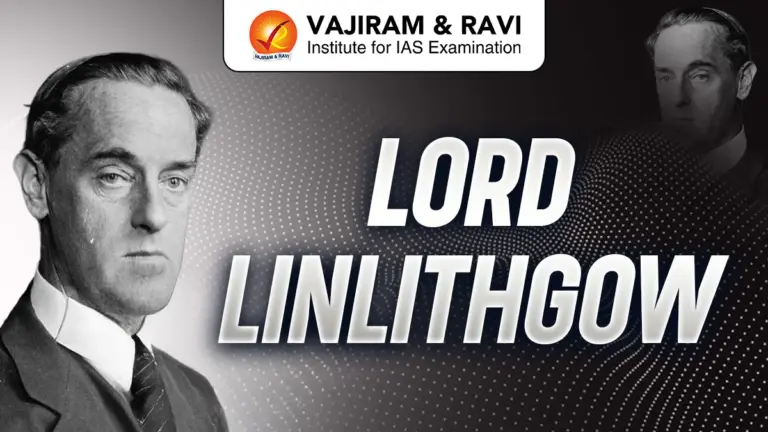
Lord Linlithgow, formally known as Victor Alexander John Hope, was Statesman, Agriculturalist and Colonial Administrator under the British Administration. He was the longest serving Viceroy of British India who held the office for 7.5 years from April 1936 to October 1943. His tenure coincided with critical constitutional changes, the outbreak of the Second World War and the most intense phase of the Indian freedom struggle. He implemented the Government of India Act 1935, oversaw provincial autonomy and took decisive wartime actions without Indian consent. His administration shaped India’s political trajectory, deepened nationalist resistance and left a controversial legacy marked by political repression, economic strain and humanitarian crises.
Lord Linlithgow Biography
Lord Linlithgow was born on 24 September 1887 in Abercorn, West Lothian, Scotland. He succeeded as the 2nd Marquess of Linlithgow in 1908. He was educated at an elite British institution. He emerged as a Unionist politician, agricultural expert and colonial administrator. Before serving as the Viceroy of India, he chaired the Royal Commission on Agriculture in India from 1926 to 1928 and gained deep exposure to Indian rural conditions. In his later life, he acted as Lord High Commissioner to the Church of Scotland. Linlithgow retired on 1 October 1943 after more than seven years and was succeeded by Lord Wavell amid worsening political deadlock. He later died on 5 January 1952 at the age of 64 at Linlithgowshire, Scotland.
Lord Linlithgow Contributions
The policies designated by Lord Linlithgow significantly influenced provincial politics, centre and province relations and Britain’s wartime control over India. The important works of Linlithgow has been listed below:
- Implementation of Government of India Act 1935: Linlithgow operationalised the Government of India Act 1935 by conducting provincial elections in 1937, enabling elected ministries in British Indian provinces and ending dyarchy at the provincial level.
- Provincial Autonomy System: He ensured smooth functioning of autonomous provincial governments, especially Congress ministries in five provinces, by limiting excessive use of governors’ reserve powers initially.
- Administrative Reorganisation: During his tenure, Sind was separated from Bombay Presidency, Orissa became a distinct province and Burma was constitutionally separated from India in 1937.
- Agricultural Policy Experience: Drawing from his earlier commission work, he promoted administrative focus on agricultural productivity, though wartime priorities limited large scale rural reforms.
- Expansion of Executive Council: Despite Congress refusal, Linlithgow increased Indian representation in the Viceroy’s Executive Council, attempting limited inclusiveness without transferring real power.
- Wartime Mobilisation: Under his leadership, over two million Indian soldiers voluntarily joined British forces during World War II, making the Indian Army the largest volunteer force globally by 1943.




Events During Lord Linlithgow Tenure
The tenure of Lord Linlithgow witnessed vast political events that reshaped Indian nationalism, intensified communal divisions and escalated confrontation between colonial authority and mass movements as highlighted below:
- Provincial Elections of 1937: Elections under the 1935 Act resulted in Congress forming ministries in eight provinces, while the Muslim League failed to secure power, deepening political rivalry.
- Declaration of World War II 1939: In September 1939, Linlithgow declared India at war with Germany without consulting Indian leaders, triggering nationwide political outrage and Congress protest.
- Resignation of Congress Ministries: Following the unilateral war declaration, Congress ministries resigned during October to November 1939, ending constitutional cooperation and expanding British administrative control.
- August Offer: Linlithgow proposed post war constitutional framing and expanded advisory roles in 1940, but rejected immediate self government, leading to its rejection by Congress and Muslim League.
- Individual Satyagraha 1940: Gandhi launched limited civil resistance through the selected individuals like Vinoba Bhave and Jawaharlal Nehru, highlighting opposition while avoiding mass violence initially.
- Lahore Resolution 1940: During his tenure, the Muslim League passed the Lahore Resolution demanding separate Muslim majority states, formalising the “Two Nation Theory”.
- Cripps Mission 1942: Sent by Britain amid Japanese advances, the mission promised post-war dominion status but allowed provincial secession, leading to rejection by all major Indian groups.
- Quit India Movement 1942: Linlithgow responded to the Quit India Resolution by arresting Congress leaders immediately, suppressing the movement through force, censorship and mass detentions.
- Japanese Threat and Military Expansion: Japanese occupation of Andaman Islands in 1942 intensified wartime urgency, reinforcing Linlithgow’s repressive measures to maintain internal security.
- Bengal Famine 1943: His administration faced severe criticism for policy failures during the Bengal famine, which caused nearly three million deaths amid food shortages and wartime inflation.
- Political and Economic Criticism: Leaders like V. P. Menon and Tej Bahadur Sapru criticised his regime for deepening divisions, rising living costs and weakening political unity.

 Last updated on March, 2026
→ UPSC Final Result 2025 is now out.
→ UPSC has released UPSC Toppers List 2025 with the Civil Services final result on its official website.
→ Anuj Agnihotri secured AIR 1 in the UPSC Civil Services Examination 2025.
→ UPSC Marksheet 2025 is now out.
→ UPSC Notification 2026 & UPSC IFoS Notification 2026 is now out on the official website at upsconline.nic.in.
→ UPSC Calendar 2026 has been released.
→ Check out the latest UPSC Syllabus 2026 here.
→ UPSC Prelims 2026 will be conducted on 24th May, 2026 & UPSC Mains 2026 will be conducted on 21st August 2026.
→ The UPSC Selection Process is of 3 stages-Prelims, Mains and Interview.
→ Prepare effectively with Vajiram & Ravi’s UPSC Prelims Test Series 2026 featuring full-length mock tests, detailed solutions, and performance analysis.
→ Enroll in Vajiram & Ravi’s UPSC Mains Test Series 2026 for structured answer writing practice, expert evaluation, and exam-oriented feedback.
→ Join Vajiram & Ravi’s Best UPSC Mentorship Program for personalized guidance, strategy planning, and one-to-one support from experienced mentors.
→ Shakti Dubey secures AIR 1 in UPSC CSE Exam 2024.
→ Also check Best UPSC Coaching in India
Lord Linlithgow FAQs
Q1. Who was Lord Linlithgow?+
Q2. Which major law was implemented during Lord Linlithgow’s tenure?+
Q3. Why did Congress ministries resign in 1939 ?+
Q4. What was the August Offer 1940 of Lord Linlithgow?+
Q5. Why is the tenure of Lord Linlithgow considered controversial?+
Tags: lord linlithgow modern history upsc modern history notes