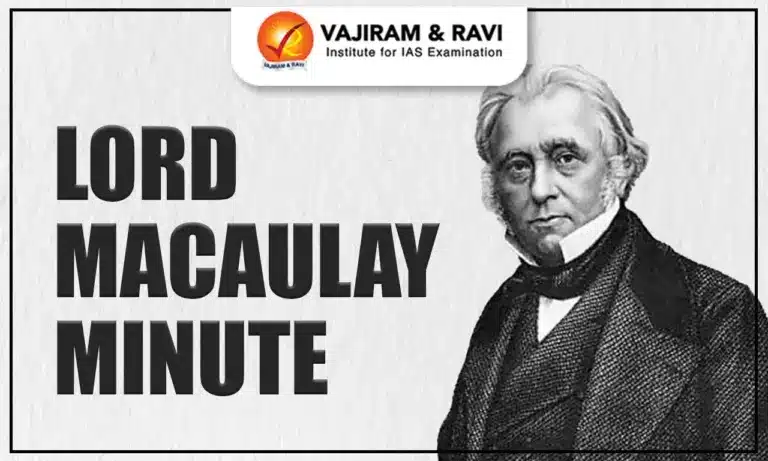
Lord Macaulay Minute was an important document in colonial India’s educational history as it advocated the introduction and promotion of English education for Indians. British historian and politician Thomas Babington Macaulay introduced this document on 2 February 1835. Macaulay’s vision was to create a class of Indians who could act as intermediaries between the British rulers and the Indian masses. He aimed to develop individuals who would be “Indian in blood and colour, but English in tastes, opinions, morals, and intellect.” Macaulay dismissed the worth of traditional Indian learning, claiming that European knowledge especially in science and social thought was way above. In this article, we are going to cover Lord Macaulay minute, its historical background, features and objectives.
Lord Macaulay Minute Historical Background
- In the beginning, the British East India Company showed little interest in education, focusing solely on trade and profit.
- Over the period, they realized the strategic importance of education and began setting up limited institutions of higher learning.
- Early efforts promoted Indian classical learning in languages such as Sanskrit, Arabic, and Persian (the court language at the time).
- The Charter Act of 1813 was the first concrete step, allocating ₹1 lakh annually for education. However, missionary efforts largely focused on religious and moral instruction, aiming to Christianize Indians.
- A major debate emerged between:
- Orientalists : who supported traditional Indian learning in native languages.
- Anglicists: who advocated for English education and Western sciences.
- To resolve this, Macaulay arrived in India in 1834 as the President of the General Committee of Public Instruction (GCPI). His Minute finally tilted the balance in favour of the Anglicists.
Macaulay’s Minute Features
Following were the features of Macaulay’s Minutes:
- Education funds should be used exclusively for promoting European literature and science in English.
- Stipends for students already enrolled in traditional institutions would continue, but no new grants would be provided for Oriental studies.
- No government support for printing Oriental works.
- All resources were to be diverted towards English education, with the belief that it would serve as the gateway to modern knowledge.





Lord Macaulay’s Minute Objectives
Following are the objectives of Lord Macaulay’s Minute:
- Prioritization of Western Education: Funds should be spent only on Western sciences and literature.
- Closure of Oriental Colleges: Institutions teaching only Eastern philosophy and classics were to be discontinued.
- Downward Filtration Theory: Only a small group of elites would be educated, who in turn were expected to spread knowledge to the masses.
- Cultural Assimilation: Creating a loyal class of Indians aligned with British values and interests.
Lord Macaulay
- Thomas Babington Macaulay (1800-1859) was a politician, historian, and essayist.
- He is known as the architect of India’s modern education system under British rule.
- Lord Macaulay advocated the superiority of Western knowledge, famously stating that “a single shelf of a good European library was worth the whole native literature of India and Arabia.”
- He was a strong believer in liberal progress and European traditions, while dismissing Indian and Arabic learning as inferior.
Downward Filtration Theory
- Downward Filtration Theory was proposed in Macaulay’s Minute of 1835.
- The theory suggested providing education only to a small upper-class elite, who would act as agents of knowledge diffusion for the wider population.
- It is based on the belief that education would “trickle down” from elites to the masses.
- In practice, it led to a social and educational divide, benefiting the upper classes while leaving the majority uneducated.

 Last updated on April, 2026
→ UPSC Final Result 2025 is now out.
→ UPSC has released UPSC Toppers List 2025 with the Civil Services final result on its official website.
→ Anuj Agnihotri secured AIR 1 in the UPSC Civil Services Examination 2025.
→ UPSC Marksheet 2025 is now out.
→ UPSC Notification 2026 & UPSC IFoS Notification 2026 is now out on the official website at upsconline.nic.in.
→ UPSC Calendar 2026 has been released.
→ Check out the latest UPSC Syllabus 2026 here.
→ UPSC Prelims 2026 will be conducted on 24th May, 2026 & UPSC Mains 2026 will be conducted on 21st August 2026.
→ The UPSC Selection Process is of 3 stages-Prelims, Mains and Interview.
→ Prepare effectively with Vajiram & Ravi’s UPSC Prelims Test Series 2026 featuring full-length mock tests, detailed solutions, and performance analysis.
→ Enroll in Vajiram & Ravi’s UPSC Mains Test Series 2026 for structured answer writing practice, expert evaluation, and exam-oriented feedback.
→ Join Vajiram & Ravi’s Best UPSC Mentorship Program for personalized guidance, strategy planning, and one-to-one support from experienced mentors.
→ Shakti Dubey secures AIR 1 in UPSC CSE Exam 2024.
→ Also check Best UPSC Coaching in India
Lord Macaulay Minute FAQs
Q1. What was introduced following Macaulay's Minute of 1835?+
Q2. What were the main features of Lord Macaulay's recommendations?+
Q3. Who was the Governor-General of India during Macaulay's Minute?+
Q4. What is the difference between Macaulay Minute and Wood's Despatch?+
Q5. What was Macaulay's Minute?+
Tags: lord macaulay minute