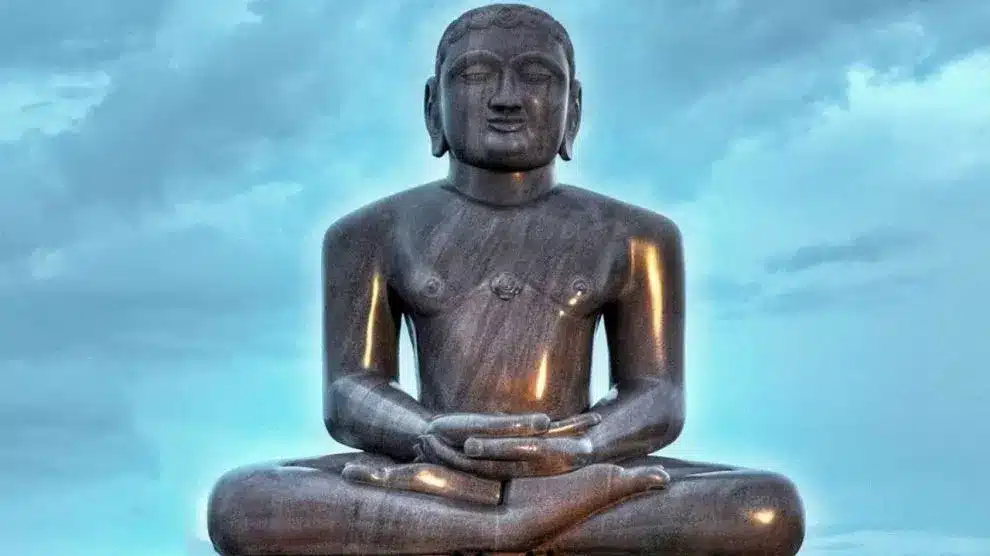
About Lord Mahavir
- He was the twenty-fourth and the last Tirthankara of the Jain religion.
- Mahavir was born in 599 B.C. as a prince in Bihar. At the age of 30, he left his family and royal household, gave up his worldly possessions, including clothing, and became a monk.
- He followed an extreme ascetic life, attaining kevala, the stage of omniscience or highest perception.
- Teaching a doctrine of austerity, Mahavira advocated nonviolence (ahimsa) in all circumstances and the acceptance of the mahavratas, the five “great vows” of renunciation.
- At the heart of right conduct for Jains lie the five great vows:
- Nonviolence (Ahimsa): not to cause harm to any living beings
- Truthfulness (Satya): to speak the harmless truth only
- Non-stealing (Asteya): not to take anything not properly given
- Chastity (Brahmacharya): not to indulge in sensual pleasure
- Non-possession/Non-attachment (Aparigraha): complete detachment from people, places, and material things.
- Mahavir’s Teachings:
- He organized his followers into a fourfold order, namely monk (Sadhu), nun (Sadhvi), layman (Shravak), and laywoman (Shravika). Later on, they are known as Jains.
- The ultimate objective of his teaching is how one can attain total freedom from the cycle of birth, life, pain, misery, and death, and achieve the permanent blissful state of one’s self. This is also known as liberation, nirvana, absolute freedom, or Moksha.
- He preached that right faith (samyak-darshana), right knowledge (samyak-jnana), and right conduct (samyak-charitra) together will help attain the liberation of one’s self.
- Mahavir’s message of nonviolence (Ahimsa), truth (Satya), non-stealing (Achaurya), celibacy (Brahma charya), and non-possession (Aparigraha) is full of universal compassion.
- Mahavir rejected the concept of God as a creator, a protector, and a destroyer of the universe. He also denounced the worshiping of gods and goddesses as a means of material gains and personal benefits.
Who are Tirthankaras?
- Tirthankaras are also known as Arihants or Jinas.
- Arihant: One who destroys his inner enemies like anger, greed, passion, ego, etc.
- Jina: One who conquers his inner enemies like anger, greed, passion, ego, etc. The followers of Jina are known as Jains.
- Tirthankara: Those Jinas who establishes the four-fold order (Monk, Nun, Layman, and Laywoman) of religion.
- According to Jain philosophy, all Tirthankaras were human beings but they have attained a state of perfection or enlightenment through meditation and self-realization.
- They are the Gods of Jains.
Q1) What is Jainism?
Jainism is one of the three most ancient religions of India, with roots that go back to at least the mid-first century B.C.E. Today, it is still an integral part of Indian culture. Jainism teaches that the path to enlightenment is through nonviolence and reducing harm to living things (including plants and animals) as much as possible.
Source: A thousand year old Mahavir statue has been discovered in Tamil Nadu!


 Last updated on Oct, 2026
→ UPSC 2027 Notification will be released on 13 January 2027 at upsconline.nic.in.
→ Check Nobel Prize 2026 Winners List here.
→ Download PIB PRiSM Monthly Magazine 2026 here.
→ Check UPSC Monthly Current Affairs Magazine The Recitals here.
→ Check out the latest UPSC Syllabus here.
→ Download UPSC Model Answers for Mains 2026
→ UPSC Mains Question Paper 2026 is out now for Essay & GS Paper 1, 2, 3 & 4.
→ UPSC Calendar 2027 has been released.
→ Enroll in Vajiram & Ravi’s UPSC Mains Test Series 2027 for structured answer writing practice, expert evaluation, and exam-oriented feedback.
→ Join Vajiram & Ravi’s UPSC Mentorship Program 2027 for personalized guidance, strategy planning, and one-to-one support from experienced mentors.
→ Go through the UPSC Mains Previous Year Papers to enhance your preparation.
→ UPSC has released UPSC Toppers List 2025 with the Civil Services final result on its official website.
→ Also check Best UPSC Coaching in India