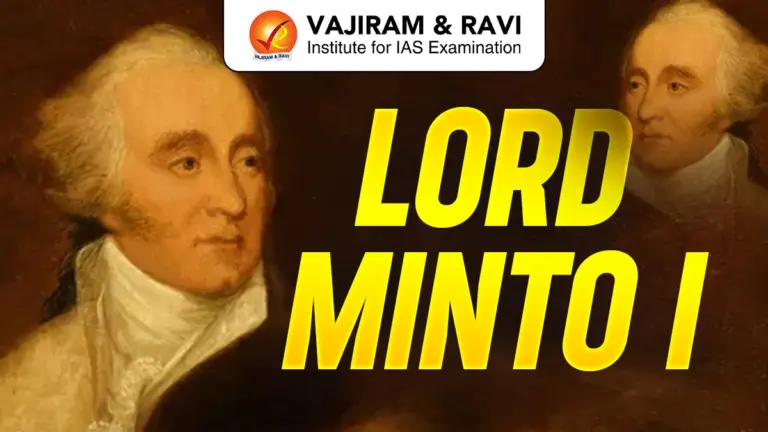
Lord Minto I, formally known as Gilbert Elliot Murray Kynynmound, was a British statesman, diplomat and administrator who served as Governor General of India from 31 July 1807 to 4 October 1813. His tenure in India coincided with the Napoleonic Wars, making foreign threats and diplomatic balance his primary concern. Lord Minto I is remembered for restraining French expansion in Asia, strengthening British strategic influence and maintaining relative peace within India through cautious and strategic means of governance.
Lord Minto I Biography
Lord Minto I was born on 23 April 1751 in Edinburgh to Sir Gilbert Elliot, 3rd Baronet in a prominent Scottish family deeply connected with colonial administration and British politics. He was educated under the guidance of philosopher David Hume in Paris before studying at the University of Edinburgh and Christ Church, Oxford. He was called to the Bar in 1774 and entered Parliament in 1776 as an independent, serving until 1795. He later became Viceroy of the Anglo-Corsican Kingdom, Envoy to Austria, President of the Board of Control and finally Governor General of India in 1807, governing until 1813. Minto died at the age of 63 on 21 June 1814 at Stevenage, Hertfordshire.
Read about: Lord Reading
Lord Minto I Contributions
The contributions of Lord Minto I were more external and geopolitical than territorial within India as highlighted below:
- Diplomatic Stabilisation of Northern India: Lord Minto avoided aggressive expansion in India and followed a non-interventionist approach, ensuring internal stability while focusing British resources on countering European threats rather than Indian warfare.
- Treaty with Ranjit Singh in 1809: The Treaty of Amritsar formally ended Sikh expansion east of the Sutlej and secured British possessions without military conflict, ensuring frontier stability for decades.
- Containment of French Influence: Lord Minto systematically reduced French political and military influence in Asia by targeting their overseas bases rather than engaging in costly continental wars within India.
- Expansion into the East Indies: Under his leadership, British forces occupied Dutch and French possessions such as Java, Amboina and the Moluccas, significantly expanding British control in Southeast Asia during the Napoleonic period.
- Strategic Naval Dominance: By capturing key islands like Mauritius and Bourbon in 1810, Minto ensured British naval supremacy in the Indian Ocean, safeguarding trade routes vital for the East India Company.
- Diplomatic Missions to West Asia: He sent missions to Persia, Afghanistan and Sind to block any potential Franco-Russian invasion routes into India, strengthening India’s external security through alliances.
- Release of Matthew Flinders: In 1810, Lord Minto successfully secured the release of British navigator Matthew Flinders from six years of imprisonment by French authorities in Mauritius, reflecting his diplomatic effectiveness.
- Administration: His governance emphasised moderation, financial discipline and avoidance of unnecessary military campaigns, aligning with the cautious policies earlier followed by Lord Cornwallis.





Events During Lord Minto I Tenure
Lord Minto I’s tenure was marked by significant diplomatic, military and geopolitical events shaped by global conflicts rather than internal Indian revolts or wars.
- Appointment as Governor General in 1807: He assumed office on 31 July 1807 under King George III, succeeding Sir George Barlow, at a time when British India faced external threats from Napoleonic France.
- Napoleonic Wars: European wars directly influenced Indian policy, as Lord Minto stated that events in Europe prevented forward expansion in India, while Indian responsibilities prevented withdrawal from Asian affairs.
- Treaty of Amritsar 1809: He concluded a crucial treaty with Maharaja Ranjit Singh, recognising the Sutlej River as the boundary between Sikh territories and British India, preventing conflict and ensuring long term peace on the north-west frontier.
- Persian and Afghan Missions: John Malcolm was sent to Persia and Mountstuart Elphinstone to Kabul to secure assurances against French military access, successfully neutralising continental threats to India.
- Sind Diplomacy: Agreements with the Amirs of Sind ensured denial of passage to French forces, strengthening India’s western defensive buffer without direct annexation.
- Conquest of Bourbon and Mauritius 1810: British forces captured these French islands, dismantling French naval bases in the Indian Ocean and ending their capacity to threaten British maritime trade.
- Annexation of Dutch Possessions: The British occupied Amboina and the Spice Islands, crucial for global trade in spices, weakening Napoleonic allies and strengthening Company revenues.
- Capture of Java in 1811: The successful British invasion of Java marked one of the largest overseas operations of the East India Company, extending British dominance deep into Southeast Asia.
- Control over Pindari Threats: Lord Minto restrained the Pindari leader Amir Khan from interfering in Berar through diplomatic pressure and limited force, avoiding a wider conflict.

 Last updated on March, 2026
→ UPSC Final Result 2025 is now out.
→ UPSC has released UPSC Toppers List 2025 with the Civil Services final result on its official website.
→ Anuj Agnihotri secured AIR 1 in the UPSC Civil Services Examination 2025.
→ UPSC Marksheet 2025 is now out.
→ UPSC Notification 2026 & UPSC IFoS Notification 2026 is now out on the official website at upsconline.nic.in.
→ UPSC Calendar 2026 has been released.
→ Check out the latest UPSC Syllabus 2026 here.
→ UPSC Prelims 2026 will be conducted on 24th May, 2026 & UPSC Mains 2026 will be conducted on 21st August 2026.
→ The UPSC Selection Process is of 3 stages-Prelims, Mains and Interview.
→ Prepare effectively with Vajiram & Ravi’s UPSC Prelims Test Series 2026 featuring full-length mock tests, detailed solutions, and performance analysis.
→ Enroll in Vajiram & Ravi’s UPSC Mains Test Series 2026 for structured answer writing practice, expert evaluation, and exam-oriented feedback.
→ Join Vajiram & Ravi’s Best UPSC Mentorship Program for personalized guidance, strategy planning, and one-to-one support from experienced mentors.
→ Shakti Dubey secures AIR 1 in UPSC CSE Exam 2024.
→ Also check Best UPSC Coaching in India
Lord Minto I FAQs
Q1. Who was Lord Minto I?+
Q2. What was the Treaty of Amritsar 1809 signed under Lord Minto I?+
Q3. What territories were captured during Lord Minto I’s tenure?+
Q4. What policy did Lord Minto I follow in India?+
Q5. How did Lord Minto I counter the French threat to India?+
Tags: lord minto I