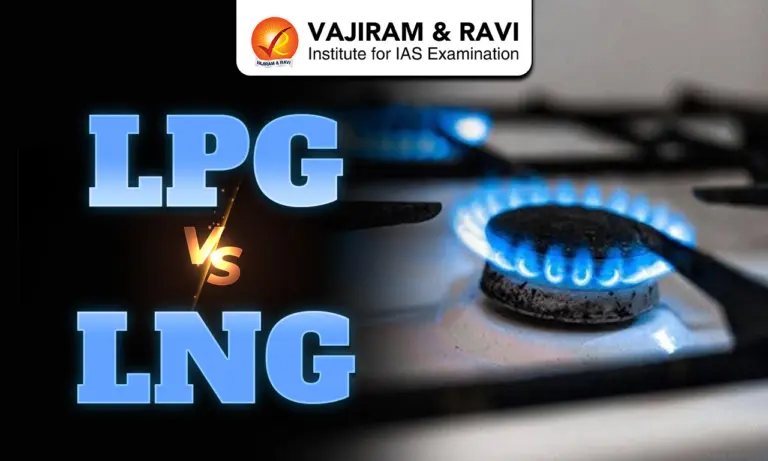
LPG vs LNG Latest News
- The disruption of shipping through the Strait of Hormuz due to the West Asia conflict has significantly impacted India’s energy supplies, especially LPG and LNG.
- India imports about 60% of its LPG needs, and since 90% of these imports pass through the Strait, around 54% of LPG supply is affected. This has forced the government to cut supplies to commercial and industrial users to prioritise households.
- Natural gas has also been impacted, though to a lesser extent. India imports about half of its gas as LNG, with 55–60% coming via the Strait, leading to a disruption of roughly 30% of supply.
- To manage this, supplies to industries have been reduced while ensuring availability for households (PNG) and transport (CNG). Overall, the LPG situation is more severe, prompting the government to encourage a shift to PNG where possible.
Chemistry and Composition of LPG and LNG
- Liquefied Petroleum Gas (LPG) is mainly a mixture of propane and butane, produced as a byproduct of crude oil refining and natural gas processing. It may also contain small amounts of other hydrocarbons.
- In contrast, Liquefied Natural Gas (LNG) is primarily methane, derived from natural gas.
Liquefaction Process and Storage
- LPG becomes liquid under moderate pressure or low temperatures, making it relatively easy to store and transport.
- LNG, however, requires extreme cooling below -160°C and must be stored in specialised cryogenic tanks, making its handling more complex and energy-intensive.
Volume and Transportation Advantage
- Both fuels are liquefied to reduce volume for transport.
- LPG reduces to about 1/260th of its gaseous volume, while LNG shrinks further to about 1/600th, enabling efficient long-distance transportation, especially where pipelines are not feasible.
Usage and Applications
- LPG is widely used for cooking, heating, and some industrial applications, and also as a vehicle fuel in certain regions.
- LNG itself has limited direct use but is mainly transported and then converted back into natural gas, which is used for cooking, transport (CNG), and industries such as fertilisers, power generation, refineries, and petrochemicals.





Delivery and Distribution Systems
- LNG is transported via specialised cryogenic ships to regasification terminals, where it is converted back into natural gas and supplied through pipelines as PNG (piped natural gas) or CNG for vehicles.
- In contrast, LPG is bottled in cylinders and delivered mainly by road, making it accessible even in remote areas without pipeline infrastructure.
Storage and Accessibility
- LPG is easier to store, requiring only pressurised cylinders, which makes it highly portable and suitable for rural and remote regions.
- PNG, however, depends entirely on pipeline connectivity and cannot be easily stored unless converted into LNG again.
- As a result, LPG is preferred in areas without pipelines, while PNG is promoted in urban regions.
Convenience for Consumers
- PNG offers greater convenience once infrastructure is in place, providing continuous, metered supply without the need for refills or bookings.
- LPG, on the other hand, requires periodic cylinder replacement and manual handling.
Safety Considerations
- PNG is considered safer because natural gas is lighter than air, allowing it to disperse quickly in case of leaks.
- LPG is heavier than air, tends to accumulate, and poses a higher risk of fire or explosion during leakage.
- While LPG offers portability and wider reach, PNG provides greater convenience, safety, and efficiency in areas with established pipeline infrastructure.
Crisis Impact and Supply Prioritisation
- Amid disruptions caused by the Strait of Hormuz crisis, the government has acknowledged significant stress on LPG supplies, though household consumption remains protected.
- While 100% supply is ensured for PNG households and CNG transport, supplies to industrial and commercial users have been curtailed to about 80%.
- The disruption is more severe for LPG (about 54% affected) compared to natural gas (around 30% affected).
- India has a much larger LPG user base (33.3 crore households) compared to only 1.5 crore PNG connections.
Push for PNG Expansion
- To ease pressure on LPG, the government is encouraging consumers to switch to PNG where available.
- City Gas Distribution (CGD) companies are offering incentives like free gas and waived connection charges.
- The Centre has also urged states to fast-track PNG network expansion and offered additional LPG allocations as incentives.
Boosting Domestic LPG Production
- The government has directed refiners to maximise LPG production by diverting inputs like propane and butane from petrochemicals.
- This has increased domestic LPG output by 40%, raising its share in meeting demand from 40% to about 55%.
Demand Management Measures
- To manage limited supplies, the government has increased the gap between LPG cylinder bookings to 25 days in urban areas and 45 days in rural areas.
- It has also activated alternative fuels like kerosene, fuel oil, biomass, and coal for industrial and commercial users to offset LPG shortages.
Source: IE

 Last updated on March, 2026
→ UPSC Final Result 2025 is now out.
→ UPSC has released UPSC Toppers List 2025 with the Civil Services final result on its official website.
→ Anuj Agnihotri secured AIR 1 in the UPSC Civil Services Examination 2025.
→ UPSC Marksheet 2025 is now out.
→ UPSC Notification 2026 & UPSC IFoS Notification 2026 is now out on the official website at upsconline.nic.in.
→ UPSC Calendar 2026 has been released.
→ Check out the latest UPSC Syllabus 2026 here.
→ UPSC Prelims 2026 will be conducted on 24th May, 2026 & UPSC Mains 2026 will be conducted on 21st August 2026.
→ The UPSC Selection Process is of 3 stages-Prelims, Mains and Interview.
→ Prepare effectively with Vajiram & Ravi’s UPSC Prelims Test Series 2026 featuring full-length mock tests, detailed solutions, and performance analysis.
→ Enroll in Vajiram & Ravi’s UPSC Mains Test Series 2026 for structured answer writing practice, expert evaluation, and exam-oriented feedback.
→ Join Vajiram & Ravi’s Best UPSC Mentorship Program for personalized guidance, strategy planning, and one-to-one support from experienced mentors.
→ Shakti Dubey secures AIR 1 in UPSC CSE Exam 2024.
→ Also check Best UPSC Coaching in India
LPG vs LNG FAQs
Q1. What is the difference between LPG vs LNG?+
Q2. Why was LPG supply hit harder than LNG?+
Q3. How are LPG vs LNG transported?+
Q4. Why is PNG preferred over LPG in cities?+
Q5. How is India managing LPG vs LNG crisis?+
Tags: LPG vs LNG mains articles upsc current affairs upsc mains current affair