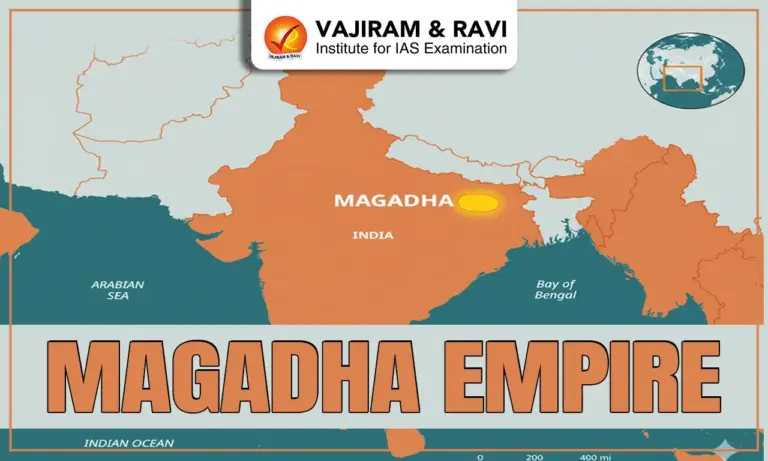
The Magadha Empire was one of the most powerful and influential empires of ancient India, known for its strategic location, military strength, and political acumen. Emerging as a prominent Mahajanapada during the 6th century BCE, Magadha played a decisive role in shaping the political, cultural, and economic landscape of the Indian subcontinent. It laid the foundation for subsequent empires such as the Mauryas and significantly influenced Indian history. This article delves into the Magadha Empire’s rise, its major dynasties, administrative and economic structures, cultural contributions, and enduring legacy.
Magadha Empire
The Magadha Empire covers the dynamic evolution of political power, economic organization, and cultural patronage in ancient India. Its rise was facilitated by a combination of strategic geography, strong leadership, military innovation, and economic prosperity. Successive dynasties the Brihadrathas, Pradyotas, Haryankas, Sisunagas, and Nandas each contributed uniquely to its consolidation and expansion.
The empire’s legacy, particularly in governance, trade, urbanization, and religious patronage, laid the foundation for the Mauryan Empire, which became one of the greatest empires in Indian history. Magadha’s story reflects the intricate interplay of geography, economy, military power, and culture that shaped the trajectory of ancient India, leaving a lasting imprint on its political and cultural landscape.
Magadha Empire Geographical Location and Importance
Magadha was located in the eastern part of the Gangetic plain, primarily in present-day Bihar, encompassing areas around Patna, Gaya, Rajgir, and Bodh Gaya. The kingdom was naturally fortified by hills and rivers, making it strategically defensible. Key geographical features contributing to its rise included:
- Fertile Alluvial Soil: The plains of the Ganga and Son rivers provided nutrient-rich soil, allowing abundant agricultural production and sustaining a growing population.
- Iron Resources: The Chotanagpur plateau offered a plentiful supply of iron ore, critical for weapons and agricultural tools, giving Magadha a technological and military edge.
- Rivers and Trade Routes: The Ganga, Son, and Gandak rivers facilitated trade, transport, and communication, enhancing economic prosperity and political control.
- Centralized Location: Being at the heart of northern India, Magadha could influence neighboring Mahajanapadas and act as a hub for trade, administration, and military campaigns.
Neighboring regions included the Republic of Vajjis to the north, the Kosala Kingdom to the west, and Avanti (Ujjain) further west. Control over these regions was crucial for dominance in northern India.





Mahajanapadas and the Context of Rise
By the 6th century BCE, northern India was divided into 16 Mahajanapadas, comprising monarchies and republics. Monarchical states like Magadha, Kosala, and Kashi concentrated on agriculture and centralized administration, whereas republics such as the Licchavis, Shakyas, and Mallas emphasized collective decision-making.
Urbanization played an important role in the rise of these states. Towns such as Rajgir, Vaishali, Hastinapur, Shravasti, Kaushambi, and Champa became centers of trade, administration, and culture. Markets emerged in areas of agricultural surplus, connecting distant regions through trade networks. Religious centers like Vaishali attracted scholars, monks, and pilgrims, promoting both cultural and economic activity.
The strategic positioning of Magadha, combined with its fertile land, iron resources, and central location, enabled it to gradually dominate other Mahajanapadas, setting the stage for an empire that would later encompass large parts of northern and eastern India.
Magadha Empire Rise
The ascendancy of the Magadha Empire was marked by successive dynasties, each contributing to territorial expansion, administrative consolidation, and military innovation. These dynasties include:
1. Brihadratha Dynasty
The Brihadratha Dynasty was the first known ruling line of Magadha. Its rulers are mentioned in the Mahabharata and Puranas, highlighting the dynasty’s early prominence. Key points include:
- Founder: Brihadratha, son of Vasu of the Kuru kingdom of Chedi.
- Famous King: Jarasandha, renowned as a warrior and ruler. He played a critical role in the political consolidation of Magadha.
- Administration: Focused on central authority, consolidation of smaller principalities, and maintenance of order.
- End of Dynasty: Ripunjaya, the last king, was assassinated by minister Punika/Pulika, who established the Pradyota Dynasty.
2. Pradyota Dynasty
The Pradyota Dynasty, founded by Punika/Pulika, ruled after the Brihadrathas. Although historical records are somewhat confusing, key aspects include:
- Origins: Punika/Pulika placed his son, Pradyota, on the throne.
- Capital: Avanti (Ujjain), though their influence extended over Magadha temporarily.
- Religion: Brahmanism and Buddhism coexisted, reflecting religious diversity.
- Significance: The Pradyotas consolidated territories and engaged in diplomacy, setting the stage for later expansion by Magadha proper.
3. Haryanka Dynasty
The Haryanka Dynasty (544–412 BCE) is central to Magadha’s expansion and political consolidation. It was founded by Bimbisara, a contemporary of Buddha. Highlights include:
- Conquests and Diplomacy: Bimbisara annexed Anga, married princesses from Kosala, Licchavi, and Madra clans, creating strategic alliances.
- Administrative Reforms: Strengthened centralized governance, maintained law and order, and introduced revenue measures.
- Religious Patronage: Supported Buddhism and Jainism, facilitating the growth of monastic institutions.
- Ajatashatru: Bimbisara’s son, known for aggressive expansion, conquered Kashi and Vaishali after 16 years of conflict, extending Magadha’s influence.
- Patliputra Foundation: Successor Udayin built forts at the Ganga-Son confluence, founding Patliputra (modern Patna), a strategic capital.
4. Sisunaga Dynasty
The Sisunaga Dynasty succeeded the Haryankas and continued territorial consolidation:
- Founder: Sisunaga, likely a minister or noble who rose to power.
- Capital Shift: Kalasoka briefly moved the capital to Vaishali.
- Achievements: Destroyed Avanti’s power, incorporating it under Magadha, ending a long-standing rivalry.
- End of Dynasty: Mahananda, the last ruler, was killed by Mahapadma Nanda, who founded the Nanda Dynasty.
5. Nanda Dynasty
The Nanda Dynasty (c. 467-321 BCE) represents the peak of Magadha’s pre-Mauryan power. Its key features include:
- Founder: Mahapadma Nanda, known for administrative skill and military might.
- Military Strength: Maintained an infantry of 200,000, cavalry of 60,000, and 6,000 war elephants, supported by advanced tax collection systems.
- Territorial Expansion: Annexed Kalinga, Kosala, and parts of present-day Uttar Pradesh and Bihar.
- Wealth: Accumulated enormous riches, facilitating military campaigns and state administration.
- End of Dynasty: Dhana Nanda, the last ruler, was unpopular due to low-caste origins and oppressive taxation. Overthrown by Chandragupta Maurya, paving the way for the Mauryan Empire.
Reasons for the Rise of Magadha Empire
Magadha’s rise as a dominant power was due to several interlinked factors:
- Strategic Geographical Location: Fertile plains, river systems, and central positioning enabled agricultural surplus, trade, and defense.
- Surplus Resources: Abundant food production and revenue allowed support for large armies and state infrastructure.
- Availability of Iron: Access to iron resources from Chotanagpur facilitated weapons, tools, and military superiority.
- Strong Leadership: Rulers like Bimbisara, Ajatashatru, and Mahapadma Nanda combined strategic marriages, military campaigns, and administrative reforms to consolidate power.
- Capital Location: Patliputra provided central administration, military defense (surrounded by rivers), and communication advantages.
- Trade and Urbanization: Emergence of towns as administrative, trade, and religious centers strengthened economic and cultural influence.
Magadha Empire Administration and Governance
Magadha Empire developed an organised administrative system:
- Monarchical Structure: Kings wielded absolute power, assisted by ministers and regional governors.
- Revenue Administration: Land revenue was a primary source of income. Tax collection was organized and supported the army and infrastructure.
- Military Organization: Large standing armies included infantry, cavalry, chariots, and elephants.
- Capital Fortifications: Rajgir was naturally fortified by hills, while Patliputra served as a riverine fortress, making invasion difficult.
- Judicial System: Maintained law and order, resolved disputes, and protected property rights.
Magadha Empire Economy and Trade
Magadha Empire’s economic strength stemmed from:
- Agriculture: Fertile alluvial soil produced surplus crops, enabling trade and taxation.
- Iron Tools: Advanced metallurgy improved productivity and military strength.
- Trade Networks: Towns like Rajgir, Patliputra, and Vaishali were key trade centers, connecting regions within India.
- Urban Centers: Facilitated markets, crafts, and cultural activities, enhancing regional prosperity.
Magadha Empire Culture, Religion, and Society
Magadha Empire was a hub of religious and cultural development:
- Buddhism: Gautama Buddha lived and taught in Magadha, with Rajgir and Bodh Gaya being prominent centers.
- Jainism: Mahavira, the 24th Tirthankara, spent much of his life in the region.
- Patronage: Kings supported monasteries, temples, and learning centers.
- Arts and Architecture: Development of stupas, temples, and urban planning reflected a vibrant cultural life.
Magadha Empire Military Strategies and Conquests
Magadha Empire rulers emphasized military expansion:
- Elephants and Cavalry: Provided battlefield dominance and intimidation.
- Strategic Forts: Rajgir and Patliputra offered natural and constructed defenses.
- Diplomacy and Marriage Alliances: Marriages with neighboring kingdoms reduced hostilities and expanded influence.
- Conquest of Rival Mahajanapadas: Annexation of Anga, Kashi, Kosala, and Vaishali ensured political supremacy.
Magadha Empire Legacy
The Magadha Empire’s influence extended far beyond its time:
- Foundation for Mauryan Empire: Chandragupta Maurya built upon Magadha’s military, administrative, and economic framework.
- Political Models: Set precedents for centralized governance, taxation, and military organization.
- Cultural Hub: Nurtured Buddhism and Jainism, which spread across Asia.
- Economic Growth: Paved the way for trade, urbanization, and resource utilization in northern India.
- Infrastructure Development: Forts, roads, and urban centers enhanced connectivity and administration.

 Last updated on March, 2026
→ UPSC Final Result 2025 is now out.
→ UPSC has released UPSC Toppers List 2025 with the Civil Services final result on its official website.
→ Anuj Agnihotri secured AIR 1 in the UPSC Civil Services Examination 2025.
→ UPSC Marksheet 2025 is now out.
→ UPSC Notification 2026 & UPSC IFoS Notification 2026 is now out on the official website at upsconline.nic.in.
→ UPSC Calendar 2026 has been released.
→ Check out the latest UPSC Syllabus 2026 here.
→ UPSC Prelims 2026 will be conducted on 24th May, 2026 & UPSC Mains 2026 will be conducted on 21st August 2026.
→ The UPSC Selection Process is of 3 stages-Prelims, Mains and Interview.
→ Prepare effectively with Vajiram & Ravi’s UPSC Prelims Test Series 2026 featuring full-length mock tests, detailed solutions, and performance analysis.
→ Enroll in Vajiram & Ravi’s UPSC Mains Test Series 2026 for structured answer writing practice, expert evaluation, and exam-oriented feedback.
→ Join Vajiram & Ravi’s Best UPSC Mentorship Program for personalized guidance, strategy planning, and one-to-one support from experienced mentors.
→ Shakti Dubey secures AIR 1 in UPSC CSE Exam 2024.
→ Also check Best UPSC Coaching in India
Magadha Empire FAQs
Q1. Who founded the Magadha Empire?+
Q2. What are the 7 dynasties of Magadha?+
Q3. Who ruled the Haryanka Dynasty?+
Q4. Who ruled the Nanda Dynasty?+
Q5. Who ruled the Sisunaga Dynasty?+
Tags: magadha empire