Magnetometer Latest News
Researchers at the Raman Research Institute (RRI), an autonomous institution of the Department of Science and Technology (DST), have devised a novel Raman-Driven Spin Noise Spectroscopy method for magnetometry in an all-optical quantum magnetometer that could address these challenges.
About Magnetometer
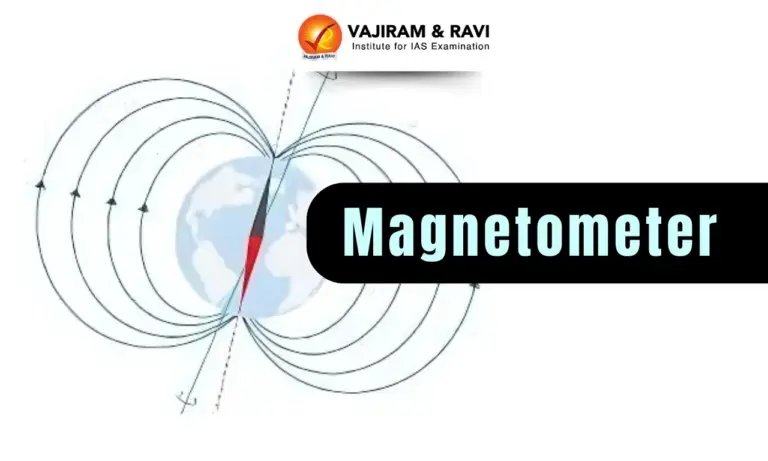
- A magnetometer is a passive instrument that measures changes in the Earth’s magnetic field.
- The most promising methods for magnetic field measurement are based on detecting polarization rotation of a probe light passing through alkali atoms in a very weak magnetic field.
- Magnetometers based on this method, referred to as Optically pumped atomic magnetometers (OPAMs) and Spin Exchange Relaxation Free (SERF) magnetometers.
- Typically have high sensitivity but demand sophisticated magnetic shielding and have a lower dynamic range.
- Magnetometers are useful devices with applications in areas ranging from fundamental physics to medical imaging and navigation.
What is Raman-Driven Spin Noise Spectroscopy (RDSNS)?
- It uses laser light to listen to the tiny quantum jitters of Rubidium atoms.
- These jittery movements, called spin noise, are random fluctuations in the spin of atoms—fundamental quantum properties like tiny bar magnets.
- When exposed to a magnetic field, the pattern of this spin noise shifts in predictable ways. By shining lasers and analyzing the noise, researchers can accurately measure the magnetic field without touching or disturbing the atoms.
- RDSNS enhances the dynamic range considerably without significant loss of sensitivity.
- This method could transform the way we measure magnetic fields—making the process faster, portable and precise even in noisy, real-world environments.
- This method exhibits potential for field-deployable applications of magnetic field measurement with broadband capability and fast time response, extending across various scientific, industrial and exploratory fields.
Source: PIB






 Last updated on March, 2026
→ UPSC Final Result 2025 is now out.
→ UPSC has released UPSC Toppers List 2025 with the Civil Services final result on its official website.
→ Anuj Agnihotri secured AIR 1 in the UPSC Civil Services Examination 2025.
→ UPSC Marksheet 2025 is now out.
→ UPSC Notification 2026 & UPSC IFoS Notification 2026 is now out on the official website at upsconline.nic.in.
→ UPSC Calendar 2026 has been released.
→ Check out the latest UPSC Syllabus 2026 here.
→ UPSC Prelims 2026 will be conducted on 24th May, 2026 & UPSC Mains 2026 will be conducted on 21st August 2026.
→ The UPSC Selection Process is of 3 stages-Prelims, Mains and Interview.
→ Prepare effectively with Vajiram & Ravi’s UPSC Prelims Test Series 2026 featuring full-length mock tests, detailed solutions, and performance analysis.
→ Enroll in Vajiram & Ravi’s UPSC Mains Test Series 2026 for structured answer writing practice, expert evaluation, and exam-oriented feedback.
→ Join Vajiram & Ravi’s Best UPSC Mentorship Program for personalized guidance, strategy planning, and one-to-one support from experienced mentors.
→ Shakti Dubey secures AIR 1 in UPSC CSE Exam 2024.
→ Also check Best UPSC Coaching in India
Magnetometer FAQs
Q1. What is a Magnetic Field? +
Q2. What is rubidium used for?+
Tags: magnetometer