The Maitraka Dynasty was an important ruling power in western India that governed Gujarat and Saurashtra from about 475 CE to 775 CE. It was founded by Senapati Bhatarka. The dynasty emerged after the decline of the Gupta Empire and established its capital at Vallabhi. Over nearly three centuries, the Maitrakas maintained political stability, promoted education, supported multiple religions and developed strong administrative and economic systems, making Vallabhi a major centre of learning and trade.
Maitraka Dynasty Historical Background
The Maitraka Dynasty arose in western India after the weakening of Gupta authority and quickly established itself as a regional power.
- Origin: The dynasty began around 475 CE when Senapati Bhatarka, a Gupta military governor, took advantage of weakening central control and declared independence in Saurashtra and Gujarat.
- Establishment of Vallabhi: Bhatarka shifted the capital to Vallabhi, which became a political, educational and economic centre due to its coastal location and trade advantages.
- Early political position: Initial rulers continued using the title “Senapati,” indicating nominal loyalty to the Guptas, but they exercised real independence in governance and administration.
- Territorial expansion: Under strong rulers, the kingdom extended into regions of Malwa and Rajasthan, showing the dynasty’s growing military and political strength.
- Duration and stability: The Maitrakas ruled for nearly 300 years, providing stability in a fragmented post Gupta period and enabling growth in culture, trade and religion.
Maitraka Dynasty Rulers
The Maitraka Dynasty rulers played a crucial role in consolidating power, expanding territory and promoting culture and learning.
- Bhatarka: Founder of the dynasty who established independence around 475 CE, set up Vallabhi as capital and maintained the title Senapati while consolidating political authority.
- Dharasena I: Strengthened military organization and administrative control, laying the foundation for Vallabhi’s emergence as a major centre of power in western India.
- Dhruvasena I: Known for religious tolerance, he supported Buddhist monasteries and Jain scholars and is associated with the Jain council held at Vallabhi.
- Dhruvasena II (Baladitya): Strengthened diplomatic relations by marrying Harshavardhana’s daughter; Chinese traveller Hiuen Tsang praised his administrative ability and governance.
- Dharasena IV: One of the most powerful rulers who assumed titles like “Chakravartin” and “Maharajadhiraja,” indicating imperial status and peak political authority.
- Siladitya I: Recognized for administrative excellence and kindness; his reign marked stability and prosperity with continued patronage of education and religion.
- Siladitya VII: The last ruler who faced repeated Arab invasions and was eventually defeated, marking the end of the Maitraka Dynasty.





Maitraka Dynasty Administration and Governance
The Maitraka Dynasty administration followed a structured system influenced by Gupta practices with local adaptations.
- Central authority: The king held supreme power and used titles like Maharaja and Paramabhattaraka, symbolizing both political and religious authority.
- Council of ministers: Important officials like Mahasandhivigrahaka and Akshapatalika assisted the king in administration, diplomacy and record keeping.
- Administrative divisions: The kingdom was divided into Vishayas and Bhuktis, ensuring effective governance across regions with delegated authority.
- Local governance: Villages were basic administrative units managed by local headmen and elders, enabling decentralized administration and efficient functioning.
- Land grant system: Numerous copper plate inscriptions record land grants to Brahmanas and religious institutions, reflecting economic organization and administrative detail.
Maitraka Dynasty Economy
The Maitraka Dynasty economy was strong and supported by agriculture, trade and a structured monetary system.
- Agricultural base: Agriculture formed the backbone of the economy, supported by fertile land in Saurashtra and systematic land revenue collection.
- Trade networks: Coastal location enabled maritime trade across the Arabian Sea, making Vallabhi an important commercial hub connecting India with foreign regions.
- Urban development: Vallabhi developed into a major centre of commerce and education, attracting merchants and scholars from different regions.
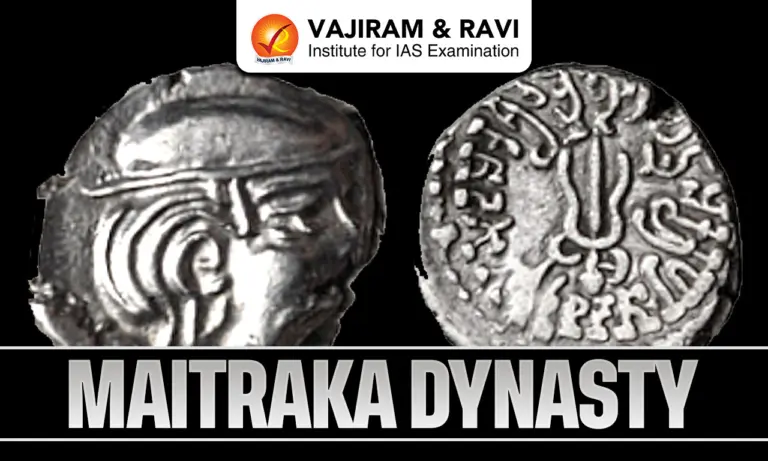
- Coinage system: The Maitrakas issued silver and copper coins influenced by Western Kshatrapa and Gupta styles, showing continuity in monetary traditions.
- Symbols and features: Coins featured the king’s image on the obverse and symbols like Trishula or battle axe on the reverse, reflecting Shaivite affiliation.
- Economic changes: Later coins were often silver plated copper, indicating economic adjustments and possible decline in metal availability toward the end.
Maitraka Dynasty Society and Culture
The society under Maitraka Dynasty was diverse and marked by religious tolerance, education and cultural development.
- Religious tolerance: Although most rulers were Shaivites, they supported Buddhism, Jainism and Vaishnavism, ensuring peaceful coexistence of multiple faiths.
- Jain council at Vallabhi: Vallabhi became an important Jain centre where sacred texts were compiled, showing the dynasty’s support for religious scholarship.
- Buddhist influence: Over 100 monasteries existed in the kingdom, making it a major centre of Buddhist learning and attracting scholars from different regions.
- Vallabhi University: The university became famous for higher education in religious and secular subjects, comparable to Nalanda in importance.
- Social harmony: The rulers maintained balance among different communities by providing grants and patronage without discrimination.
Maitraka Dynasty Art and Architecture
The Maitraka Dynasty period witnessed development in temple architecture and religious structures influenced by Gupta traditions.
- Architectural style: Temples were built in Nagara and Saurashtra styles with square sanctums and tiered roofs, marking a transition to early medieval architecture.
- Religious structures: Important sites included Bhartishwara Temple, Khimeshwara Monastery and Dudda Vihara, reflecting diverse religious patronage.
- Vallabhi University structures: The university complex had viharas like Abhyantarika and Bhataraka, used for teaching and residential purposes.
- Sculpture and art: Sculptures depicted Hindu deities and Jain figures like Shantinatha, made from local sandstone with detailed carving techniques.
- Cultural significance: Architecture and art show the blending of religious traditions and the prosperity of the dynasty during its peak.
Maitraka Dynasty Decline
The decline of the Maitraka Dynasty was mainly due to external invasions and changing political conditions.
- Conflict with major powers: The Maitrakas faced military pressure from the Chalukyas of the Deccan and Emperor Harsha of Kannauj, weakening their dominance.
- Temporary revival: After Harsha’s death, the Maitrakas regained some independence and stability for a short period.
- Arab invasions: From the early 8th century, Arab forces from Sindh launched repeated attacks, targeting coastal regions and trade centres.
- Destruction of Vallabhi: Around 775–780 CE, Vallabhi was attacked and destroyed, severely damaging the political and economic structure of the kingdom.
- End of the dynasty: The last ruler, Siladitya VII, was defeated and killed, leading to the final collapse of the Maitraka rule in western India.

 Last updated on April, 2026
→ UPSC Final Result 2025 is now out.
→ UPSC has released UPSC Toppers List 2025 with the Civil Services final result on its official website.
→ Anuj Agnihotri secured AIR 1 in the UPSC Civil Services Examination 2025.
→ UPSC Marksheet 2025 is now out.
→ UPSC Notification 2026 & UPSC IFoS Notification 2026 is now out on the official website at upsconline.nic.in.
→ UPSC Calendar 2026 has been released.
→ Check out the latest UPSC Syllabus 2026 here.
→ UPSC Prelims 2026 will be conducted on 24th May, 2026 & UPSC Mains 2026 will be conducted on 21st August 2026.
→ The UPSC Selection Process is of 3 stages-Prelims, Mains and Interview.
→ Prepare effectively with Vajiram & Ravi’s UPSC Prelims Test Series 2026 featuring full-length mock tests, detailed solutions, and performance analysis.
→ Enroll in Vajiram & Ravi’s UPSC Mains Test Series 2026 for structured answer writing practice, expert evaluation, and exam-oriented feedback.
→ Join Vajiram & Ravi’s Best UPSC Mentorship Program for personalized guidance, strategy planning, and one-to-one support from experienced mentors.
→ Shakti Dubey secures AIR 1 in UPSC CSE Exam 2024.
→ Also check Best UPSC Coaching in India
Maitraka Dynasty FAQs
Q1. Who founded the Maitraka Dynasty?+
Q2. What was the capital of the Maitraka Dynasty?+
Q3. Which ruler made the Maitraka Dynasty most powerful?+
Q4. Why was Vallabhi important during the Maitraka Dynasty period?+
Q5. What led to the decline of the Maitraka Dynasty?+
Tags: geography geography notes maitraka dynasty