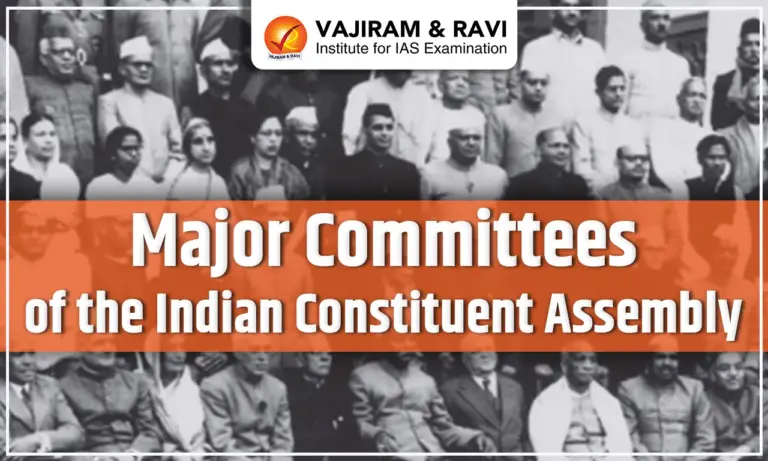
The Constituent Assembly of India was a landmark body responsible for framing the Constitution of independent India. It represented diverse regions, social groups, and political perspectives, ensuring that the Constitution was inclusive, coherent, and forward-looking. Understanding its committee system is crucial for UPSC aspirants, as it helps answer questions on Polity, Governance, Federalism, and Social Justice.
Constituent Assembly Formation
The Constituent Assembly of India was established to draft the Constitution and prepare for independent governance. Initially guided by the Cabinet Mission Plan of 1946, it later gained full legislative powers through the Indian Independence Act of 1947. The Assembly represented provinces, princely states, and diverse communities, ensuring an inclusive constitution. Its first session was held on 9 December 1946, with Dr. Rajendra Prasad elected as President.
- Initial Strength: 389 members (292 from provinces, 93 from princely states, 4 from Chief Commissioner provinces)
- Post-Partition Strength: 299 members
- First Meeting: 9 December 1946 (Interim President: Dr. Sachchidananda Sinha)
- President: Dr. Rajendra Prasad (elected 11 December 1946)
- Functioning Period: December 1946 – November 1949
- Adoption of Constitution: 26 November 1949
Cabinet Mission Plan of 1946
The Cabinet Mission Plan was the blueprint for the Constituent Assembly’s formation. It outlined the composition, election procedure, and federal structure for India, ensuring fair representation of all provinces and communities. The plan also recommended committees to streamline constitution drafting. It emphasized consensus-building and a federal framework with Union and provincial autonomy.
- Provided framework for formation and composition of the Assembly.
- Determined method of election of members from provinces and princely states.
- Recommended committees for specific constitutional tasks.
- Emphasized federal structure and provincial autonomy.
- Ensured representation of minorities and diverse communities.






Indian Independence Act of 1947
The Indian Independence Act legally empowered the Constituent Assembly as a sovereign legislative body. Passed by the British Parliament, it confirmed the Assembly’s authority to draft the Constitution and enact laws. The Act also made the Assembly the successor to British legislative powers in India.
- Confirmed Constituent Assembly’s sovereign status.
- Granted full legislative authority to draft laws and Constitution.
- Recognized Assembly as successor to British legislative powers.
- Enabled Assembly to act independently during transition.
- Provided legal legitimacy for constitution-making and governance.
Objectives of Committees in the Constituent Assembly
The Constituent Assembly formed 22 committees to ensure systematic drafting and inclusive deliberation. Their objectives were:
- Structured Drafting: Divide the complex task into manageable parts
- Expert Consultation: Involve specialists in law, administration, and governance
- Inclusivity: Represent different social groups, regions, and minorities
- Deliberation & Review: Examine, debate, and refine proposals before Assembly approval
- Efficiency: Reduce the workload on the main Assembly by pre-processing issues
Major Committees of the Indian Constituent Assembly List
Major Committees of the Indian Constituent Assembly handled the core aspects of the Constitution, including Union-State relations, fundamental rights, and governance structures.
| Major Committees of the Indian Constituent Assembly List | ||
| Name of Major Committee | Chairperson | Function / Focus |
|
Union Powers Committee |
Examined the distribution of powers between Union and States; recommended legislative and executive powers for the Union government. |
|
|
Union Constitution Committee |
Pandit Jawaharlal Nehru |
Drafted provisions for the structure and functioning of the Union government, including Parliament and executive authorities. |
|
States Committee |
Focused on relations between Centre and States, integration of princely states, and state autonomy. |
|
|
Provincial Constitution Committee |
Sardar Vallabhbhai Patel |
Drafted a constitutional framework for provinces, including legislative and administrative powers at the provincial level. |
|
Drafting Committee |
B.R. Ambedkar |
Drafted the Constitution of India, prepared and finalised clauses, and incorporated recommendations from other committees. |
|
Advisory Committee |
Sardar Vallabhbhai Patel |
Provided advice on policy matters, governance issues, and constitutional proposals from other committees. |
|
Fundamental Rights Sub-Committee |
J.B. Kripalani |
Formulated provisions on Fundamental Rights to safeguard civil liberties and individual freedoms. |
|
Minorities Sub-Committee |
H.C. Mukherjee |
Examined safeguards for religious and cultural minorities and recommended protective measures. |
|
North East Frontier Tribal Areas & Assam Excluded & Partially Excluded Areas Sub-Committee |
A.V. Thakkar |
Addressed administration and special constitutional provisions for tribal areas in North East India. |
|
Excluded & Partially Excluded Areas Sub-Committee |
A.V. Thakkar |
Examined governance and legal provisions for areas excluded or partially excluded from regular provincial administration. |
|
Rules and Procedure Committee |
Determined rules and procedures for the Constituent Assembly’s functioning and legislative processes. |
|
|
Steering Committee |
Dr. Rajendra Prasad |
Coordinated the work of all committees, prioritised the agenda, and ensured smooth workflow and reporting. |
Minor Committees of the Indian Constituent Assembly List
The Minor Committees of the Indian Constituent Assembly assisted the major committees by handling administrative, procedural, and technical tasks. They ensured the smooth functioning of the Assembly and provided expert input for specialised areas such as finance, national symbols, citizenship, and media coverage.
| Minor Committees of the Indian Constituent Assembly List | ||
| Name of Minor Committee | Chairperson | Function / Focus |
|
Finance and Staff Committee |
Dr. Rajendra Prasad |
Managed administrative and financial arrangements of the Assembly, including salaries, staff appointments, and budgetary provisions. |
|
Credentials Committee |
Alladi Krishnaswami Ayyar |
Verified the credentials of Assembly members to ensure proper representation and legitimacy of membership. |
|
House Committee |
Pattabhi Sitaramayya |
Oversaw accommodation, facilities, and logistical arrangements for members within the Assembly premises. |
|
Order of Business Committee |
Dr. K.M. Munshi |
Scheduled the Assembly’s agenda, organized debates, and managed the flow of legislative business. |
|
Ad Hoc Committee on National Flag |
Dr. Rajendra Prasad |
Recommended the design and adoption of the Indian national flag and its symbolic elements. |
|
Committee on Functions of Constituent Assembly |
G.V. Malvankar |
Defined the operational functions, responsibilities, and procedural framework of the Assembly. |
|
Ad Hoc Committee on Supreme Court |
S. Varadachari |
Drafted provisions and guidelines for the formation, powers, and functioning of the Supreme Court of India. |
|
Committee on Chief Commissioners’ Provinces |
Pattabhi Sitaramayya |
Examined governance and administrative arrangements for Chief Commissioner provinces. |
|
Expert Committee on Financial Provisions of the Union Constitution |
Nalini Ranjan Sarkar |
Drafted detailed financial provisions for the Union government, including revenue distribution and budgetary rules. |
|
Linguistic Provinces Commission |
S.K. Dhar |
Proposed recommendations for the formation of language-based provinces and administrative divisions. |
|
Special Committee to Examine Draft Constitution |
Jawaharlal Nehru |
Reviewed the draft Constitution, suggested revisions, and coordinated inputs from other committees. |
|
Press Gallery Committee |
Usha Nath Sen |
Managed media access, press coverage, and reporting of Assembly proceedings. |
|
Ad Hoc Committee on Citizenship |
S. Varadachari |
Drafted provisions related to citizenship, rights, and eligibility criteria for Indian citizens. |
Women in the Indian Constituent Assembly
Women played a significant role in shaping India’s Constitution by participating actively in debates and committees. They contributed to issues related to fundamental rights, social justice, minority protection, and governance. Out of 299 members, 15 were women, representing various regions, communities, and professional backgrounds.
| Women in the Indian Constituent Assembly | ||
| Name of Member | Committee(s) | Contribution / Focus |
|
Ammu Swaminathan |
Steering Committee, Fundamental Rights discussions |
Contributed to policy and procedural deliberations on rights and governance |
|
Annie Mascarene |
Minor Committees |
Assisted in administrative and procedural tasks of Assembly |
|
Begum Aizaz Rasul |
Advisory and Minor Committees |
Advocated for minority rights and social justice provisions |
|
Various Debates |
Provided inputs on social reform, civil liberties, and governance |
|
|
Sucheta Kripalani |
Drafting Committee member |
Worked on drafting provisions related to rights and governance |
|
Vijaya Lakshmi Pandit |
Advisory roles |
Contributed to discussions on foreign policy and administrative issues |
|
Hansa Mehta |
Fundamental Rights Sub-Committee |
Played a key role in drafting gender equality and civil rights provisions |
|
Renuka Ray |
Minor Committees |
Focused on procedural and legislative matters |
|
Purnima Banerji |
Steering and Procedural Committees |
Assisted in operational coordination of Assembly and debates |
Drafting Committee
The Drafting Committee was the most important committee of the Constituent Assembly, tasked with preparing the final draft of the Constitution. Formed on 29 August 1947, it was chaired by Dr. B.R. Ambedkar and included six other members with expertise in law, administration, and governance.
- Chairman: Dr. B.R. Ambedkar, considered the chief architect of the Constitution.
- Members: K.M. Munshi, N. Gopalaswami Ayyangar, Alladi Krishnaswamy Ayyar, Syed Mohammed Sadulla, B.L. Mitter (replaced by N. Madhava Rau), D.P. Khaitan (replaced by T.T. Ramakrishna Chari).
- Formation Date: 29 August 1947.
- Responsibilities: Drafted, reviewed, and finalized the Constitution, incorporating inputs from all other committees.
- Key Milestones: First draft – Feb 1948, Second draft – Oct 1948, Final draft introduced – 4 Nov 1948, Adopted – 26 Nov 1949.

 Last updated on March, 2026
→ UPSC Final Result 2025 is now out.
→ UPSC has released UPSC Toppers List 2025 with the Civil Services final result on its official website.
→ Anuj Agnihotri secured AIR 1 in the UPSC Civil Services Examination 2025.
→ UPSC Marksheet 2025 is now out.
→ UPSC Notification 2026 & UPSC IFoS Notification 2026 is now out on the official website at upsconline.nic.in.
→ UPSC Calendar 2026 has been released.
→ Check out the latest UPSC Syllabus 2026 here.
→ UPSC Prelims 2026 will be conducted on 24th May, 2026 & UPSC Mains 2026 will be conducted on 21st August 2026.
→ The UPSC Selection Process is of 3 stages-Prelims, Mains and Interview.
→ Prepare effectively with Vajiram & Ravi’s UPSC Prelims Test Series 2026 featuring full-length mock tests, detailed solutions, and performance analysis.
→ Enroll in Vajiram & Ravi’s UPSC Mains Test Series 2026 for structured answer writing practice, expert evaluation, and exam-oriented feedback.
→ Join Vajiram & Ravi’s Best UPSC Mentorship Program for personalized guidance, strategy planning, and one-to-one support from experienced mentors.
→ Shakti Dubey secures AIR 1 in UPSC CSE Exam 2024.
→ Also check Best UPSC Coaching in India
Major Committees of the Indian Constituent Assembly FAQs
Q1. How many Major Committees were there?+
Q2. Who chaired the Drafting Committee?+
Q3. What was the role of the Union Powers Committee?+
Q4. Which committee dealt with Fundamental Rights?+
Q5. What was the function of the Advisory Committee?+
Tags: major committees of the indian constituent assembly