


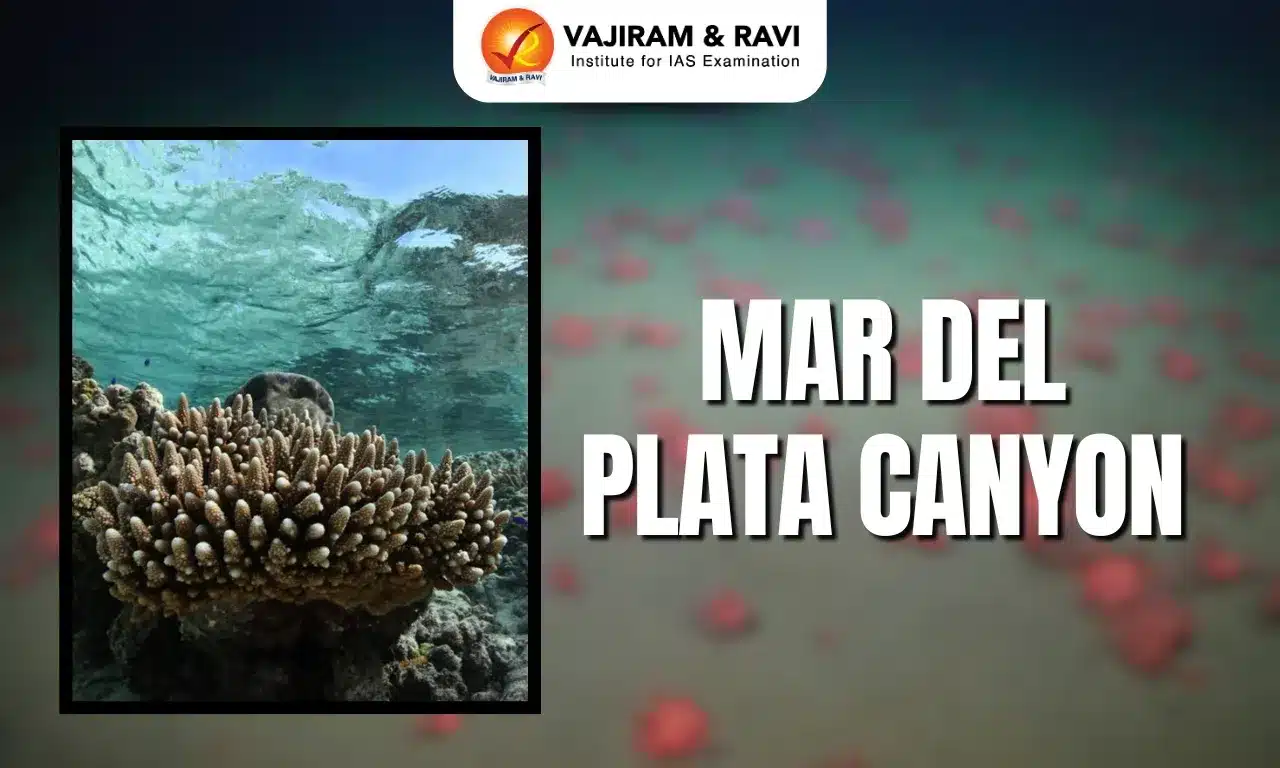
Mar Del Plata Canyon Latest News
A groundbreaking expedition to Argentina’s Mar del Plata Canyon uncovered over 40 potential new deep-sea species, including glass squids and pink lobsters.
About Mar Del Plata Canyon
- It is located at the continental margin off the coast of Buenos Aires Province, Argentina.
- It lies about 250-300 km offshore from the city of Mar del Plata.
- It is one of Argentina’s largest submarine canyons.
- The area is characterised by fine sand with a mixture of terrigenous material and planktonic foraminifera substrate.
- It is highly productive and influenced by the permanent Argentine Shelf-break Front.
- This front marks the boundary where subantarctic shelf waters meet the cooler, more saline waters of the Falkland-Malvinas Current, creating a significant thermohaline front.


What are Submarine Canyons?
- A submarine canyon is any of a class of narrow, steep-sided valleys that cut into continental slopes and continental rises of the oceans.
- Submarine canyons originate either within continental slopes or on a continental shelf.
- They are rare on continental margins that have extremely steep continental slopes or escarpments.
- Most submarine canyons extend only about 48 km (30 miles) or less in length, but a few are more than 320 km (200 miles) long.
- They usually are many kilometres in width; for instance, the Grand Bahama Canyon measures 37 km (23 miles) at its widest point.
- Submarine canyons are so called because they resemble canyons made by rivers on land.
- A relatively large number of submarine canyons are located directly offshore of river canyons of adjacent land areas and may have once been connected to extensions of the latter.
- In most cases, however, the characteristics of the submarine variety and those of the nearby land canyons are quite distinct.
- The submarine canyons, for example, tend to have steeper side slopes, much higher gradients, and considerably narrower floors.
- Like rivers on land, these underwater features act as the primary conduits for sediments (and associated nutrients and organic carbon) transported from the continental shelf to the deep ocean basins.
- Here the sediment is deposited, forming enormous sediment accumulations, called submarine fans, that resemble river deltas.
Source: TOI

 Last updated on Oct, 2026
→ UPSC 2027 Notification will be released on 13 January 2027 at upsconline.nic.in.
→ Check Nobel Prize 2026 Winners List here.
→ Download PIB PRiSM Monthly Magazine 2026 here.
→ Check UPSC Monthly Current Affairs Magazine The Recitals here.
→ Check out the latest UPSC Syllabus here.
→ Download UPSC Model Answers for Mains 2026
→ UPSC Mains Question Paper 2026 is out now for Essay & GS Paper 1, 2, 3 & 4.
→ UPSC Calendar 2027 has been released.
→ Enroll in Vajiram & Ravi’s UPSC Mains Test Series 2027 for structured answer writing practice, expert evaluation, and exam-oriented feedback.
→ Join Vajiram & Ravi’s UPSC Mentorship Program 2027 for personalized guidance, strategy planning, and one-to-one support from experienced mentors.
→ Go through the UPSC Mains Previous Year Papers to enhance your preparation.
→ UPSC has released UPSC Toppers List 2025 with the Civil Services final result on its official website.
→ Also check Best UPSC Coaching in India
Mar Del Plata Canyon FAQs
Q1. Where is the Mar del Plata Canyon located?+
Q2. Which oceanographic front influences the productivity of the Mar del Plata Canyon?+
Q3. Where do submarine canyons usually originate?+
Q4. What role do submarine canyons play in marine sediment transport?+
Tags: prelims pointers upsc current affairs upsc prelims current affairs








